Wednesday, November 01, 2006

Democrat hoax revealed!

Thank goodness for reasonable conservative Jon Swift, who has discovered a shocking, despicable conspiracy by the Democrats to make President Bush seem like a liar over whether or not his Iraq policy has ever been to "stay the course":

As a rebuttal to President Bush's statement that his strategy in Iraq has never been "stay the course," Think Progress offered six links to purported statements the President made over the last two years saying that we should "stay the course." Every one of these links went to the same website, whitehouse.gov. The site claims to be the "official" site for the President but of course anyone could set up a spoof website and make such a claim. A "whois" search gives no information about the anonymous owner of this domain. But if you search this site on the Wayback Machine at the Internet Archive you discover something very interesting. Take a look at what the site looked like in 1997. Before it claimed to be the "official" site for the Bush White House, this site was actually a brazen propaganda arm of the Clinton Administration!

To see the depths of Democrat perfidy, visit the Think Progress website.

Leave nothing but footprints

If humanity disappeared today, how long would it take for all traces of us to disappear? Suprisingly little time.

Doom timeline
Click image for larger view.

I could argue with some of the details from the timeline. E.g. endangered species begin recovering "immediately"? That's simplistic thinking -- sure, the immediate pressure on them will be reduced, but they still have to survive the years or decades it takes for their habitats to recover.

Similarly, it is foolish to imagine that methane will disappear from the atmosphere in the short term. So long as there are vast prairies and savannahs with vast herds of grazers, there will be methane. And don't forget the fungi and termites.

But despite these flaws, it is humbling to realise that virtually all traces of humanity would disappear after a mere fifty thousand years. After 200,000 years, even the most stable of man-made chemicals will have decayed or transformed. With the exception of some of the more long-lasting radioactive waste, in less than a quarter of a million years there won't be a sign we ever existed. We'd be lucky to even leave a fossil or two. Possibly the last trace of humanity could be a few footprints and pieces of machinery on the Moon.

It took about a quarter of a million years to go from Homo erectus to Neil Armstrong on the moon, and it could take the same again for virtually every trace of humanity to disappear from the Earth. Half a million years from appearance to disappearance. It gives you pause for thought to remember that life on Earth is about four billion years old, old enough to have seen eight thousand non-human civilizations rise, fall and disappear. There is no evidence for any of these, and good (well, moderately good at least) reason to expect that there were none, but if there were, chances are we wouldn't know.

(Original source of the timeline: http://www.treehugger.com/files/doom_1.php)

Children's Discworld books

I'm always amazed at readers who see Terry Pratchett's Wee Free Men and The Amazing Maurice And His Educated Rodents (to name just two) as children's books. I understand why the publishers choose to market them to children, especially Maurice. That's just marketing, and nobody expects marketing to reflect actual reality, merely commercial reality.

But it is the Discworld readers who make the same claim that perplex me. Have they actually read the books with their eyes (and minds!) open? Or just the blurb on the back? I just don't see that there's anything light about these books -- they are equally grown-up as the "adult" Discworld books. They contain the same major themes, the same tight plotting, the same quality of story-telling, the same ethical issues. There's nothing childish about A Hat Full of Sky or Maurice.

Sure, the main protagonists are children, or animals, rather than adults; the novels themselves are shorter, and divided into chapters (all the better for parents to say to their children "I'll just read to the end of the chapter", according to PTerry himself). Mere details. The heart and soul of the books are every bit as grown-up as Carpe Jugulum or Night Watch, just packaged in a more child-friendly format.

Long novels aren't just for grown-ups (witness the popularity of Lord of the Rings amongst children), nor are short novels just for children. If adults can read books where the protagonist is male or female, human or alien or robot, then why can't they read books where the protagonist is a child? We've all been children at some time in our life (with the exception of Mrs Impala, hat hat hat), but not all of us have been grown-ups or robots.

The protagonist of Wee Free Men, Tiffany Aching, is just nine in elapsed years, but much older in uncommon sense. Book reviewers, librarians and parents who don't look beyond her chronological age say Wee Free Men is a children's book. I say, a fie on them! Pratchett's shorter novels aren't children's books at all, they are stealth adult fiction wrapped in the format of children's books, suitable for children of all ages from 7 to 77.

Web of mystery

    "Not only is the universe stranger than we imagine, it is stranger than we can imagine." -- Sir Arthur Eddington.


Recently a 60 acre (24 hectare) field in British Columbia became home to millions of tiny spiders which spun an enormous, 60 acre web. Biologist Brian Thair was quoted as saying:

"It was astounding to see," he said. "I couldn't believe my eyes. From two kilometres away it looked like a sheet of wet aluminium. It was the size of several city blocks. I have never in my 30 years as a biologist seen anything like this, in terms of quantity of spiders and quantity of web. Nothing even remotely approaching this."

I still aten't dead

I've been busy, not dead. Nothing terribly exciting. Move along, nothing to see here, go read some of my other posts.

Saturday, October 14, 2006

Richard Dawkins on video

British biologist Richard Dawkins gave a 22 minute presentation "Queerer Than We Suppose: The strangeness of science". It can be downloaded here.

And I mean downloaded. It is a pleasure to deal with a website that doesn't mess about with pointless, annoying streaming video in secret, proprietary (and usually low quality) formats. No stupid Flash, or mms protocol, no need to mess about with Mozilla to download an imbedded video file. No futzing about with Javascript or obfuscated URLs. If you're on a slower Internet connection, or just want to be able to watch the video off-line, it is such a relief to be able to just right-click and save-as, then come back ten or twenty minutes later to watch it in your time, not theirs.

Wikipedia 1, China 0

China has demanded that Microsoft, Yahoo and Google all censor their web applications or be banned. All three software giants -- reluctantly in the case of Google, seemingly willingly in the other two cases -- complied.

China also demanded that Wikipedia censor itself for Chinese viewers. Wikipedia refused, and the powers-that-be in Beijing responded by blocking access to Wikipedia from within China.

Or rather, they tried to block access. But it seems that China needs Wikipedia more than Wikipedia needs China -- after barely a month, China has stopped blocking Wikipedia, instead concentrating on the cat-and-mouse game of trying to block only certain sensitive (that is, embarassing to the political leaders) pages, like those on Tiananmen Square.

China is desperate to catch up to the West, and that means accessing our knowledge banks, especially the Internet. If China can't afford to block Wikipedia, they certainly can't afford to block Google, Microsoft or Yahoo -- let alone all three. China is bluffing with a pair of twos, and unlike Wikipedia, the three software giants didn't have the cajones to call their bluff.

Autism and psychopathy

Cory Doctorow from BoingBoing discusses autism and psychopathy, and intriging research that suggests that neither of these are mental disorders as such.

One small step for voting security

Cheating in competitions is hardly unknown. Cheating in elections isn't unknown -- in fact, elections use many varied mechanisms and checks and balances to prevent cheating. Hardly a year goes by without news reports of some illegitimate election in some place of the world or another.

The last six years of American elections show a series of "irregularities" pointing towards the likelihood of electoral fraud. It is very worrying to see some people still resisting calls to improve the security of electronic voting. There are many politicians seemingly in bed with voting machine manufacturers who are happy to sell machines with poor security.

So it comes as a welcome surprise to see a bipartisan majority of the US Congress introduce a bill to improve voting security. Of course, there is a long way from good intentions to actual good results, but this is a good first step.

Wednesday, October 11, 2006

Thumbelina

Meet Thumbelina, officially recognised by the Guinness Book of World Records as the world's smallest horse: a mere 4 hands (17 inches or 43cm).

Thumbelina and friend

The Daily Mail writes:

'My parents have bred hundreds of miniature horses, but we have never had one as small as Thumbelina,' Mr Goessling said.

'She was just a complete fluke and we call her a mini mini.

'When she was young she found the dog kennels and decided she wanted to bed-in with the dogs, rather than with bigger horses.

'She spends all her time playing with the spaniels, but we have to try and stop her grazing on grass, because she is not allowed to eat too much.'

[...]

The tiny mare has become sometime of a celebrity in her home town in America, but Mr Goessling insists they will never sell her, no matter what price is offered.

'She is too precious to us to sell,' he added. 'I think my parents would sell me before they part with Thumbelina.

'She has that special Wow factor, which you only get when you physically see how small she really is.'

Canadian copyright snake oil

Music publishers have attempted to smuggle a provision into Canada's copyright law which would make Digital Restrictions Management software compulsory for on-line music distributers, effectively banning DRM-free music and forcing musicians to pay good money for DRM software -- even if they don't want it.

eMusic is the second largest on-line seller of digital music, all legal, all free of Digital Restrictions Management software. If the music publishers provision became law, eMusic would have to either stop selling to Canadians, or add DRM software to the music they sell, against the express wishes of the copyright owners.

This is just insanity, but it clearly demonstrates that DRM cannot survive in a free market. It is snake-oil. Making bits uncopyable is like making water not wet. The only way DRM suppliers can stay in business selling software snake oil is to take advantage of the frightened (or greedy, or both) music producers. The producers themselves have realised that their business model is dead, made obsolete by technology. Rather than adapt to changing markets, they turn to the government to outlaw -- or at least hamstring -- competitors who have adapted to the new technology.

Tuesday, October 10, 2006

Egregious abuse of copyright

Here's yet another example of the blatant abuse of the law as an anti-competitive measure: a shampoo company tries to prohibit a woman from legally and legitimately re-selling shampoo she's bought by claiming copyright infringement.

Book sales and Google

Remember Google Books, which according to the Chicken Littles in the publishing industry was going to destroy the book trade?

A report from Reuters shows that some of them are coming around:

Publishers are starting to report an uptick in sales from Google Inc.'s online program that lets readers peek inside books, two years after the launch of its controversial plan to digitally scan everything in print.

Google has been enlisting publishers to voluntarily submit their books so that Web searchers can more easily find titles related to their interests, but some fear the project could lead to piracy or exploitation of their copyrighted content.

"Google Book Search has helped us turn searchers into consumers," said Colleen Scollans, the director of online sales for Oxford University Press.

She declined to provide specific figures, but said that sales growth has been "significant". Scollans estimated that 1 million customers have viewed 12,000 Oxford titles using the Google program.

[...]

Specialty publisher Springer Science + Business reported sales growth of its backlist catalog using Google Book Search, with 99 percent of the 30,000 titles it has in the program getting viewed, including many published before 1992.

"We suspect that Google really helps us sell more books," said Kim Zwollo, Springer's global director of special licensing, declining to provide specific figures because the company is privately owned.

It isn't just Google books having this effect -- Amazon's similar service, where viewers can read small snippets of books before buying, also helps sales.

This isn't exactly rocket science. Imagine if book shops kept books sealed in plastic, and would-be buyers couldn't browse the book first. Sales would fall through the floor.

Democracy fights back

Programmer Clint Curtis has testified under oath that Representative Tom Feeney (Florida, Rep.) asked him to write a program to allow touch-screen voting machines that could "flip the vote 51-49 to whoever you wanted it to go to and whichever race you wanted to win."

At the time, Feeney was Speaker of the House of Florida at the time, as well as a lobbyist and corporate attorney for Curtis' employer. And for a change, it wasn't Diebold, it was Yang Enterprises Inc.

More on BoingBoing, and a YouTube video here.

Major software projects

Lousy.
Late.
Expensive.
Choose any three.

(Not that I'm cynical or anything like that. Not in the least.)

So N.Korea has the Bomb

After three or four years of "Yes they do", "No they don't", "Yes they do", "Maybe they don't", we know finally know: North Korea has tested a nuclear weapon, no ifs buts or maybes.

Well, perhaps a few buts. France is publically wondering whether the test went as well as N.Korea wanted -- the explosion was very small. By design, or did it fizzle? And having nuclear weapons is one thing, but being able to deliver them is another: there is no indication that N.Korea has the practical technology to use the weapons in battle. Without a delivery system, the bomb itself is not terribly useful.

Of course, the world's major nuclear powers -- the USA, Russia, China, France, Britain -- are condemning the test. Nobody has the honesty to say "How dare you try to defend yourself against the thousands of nuclear weapons already aimed at you!" but that's what they're thinking. N.Korea is surrounded by enemies -- perhaps rightfully so, but nevertheless they are surrounded by enemies. At best, they have a strained relationship with China. They have hostile relationships with Russia, Japan and South Korea, and let's not forget the USA.

I'm not suggesting that N.Korea is the victim here. By all accounts, there are good reasons they are feared and distrusted by their neighbours. But regardless of who is right and who is wrong, who's good and who's bad, if the rest of the world wants them to not defend themselves, what's in it for them?

Hawks often accuse doves of being impractical and of having heads filled with airy-fairy ideas of peace and brothership of all mankind. That's a load of malarky. It's the hawks who are impractical and foolish in their reliance of what I call the two-year-old model of international relations: if you shake your fist and scream and shout and stomp your feet and threaten to hit people, they will give you what you want. Of course, the hawks don't often literally scream -- that worked for Hitler against Chamberlain, in private, but in public it just makes you look like a buffoon. (An interesting case involves USSR Premier Nikita Krushchev: did he or didn't he bang his shoe on the table at the UN?) No, the hawks dress up their threats in polite language, but it comes to the same thing really: Gimme! The fatal flaw in the strategy of threatening an enemy if they don't give up their nukes is, once they have nukes, you can no longer make good on your threats without suffering yourself.

Of course, regardless of N.Korea's practical ability to strike at other countries with their nuclear bombs, or more to the point their inability, this could destabilise the area. Japan, in particular, may feel it is in their best interests to have their own nuclear deterrant, and not be reliant on the US nuclear umbrella which could so easily be turned against them, although the Japanese constitution forbids them from developing nuclear weapons.

Monday, October 09, 2006

Vigilantes on a Plane

A top British designer and well-known architect was assaulted on a plane and escorted from his flight by a vigilante claiming to be a police officer, while the airline staff did nothing and the passengers cheered.

Just another day at the airport for Muslims, Arabs, Indians and Sikhs, right? Except there was a catch.

The architect, Seth Stein, is Jewish.

The reported sequence of events is:

  1. Concerned by Stein's tanned skin and his iPod, a passenger identifying himself as Michael Wilk and claiming to be a police officer alerted the cabin crew that Stein was acting suspiciously by going to the toilet.

  2. The cabin crew informed the supposed "police officer" that the captain had done a security check on Stein and cleared him, and asked him to return to his seat.

  3. On returning to his seat, Wilk assaulted Stein, grabbing him in a headlock and rummaging around in his clothes and pockets. The cabin crew did nothing to intervene.

  4. On arriving in New York, Stein was escorted from the plane, to the applause of the frightened sheeple on the plane.

  5. Embarassed police at New York helped fast-track Stein out of the airport.

Why were the people on the plane frightened? Because the supposed police officer cried Wolf. There was no reason to be afraid except that "Wilk" (if that is his real name) made them frightened with his bogus accusation that Stein was a terrorist.

Remember, the aim of terrorists is to spread fear. Killing people is just a means to an end. "Wilk" succeeded in spreading fear and anxiety, and he did it, not by claiming to be a terrorist, but by falsely accusing somebody else of being a terrorist.

But notice the really scary thing. Wilk could easily have planted something in Stein's pockets. A printed bomb threat. A packet of white powder. A bottle of liquid. How easy would it be to frame some innocent party for making terrorist threats? If Stein had been some angry young Arab who took a swing at the real cops when they came on board, who would believe that he'd been stitched up?

The original story (now archived) is here. The story has been mirrored here, and Bruce Schneier discusses it here.

Juan Mann. One Hug.

A little inspirational story about One Man and his campaign to give free hugs to strangers in the streets of Sydney.

YouTube video here.

The story behind it is here.

Today, the hugger was at it again, brandishing his "free hugs" sign in the busy pedestrian thoroughfare, and having quite a few people take him up on his offer.

"It's a way to make people smile," Mann said.

"For every person who gets a hug, you see five walk past with a smile on their face."

Juan Mann (pronounced one man) is a play on words, but the hugger insisted his rules included no names, no phone numbers, no relationships and no dates.

[...]

But his efforts to spread the love became a little too popular for some people's liking, according to a blurb on the YouTube video, which said: "As this symbol of human hope spread across the city, police and officials ordered the Free Hugs campaign BANNED."

Undeterred, Mann collected more than 10,000 signatures on a petition he presented to the City of Sydney council. Demands for a halt to the hugs petered out shortly after, and the end of the clip shows Mann hugging an official.

Speaking by phone from Los Angeles, where the Sick Puppies moved a year ago, the lead singer [Shimon Moore] said he mixed the video with their song All The Same as a gift for his friend, to lift his spirits after his grandmother died.

It had the desired effect. Four days ago, the band posted the clip on YouTube. By 3pm today, it had close to 700,000 hits and almost 6000 comments, most of them gushing.

Like this one: "Made me cry. I love you all!"

The musician said the video had taken Mann's mission worldwide.

"He's achieved what he set out to do and I was lucky enough to be there to film it," Moore said.

Thanks to Pharyngula.

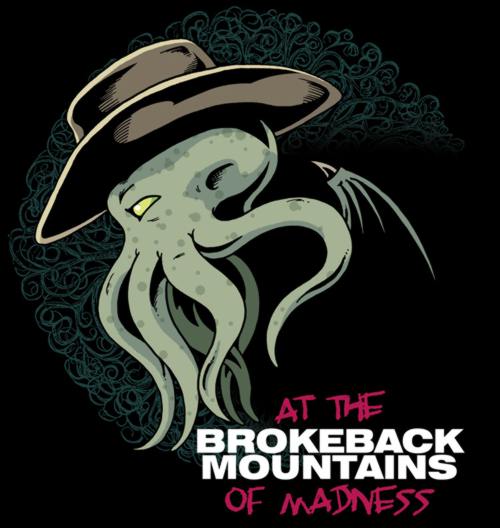
The Brokeback Mountains of Madness

The Brokeback Mountains of Madness

Click image for larger version. Original here.

Super-bird

As the train I caught this morning was packed solid with commuters, I couldn't read as I normally like to, on account of being jammed up against the door with my face pressed into the window. Consequently I happened to be staring out the window just at the right time to see Super-bird fly alongside the train.

It was wonderful! A small bird, perhaps some sort of starling, mostly grey with a bright yellow beak and fluorescent green and yellow feathers on its back, kept up with the train effortlessly for almost 500 metres, from one station to the next. It didn't just happen to be flying at the same speed as the train, it was pacing the train, flying alongside the track for the best part of half a kilometre, and kept level with the window I was looking through until the train slowed down for the next stop. The last I saw of Super-bird, it was flying down the train track, presumably rushing to a crime scene or to save the world from destruction.

I feel lucky and privileged to have witnessed it, and humbled by the thought that if I had been a few feet away, or facing the other direction, I would have missed it.