I like this idea -- it's thinking outside the box. British engineers are working on a plan to use the footsteps of pedestrians to generate electricity.
The Times reports that the technology has already been successfully trialled and the firm behind it is in talks with supermarkets and railway stations. It works by using the footfall of pedestrians to compress pads under the floor, pushing fluid through turbines to generate electricity. Copy and paste this URL into your browser to see more:
http://www.timesonline.co.uk/tol/news/environment/article4087518.ece [1]
According to the report, calculations suggest that the 34,000 train-travellers passing through London's Victoria Underground station every hour could generate enough electricity to power 6,500 lightbulbs.
[1] The Times' Terms and Conditions prohibit giving the newspaper free advertising by linking to pages on their website. Links are prohibited, but merely providing the URL is allowed. Stupid, isn't it? Back
Saturday, June 28, 2008
Electricity from footsteps

Tuesday, March 04, 2008
Amazon's chutzpah
There's a lot to like about Amazon, but also a lot to dislike, such as their ridiculous "One Click" patent and their spamming of customers. But you have to admire their chutzpah. They're running ads for their e-book reader, the Kindle, which includes this image promoting BoingBoing:
What does BoingBoing have to say about the Kindle?
Mark Pilgrim has a great, incisive post about the Amazon Kindle e-reader that sums up almost all of the reasons I won't be buying it -- it spies on you, it has DRM (which means that it has to be designed to prevent you from modding it, lest you mod it to remove the DRM), it prevents you from selling or lending your books, and the terms of service are nearly as abusive as the Amazon Unbox terms (and worse than the thoroughly dumb-ass Amazon MP3 terms).
Tuesday, September 04, 2007
Information gathering for ATLAS
If the Internet itself was created by the US military to be a redundant, highly-resistant to damage information network, the World Wide Web was created to allow physicists to share data from experiments in subatomic partical physics.
CERN, the birthplace of the WWW, is about to start a series of experiments which will push the boundaries in information gathering, processing and sharing beyond anything ever attempted before. Three-Toed Sloth discuss the incredible engineering work needed for the ATLAS experiments on subatomic particles, and the vast amounts of data the experiments will collect: petabytes -- millions of gigabytes -- per second. Almost twenty years ago, CERN gave us the Web. What will we get in another twenty years?
Wednesday, July 04, 2007
This is how computers were meant to look


Sunday, February 11, 2007
Panic
Bruce Tognazzini, known for writing about computer user interfaces, also writes about non-computer interfaces and man-machine interaction. He wrote an essay about how the design of John Denver's light plane killed him. Here he writes about panic and how it interacts with technology like scuba gear, airplanes, and computer mice.
Tuesday, September 19, 2006
iTunes buyers vote with their wallets
The BBC is reporting that on average only 5% of the tracks on the average iPod have been bought from iTunes, with even fewer coming from other music sites. The majority are downloaded from file sharing sites or ripped from CDs.
The report cautions not to artificially divide music listeners into "pirates" and "buyers", and points out that:
[...] the only salient characteristic shared by all owners of portable music players was that they were more likely to buy more music - especially CDs.
"Digital music purchasing has not yet fundamentally changed the way in which digital music customers buy music," read the report.
This tells me that free as in beer (free of charge) is far less important to music listeners than free as in speech (free of restrictions). People are willing to pay for their music, but they aren't willing to accept lousy digital restrictions or artificial file formats that nobody but the music industry wants.
Saturday, September 02, 2006
Pickle lamp
How to make a lamp out of a pickle:
Plug it into the electricity mains and watch it glow. It is so elegant in its simplicity.
DANGER: Do not try this at home. Unless you really want to. But do take care: live electricity can ruin your whole day.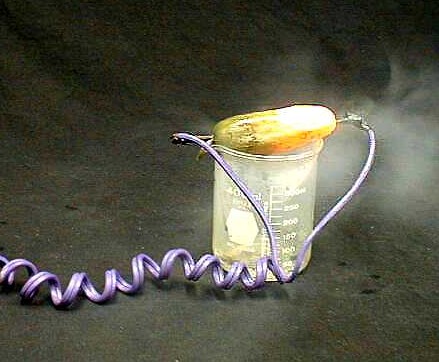 Click image for full-sized picture. Sourced from Daryl's Science.
BoingBoing discusses the glowing pickle, and points out there is a scientific mystery here: why does the pickle glow only at one end?
Thursday, August 31, 2006
Can you legally play an overseas DVD?
Virtually all DVDs have "region encoding", one or more codes on the disc that tells the player where in the world you are supposed to watch the DVD.
Needless to say, consumers are split into two groups: those who don't notice region encoding, and those who hate it passionately. For example, there are millions of fans of Japanese anime across all DVD regions, but anime DVDs are typically only released on Region 2 discs, making watching them difficult in the US or Australia. Hence, there are thriving black- and grey-markets for "mod chips" and other technologies for removing region encoding.
Kim Weatherall looks at the legality of playing DVDs from other regions in Australia. Although it is a very simple question -- "Can I legally watch this legally purchased DVD from overseas?" -- the answer is not simple at all.
After looking at various laws, including the Australian Copyright Act, the Aus-US Free Trade Agreement, and various legal rulings, the conclusion is that it is legal to watch those overseas DVDs -- but only just. It assumes two factors: firstly, that the copyrights on the computer code and video on the DVD disc, in both countries, are owned by the same person, and that the amount of video copied into the DVD player's temporary memory is not "substantial" -- whatever that means.
Weatherall's conclusion is sobering:
your right to play a DVD legitimately purchased overseas rests on as slender a thread as this: if a copyright owner can prove that a substantial part of the film is embodied in RAM at some given moment, they will be able to show that you are making a temporary copy, which is not covered by the section 43B defence.
Is this likely? Well, the question is effectively open. And Sony tried quite hard to demonstrate this after the fact in Stevens v Sony, using a demonstration of how much game could be played without keeping the disk in the machine.
Tuesday, August 15, 2006
Pictures that lie
News.com is running a pictorial report on photo manipulation. The old cliche "the camera never lies" is not true any more, and possibly never was.
There is also an interesting article about software that is being developed which can detect photo-manipulated images by looking for discrepencies in lighting and statistical anomalies at the pixel level.
Photo manipulation is (potentially) big business: as Gartner analyst L. Frank Kenney points out, the potential commercial and political gains from faked photos are huge:
"How much is the presidency of a country worth, or control of a company? People tend not to read the retractions," he said. "Once the stuff is indelibly embedded in your memory, it is tough to get out."
It is interesting to see the difference in photo manipulation strategies during recent American elections. For example, there were no shortage of photoshopped pictures of President Bush carrying "Presidenting For Dummies" or pretending to read books upside down: silly and obvious fakes. On the other hand, somebody faked a photo of John Kerry together with hated anti-Vietnam war protestor "Hanoi Jane" Fonda. Nobody really thinks George W. Bush can't tell when a book is upside down -- that's satire. But a photo of presidential candidate Kerry apparently sharing a podium with the woman who millions of Americans still consider a traitor... that goes beyond satire into outright dishonesty. If you can't find mud to sling, fake some.
I must admit I was rather disappointed with the manipulated images chosen by News.com. Too many of them were obvious fakes (which is not the same as being bad fakes) and the political implications were merely implied rather than discussed.
If you want to see highly imaginative and excellent quality photoshopped images, you could do far worse than to visit Worth1000.com and check out the contests. The possibilities are shown by entries like Paris Hilton's newest pet:

or Bishop Hugh Hefner:

[Click on images for full view]
Wednesday, August 02, 2006
How to steal RFID-equiped cars
Boing Boing reports that cars fitted with RFID-enabled locking systems are (not) surprisingly easy to steal. Thieves can remove a simple fuse and disable the RFID reader, find the spare key, use RFID-enabled blank keys they bought or stole from a dealer, or, most astonishingly of all, use a "semi-secret" sequence of pulls on the hand-brake to bypass the system. (Note: a semi-secret is not a secret.)
The biggest risk is that since insurance companies claim that RFID-keys are infallible, they often refuse to pay out when the car is stolen.
Sunday, July 30, 2006
Corn plastic
Plastic made from corn is hyped as an environmentally-friendly alternative to standard PET plastics. One of the claims about it is that it is biodegradable and can be composted.
As Boing Boing explains, it can -- under the right conditions. And those right conditions involve being heated up to 140°F (60°C) for ten days straight. In ordinary home composting, even after six months the plastic is unchanged.
Sunday, July 16, 2006
No free ride
Here is Part 1 of an interview with the legendary Vint Cerf talking about accusations that Google is getting a "free ride" from the Internet providers, and why the telcos' business plans are based on old (dare I suggest obsolete?) business models.
Somebody should remind AT&T CEO Ed Whitacre of the parable of the goose that laid the golden egg. People don't want bandwidth if there is nothing to download with it. AT&T made a nett income of almost $1.5 billion in the first quarter of 2006. But that's not enough: they want to strangle Internet technologies, charging them twice, three times, four times for the same service, because of some mental allergy to the concept of value-add -- Google pays for a service from AT&T, adds their own value, and makes money from the deal. Whitacre believes this is "getting a free ride". (Funny, I didn't notice AT&T providing Google with a server farm with thousands of PCs.)
This is prima facie evidence that one can become successful, rich company CEO of a giant multi-national corporation without having the foggiest concept of what a free market is or how it works. (Some would argue that, in a truly free market, executives like Whitacre would be earning a lot less money; but that's an argument for another day.)
Still, I think the telcos have got a point. I mean, when a carpenter buys timber and nails from his hardware supplier, and then builds furniture which he sells as a profit, he's "getting a free ride" too isn't he? Why shouldn't the hardware supplier get compensated for the carpenter's success? Sure, the supplier has already been compensated once, when the raw material was bought. But that was before they knew just what a great job the carpenter was doing. Now that they know he's talented and skillful, it's only right that they charge him extra. Stands to reason, right?
When a chef buys meat and vegetables, and creates a meal which he sells for a profit, surely that too is "getting a free ride"? Just because chef, like Google, has already paid his suppliers doesn't mean he shouldn't have to pay again and again.
That's what AT&T say, anyway.
Wednesday, July 12, 2006
Velcro as you've never seen it before
Unless, of course, you've already seen this photo somewhere else.
Link to photo of velcro being pulled apart.
Friday, June 23, 2006
A century-worth of fear mongering
The EFF discusses the music and movie industries, and their history of fear mongering:
This week, the Consumer Electronics Association (CEA) is running a great ad [PDF] in the Capitol Hill newspaper, Roll Call, reminding Congress that the entertainment oligopolies have cried wolf about new technologies many times before.
The ad collects a century-worth of fear mongering by an industry focused on legislating to protect out-dated business models[...]
The movie and music business, ironically enough given their own origins in piracy and copyright infringement, have objected to:
- The player-piano
- The wireless radio
- The cassette tape recorder
- The VCR, famously described as being like Jack The Ripper
- The DAT tape, successfully killed by RIAA-sponsored legislation
- Digital VCRs like Tivo
- The digital radio
and now the industry is crying wolf about devices capable of recording digital radio, claiming that they will destroy the music industry.
Just like the player-piano did, and the radio, and the cassette tape, and ...
Tuesday, June 20, 2006
Blocking digital cameras
BoingBoing writes about new technology that can detect and blind digital cameras:
Georgia Institute of Technology researchers developed a system that scans an area for the CCDs in digital still and video cameras. Once it locates one, the system would shine a laser into the CCD to "neutralize" its imaging capabilities.
The list of suggested applications is ... interesting:
- Preventing movie piracy
- Stopping industrial espionage
- Blocking people from taking photos of their kids with Santa at a shopping mall
One the inventors missed is stopping people from taking photos of public areas. Heaven forbid if people could just take a photo of the landscape without money changing hands.
See also this news release.
Saturday, June 10, 2006
The Right to Innovate
There is a war of aggression going on, in the halls of the US Congress. The aggressor: a handful of entertainment companies, Hollywood, the music industry, record labels and the like. They are attempting to control the very right to innovate. With the help of a few friendly Senators, the entertainment industry has succeeded in banning innovation without their approval in large areas of technology, and have shut down innovators and new businesses which threatened their business models.
The biggest weapon to date the entertainment industry have had is the Digital Millennium Copyright Act, or DMCA.
The IEEE Spectrum is running a story on how the DMCA has been used to cripple innovation, hurt consumers, destroy businesses, and hold technology companies hostage -- and how the entertainment industry plans to do even more to forbid unauthorised innovation and invention.
Death by DMCA
Before the passage of the DMCA, entertainment and technology had, for the most part, peacefully coexisted. Laws addressing the use and misuse of copyrighted content targeted "bad actors" rather than complete classes of technology. For example, when songwriters in the 1920s sued radio stations for broadcasting live music performances without paying the songwriters, the lawyers did nothing to the companies that designed and built the broadcast transmitter towers. And in the early 1980s, when videocassette recorders (VCRs) made it possible for consumers to record television broadcasts, the U.S. Supreme Court, in its landmark Betamax case, ruled that the manufacturers of home video-recording devices were not liable for copyright infringement.
Things have changed. Now, under the DMCA, those who write programs are deemed to be responsible for crimes -- real, imaginary or hypothetical -- which are committed by others using those software tools.
Thursday, June 08, 2006
How to gain a sixth-sense
Cory Doctorow from Boing Boing writes about using an implanted magnet to gain a sixth-sense:
The result is a kind of "magnet sense" -- people who've had the implant report that they can tell when a wire is live and when they're going through a magnet security-scanner at a store, even when their laptops' hard drives are spinning up.
Quinn Norton of Wired News has had the operation and writes in detail about how it felt, what the problems were, and what she was able to do once it was in place. The most amazing part is that months after the magnet implant fragmented and Quinn lost her "sixth sense," it reassembled itself (magnets tend to draw towards one another) and the sense returned.
Direct link to the Wired article is here.