Showing posts with label history. Show all posts

Friday, June 20, 2008

Silent longing

What a piece of work this guy is.

Last month, Sith Lord Benedict XVI declared that American Indians had been "silently longing" to be converted to Christianity by the Spanish Conquistadors 500 years ago, and had been seeking the god known only as God "without realizing it".

(One wonders how Emperor Popetine knows what was going through the minds of people from a foreign culture who died half a millenium ago? Oh wait, that's right, the god known only as God has made him infallible. That's what the Pope says, and he's infallible so he must be right.)

Sith Lords

(Click image for full view.)

Saturday, March 01, 2008

Holocaust idiocy

Totally without irony, Israel's Deputy Defence Minister, Matan Vilnai, threatened the people of Palestine with a holocaust (Hebrew "shoah"). Considering that Matan Vilnai was born in 1944 and has a B.A. degree in History, I find it inconceivable that he was not aware of the connotations of the word, even if he were not Jewish (yes, there are non-Jewish Israelis).

Meanwhile, here in Melbourne, artist Sam Leach has made a controversial self-portrait of himself in the same pose used for one of Adolf Hitler's famous portraits. Defending the painting, Leach stated:

Personally, as a white Australian, I inherit this Western European cultural tradition and the one of the products of that tradition was Nazism. In a nutshell, what I'm trying to say is that I think that we can't take for granted that Nazism can't happen again...

The president of the Jewish Community Council of Victoria, Anton Block, replied by stating that Leach was:

deluding himself[.]

Well, certainly someone is deluding himself.

Tuesday, September 18, 2007

Another missed anniversary

The weeks just fly past so quickly these days, and I keep missing significant anniversaries. Not so much personal ones, but historical ones.

One week ago was the anniversary of a terrible day of tragedy, when a group of unscrupulous, murderous thugs committed an atrocious crime against a democratic nation:

The September 11, 1973 military coup which overthrew the democratically elected government of Chile and replaced it with a right-wing junta lead by General Augusto Pinochet.

After the election of leftist Salvador Allende in 1970, the US government (then lead by Richard Nixon) waged undeclared economic war on Chile, hoping to bankrupt the nation. U.S. Ambassador Edward Korry said:

Not a nut or bolt shall reach Chile under Allende. Once Allende comes to power we shall do all within our power to condemn Chile and all Chileans to utmost deprivation and poverty.

President Nixon ordered CIA director Richard Helms:

Make the economy scream [in Chile to] prevent Allende from coming to power or to unseat him.

For three years the US and Chilean right-wingers tried to destabilize Chile and cause Allende's government to fall, leading to severe economic problems (including runaway hyperinflation) but despite this his party's popularity was actually higher than ever.

So in 1973, encouraged by the CIA, the Chilean military attempted, but failed, a coup in June, followed by a second, but successful, coup on September 11.

Within days, the military junta had arrested 40,000 people. Many of them were tortured and killed. Pinochet's regime was likely responsible for the murder of close to three thousand political enemies, and the torture of tens of thousands of others. In the first three years of the coup alone, 130,000 people were arrested. Over the course of Pinochet's criminal regime, at least 27,000 people were imprisoned and tortured without trial.

By the standards of some murderous dictators, Pinochet was relatively small-time. Nevertheless, a crime is a crime, and 3,000 murders is enough of a crime for some countries to invade two countries.

Amusingly, while Pinochet was no friend to the poor and middle-class of Chile, neither was he the lapdog of the old right-wing industrial oligarchy that supported his grab for power. Pinochet removed the trade protections and subsidies that allowed the oligarchy to maintain their economic and political power. Pinochet ran the country for the benefit of the wealthy, but they were his wealthy friends and international investors, not the old guard.

There's no honor among thieves.

Which reminds me... apparently there was another historically significant crime committed on September 11. Details of that crime and its consequences have not fully come to light.

Thursday, September 06, 2007

When will we get a PM we deserve?

When will Australia get a Prime Minister who will put Australia first? Our PM, "Honest John" Howard, has promised to stand by the US in Iraq regardless of the danger to Australia and the complete lack of any tactical or strategic benefit to our nation.

Mr Howard said Australia should stand by its ally in difficult times.

[...]

"One of the things that influenced my thinking is the belief that in the difficult time for your major ally, you should deliver as much international support and display as much international solidarity with your most important ally as is most appropriate."

This is the second time in recent months that Howard has nailed his flag to Bush's discredited, unpopular Iraq War. Six months ago, he tried a cheap-shot at Democrat presidential-candidate Barack Obama, and ended up embarrassing himself and his country when Obama challenged Little Johnny to put his money where his mouth is by sending more than a handful of troops to Iraq.

Somebody should take Howard aside and mention quietly to him that a true friend of the US would help them reduce their addiction on oil and violence, not encourage it. A true friend says "Come on mate, you've had too many, time to go home" and not "Fark ya all, me mate and me 'll take on any barstid in the house!". Especially when your contribution to the war effort is a few hundred troops deployed in the least violent part of Iraq.

In World Wars I and II, it was "for King and Country", and nary a word about whose king and country our boys were dying for. At least in WW-II there was an actual sense that our security was at risk from Japan, even if it turned out after the war that Japan had little or no interest in or capability of invading Australia. In Vietnam, it was "All the way with LBJ" -- our then-Prime Minister, Harold Holt, picked up the Democrat's slogan and made it his own, and we know how the Vietnam War turned out.

And now Iraq, where Howard has been one of Bush's most enthusiastic supporters (despite the lack of actual practical assistance in this ill-planned war), assuring the people of Australia that he had personally seen all the reams and reams and reams of conclusive evidence that Saddam Hussein was stockpiling weapons of mass destruction, no matter what the UN weapons inspectors said.

(That evidence turned out to be either non-existent or wrong. There was the plagiarized student's essay, the poor-quality forged papers claiming Saddam was buying uranium ore from Niger, and the lies told by the drunken Iraqi defector "Curveball". Curveball is an especially interesting example, because the West Germans who were handling him warned the US that his reports weren't trustworthy, but he became the centrepiece of the Bush administration's case for war because he told them what they wanted to hear.)

Australia's politicians have a long and inglorious history of putting our interests a distant second to those of the UK or the USA. It says something about our search for a national identity that many Australians don't even see anything wrong with that. For all our supposed patriotism, when it comes to international politics Australia is much abused and put upon by the US and UK, and we always come back for more.

Actually, I can think of one Prime Minister who did attempt to put Australia's national interest ahead of that of the US's -- Gough Whitlam, who was preparing to stand up to the US over their secret military base at Pine Gap. Coincidently, Whitlam was sacked by our Governor-General, Sir John Kerr. Despite the CIA referring to him as "our man Kerr", and despite the fact that he was an executive board member of a CIA front organisation, there's no reason to think Kerr acted at the instigation of the USA. (The coincidences sure stack up, don't they?)

Wednesday, August 15, 2007

Big fish in small ponds

Jonathan Schwarz discusses the tendency of imperial elites to prefer being enormous fish in small ponds over being big fish in a large lake:

That's the interesting thing about the standard historical trajectory of imperial elites...at a certain point they either (1) forget the power they can wield outside their country ultimately derives from a healthy society beneath them, or (2) understand that but decide they'd rather be comparatively more powerful within a poorer society and less powerful outside.
To understand choice #2 it's useful to look at an extreme example, like Saudi Arabia. Certainly it has the natural wealth to be able to oppose Israel effectively. And you'd assume their elites want to do that, given that they're always screeching about it. But effective opposition would require Saudi society to be internally far more democratic, educated and egalitarian. So the Saudi princes have decided they'd prefer their country to be a weak, poor backwater if that's what's required for them to each own nine palaces.

The signs point to the elites of the USA being the same. Look at the way the White House talks up the need to fight the War On Terror, while simultaneously reducing their actual ability to do so: alienating allies, penny-pinching on basic equipment for the troops, making decisions so mind-explodingly stupid that even incompetence can't be the explanation, like the early decision to sack 400,000 Iraqi soldiers without pay, but allow them to keep their weapons.

(Aside: the above link, by Eliot Weinberger writing for the London Review of Books, contains the most understated yet eloquent description of the mess that is the invasion and occupation of Iraq I've yet seen.)

Saturday, March 31, 2007

The Peace Wager

What was the prison guard with a pyschology degree doing negotiating with the murderous head of an army of abducted children, the Lord’s Resistance Army? What do American Christian Fundamentalists, including the son of the American tele-evangalist Billy Graham, have to do with the civil wars in the Sudan and Uganda? How is this connected to the genocide in Darfur? And what does any of this have to do with the guinea-worm?

For the answers to these questions and more, see The Peace Wager in The Walrus.

Thursday, February 22, 2007

Why didn't I know about this?

I like to consider that I'm fairly well-read, that I know more about history than the most obvious. Most people know about World War One and the Russian Revolution; but few know about the more than 170 thousand Allied troops (mostly American and Japanese) who took part in the Allied Powers' military intervention in Russia during 1918-1920.

But every now and again, I come across something which I should have know but didn't. When we think about the Indian wars in the USA, we think of the stereotypical "Western": John Wayne against the Apaches. Sometimes, if we're especially well-read, we might even think of The Last of the Mohicans.

But why had I never heard of the Seminoles before?

After you read this post, you won’t look at a 20 dollar bill - the one with Andrew Jackson’s face on it - the same way again. When you think of the wars in American history, a standard list - including the French and Indian War, the American Revolution, the War of 1812, the Civil War, World War I, World War II, Vietnam, and Iraq - come to mind. What about the Pequot War, King Philip’s War, Pontiac’s Rebellion, the Creek War, or the Black Hawk War? These were also wars we fought (King Philip’s War was the bloodiest, pound for pound, in our history), but they’re invisible. The reason - the “enemy” was native American. In this episode, I will discuss how the Seminole Indians fought three wars in Florida, holding the United States Army at bay for nearly 4 decades, resisting the Indian removal policy. The Seminoles, in fact, were never defeated in the field.

Forty years. Imagine that.

Saturday, January 06, 2007

Dorothy Lawrence

Living in a relatively civilized society in 2006, it is easy to forget how much social change has occurred in recent times. It was a little less than a century ago, in 1914, that 19 year old Dorothy Lawrence disguised herself as a man in order to join the British Army and act as a war reporter.

Her secret life lasted only ten days, before she gave herself up. But it isn't her experiences during the war that I refer to, but her tragic end. For in 1925, Dorothy Lawrence claimed she had been raped by her church guardian and was institutionalised as insane. She remained in the institution for the rest of her life, dying in 1964.

Details are sketchy, and I suppose one must allow the possibility that she really was insane, and that she hadn't been raped at all. That would be the comforting interpretation: a poor troubled lass, imagining sexual assaults, and being locked up for her own protection.

But how much more likely is it that, in 1925, the only "evidence" that she was insane was that she, a mere 30 year old woman, accused her church guardian of rape? Such a crime would have been unthinkable, and therefore only a mad woman could have thought it.

It may be that woman who are raped are treated badly by our justice system, but at least we've come this far: we no longer assume that an accusation that dear old Father Bill or Reverend Smith must, by definition, be a sign of insanity.

Monday, January 01, 2007

Gerald Ford

After the recent death of former American President Gerald Ford, historian Juan Cole has published a retrospective of Ford's presidency, with the emphasis on his foreign policy:

He was against just assassinating people, and insisted on warrants for the wiretapping of US citizens.

All presidents make errors, and some abuses occurred on Ford's watch, though they often were initiated by Kissinger. But Ford faced with no illusions the challenges of his era, of detente with the Soviet Union, continued attempts to cultivate China, the collapse of Indochina, the fall-out of the 1973 Arab-Israeli War, and the beginnings of the Lebanese Civil War. Ford was right about detente, right about China, right about Arab-Israeli peace, right about avoiding a big entanglement in Angola, right to worry about nuclear proliferation (one of his worries was the increasing evidence that the Middle East had a nuclear power, Israel, and India was moving in that direction).

Ford's challengers on the Reagan Right were wrong about everything. They vastly over-estimated the military and economic strength of the Soviet Union (yes, that's Paul Wolfowitz). They wanted confrontation with China. They dismissed the Arab world as Soviet occupied territory (even though the vast majority of Arab states was US allies at that time) and urged that it be punished till it accepted Israel's territorial gains in 1967. They insisted that the Vietnam War could have been won.

But despite its illusions and Orwellian falsehoods, the Reagan Right prevailed. Ford only momentarily lost to Carter. Both of them were to lose to Reagan, who resorted to Cold War brinkmanship, private militias, death squads, offshore accounts, unconstitutional criminality, and under the table deals with Khomeini, and who created a transition out of the Cold War that left the private militias (one of them al-Qaeda) empowered to wreak destruction in the aftermath. The blowback from that Reaganesque era of private armies of the Right helped push the US after 2001 toward an incipient fascism at which Ford, the All-American, the lawyerly gentleman, the great Wolverine, must have wept daily in his twilight years.

[Note: "Wolverine" is a reference to Ford's early career as a footballer, not to the superhero of the same name.]

Cole paints a pretty picture of Ford, and I suppose it could even be true. Ford was unique in one sense, he was the only American president in recent times who gained power without being elected into office. That made him different from all the other rabid stoats who clawed and kicked their way into power by whatever means it took.

But only a little different: Ford may not have been elected president, but he was elected into an exceedingly senior position in the Republican Party. He might have been old-school conservative, but he was only a Good Guy in comparison to the team of criminals and czarists who have stolen the Republican Party. When push came to shove, Ford's foreign policy was no less ruthless than any other American president of the last century: long on the rhetoric of virtuousness, short on actual virtue. It has taken the reckless imperialist George Bush Junior to make Ford seem appealing: Ford, to his credit, was sensible and pragmatic, which is probably the best we can hope for in the president of the USA. But, whether driven by Ford or by Kissinger, the Ford administration continued the grand old tradition of the USA, of putting short term selfish gains ahead of long term benefits.

Cole's article does a good job of showing Ford's policy successes, but before we made Ford into a saint of old-fashioned virtuous conservativism, let's remember what else he and his administration did. He pardoned his former boss, the crook Richard Nixon, preventing justice from being done. Neither he nor Kissinger voluntarily ended the pointless war in Vietnam, it took the Congress to force his hand.

He gave the okay to Indonesian president Suharto -- who had massacred hundreds of thousands of political enemies when he came into power -- to invade East Timor, leading to the killing of a quarter or a third of the East Timor population. Not only did Ford give Suharto a nod and a wink to invade, but he provided material support for the invasion, such as ground-attack planes.

Despite Ford's otherwise admirable attempts to bring Israel to the negotiating table, his administration nevertheless opposed moves by the U.N. Security Council to reach a peace settlement in the Middle East. And he gave Rumsfeld and Cheney their start in politics.

And of course, in the end Ford displayed remarkable cowardice towards the GOP czars who came after him. What good did his tears for the sins of Reagan and Bush do for his country? Why didn't he speak up while he was still alive?

Ford might have been less wicked than the Republican presidents who followed him, and possibly even the Democrats, but in my heart of hearts I can't see terribly much to admire in him.

Friday, December 22, 2006

This year in review

Cartoonist Tom Tomorrow's This Modern World has a review of the major events of 2007:

Senator Trent Lott on Iraq

Part One
Part Two
This Modern World archives

Monday, December 18, 2006

The power of ridicule

Blogger Brian Flemming quotes a reader discussing the power of ridicule to make serious social changes:

I think we should not underestimate the power of embarrassment. The book Freakonomics briefly discusses the way the Ku Klux Klan lost its subscribers, and the example is instructive. A man named Stetson Kennedy, almost single-handedly it seems, eroded the prestige of the Ku Klux Klan in the 1940s by joining them and then leaking all of their secret passwords and goofy lingo to the people who were writing "The Adventures of Superman" radio show. Week after week, there were episodes of Superman fighting the Klan, and the real Klan's mumbo jumbo was put out all over the airwaves for people to laugh at. Kids were playing Superman vs. the Klan on their front lawns. The Klan was humiliated by this, and was made to look foolish; and we went from a world in which the Klan was a legitimate organization with tens of millions of members – many of whom were senators, and even one president – to a world in which there are now something like 5,000 Klansmen. It's basically a defunct organization.

Sunday, November 19, 2006

Mission Accomplished flushed down the Memory Hole

How curious. The giant "Mission Accomplished" banner from Bush's 2003 aircraft carrier speech is no longer visible in the official Whitehouse video.

Not that the White House would try to edit history. It must be one of those coincidences...

Sunday, November 05, 2006

Fifth of November

Remember, remember the fifth of November,
The gunpowder, treason and plot,
I see of no reason why gunpowder treason
Should ever be forgot.


V for Vendetta

Thursday, November 02, 2006

Sunnis and Shiites

Out of the horror and bloody chaos of Iraq is a sign that moderate Shiite and Sunni Muslims are moving closer together against the radicals.

Recently, Saudi Arabia sponsored the Mecca Declaration, a joint ruling from Iraqi Shiite and Sunni clerics forbidding Muslims to shed the blood of another Muslim. Naturally enough, the radicals aren't paying any attention to the ruling. But the ruling is still significant. As Juan Cole writes:

Be that as it may, the declaration is historic. According to al-Sharq al-Awsat [Ar.], it maintains that the differences between Sunnis and Shiites are a matter of personal interpretation (ta'wil), not a difference over basic principles (usul). To have such a declaration sponsored by Saudi Arabia, which adheres to the Wahhabi branch of Islam that was historically negative toward Shiites[,] is a conceptual revolution. The statement has implications for Sunni-Shiite relations in Saudi Arabia, Bahrain, Lebanon, Syria, Yemen, Afghanistan, Pakistan, etc.-- not just in Iraq.

Events in Iraq demonstrated that Western Powers could use the Sunni-Shiite divide to help overthrow governments, dominate major countries in the region, and even break up whole countries. The regional elites are increasingly deciding that Sunni-Shiite ecumenism is necessary to avoid more of these disasters.

In times of crisis, the black-and-white knife-edge clarity of vision offered by fundamentalists and radicals is attractive, but crises eventually pass, even the most red-hot tempers cool, and people get sick of the killing. Despite our flaws, we are a cooperative species -- mostly. We talk, we engage in dialog and compromise.

After every generation of bloodshed, there is a generation that is less radical, more interested in butter than guns, willing to talk and trade, and prepared to reconcile their differences with yesterday's enemy. The tragedy of Homo sapiens is that we are so rarely able to learn from our errors before repeating them, but learn from them we do, for a while.

But not if you are working for the Bush administration, where it seems that ignorance and inability to learn from history is a job prerequisite. As Billmon reports, even the top people charged with dealing with the Middle East terrorism threat are ignorant of the differences between Shiite and Sunni:

Let's review. We have:

  1. The head of the FBI's national security branch

  2. The Vice Chairman of the House Intelligence subcommittee on technical and tactical intelligence

  3. The Chairwoman of the House Intelligence subcommittee charged with overseeing the C.I.A.’s recruiting efforts in the Islamic world

And they each know less -- probably much less -- about the most critical religious divide in the Middle East (the same one that is currently getting U.S. soldiers killed at the rate of about three a day) than your average commentator at Little Green Footballs.

Billmon puts it down to the same old Imperial mentality:

Even the British, renowned for the caliber of their imperial civil service, usually operated in stunning ignorance of the people and cultures they ruled over, certainly so in the case of the Arab world. Which is probably why they, too, were so often taken by surprise -- by the Sepoy Mutiny, the Battle of Isandlwana, the Easter Rising, the Iraq revolt, Palestinian resistance to Zionism, the list goes on and on.

Wednesday, November 01, 2006

Leave nothing but footprints

If humanity disappeared today, how long would it take for all traces of us to disappear? Suprisingly little time.

Doom timeline
Click image for larger view.

I could argue with some of the details from the timeline. E.g. endangered species begin recovering "immediately"? That's simplistic thinking -- sure, the immediate pressure on them will be reduced, but they still have to survive the years or decades it takes for their habitats to recover.

Similarly, it is foolish to imagine that methane will disappear from the atmosphere in the short term. So long as there are vast prairies and savannahs with vast herds of grazers, there will be methane. And don't forget the fungi and termites.

But despite these flaws, it is humbling to realise that virtually all traces of humanity would disappear after a mere fifty thousand years. After 200,000 years, even the most stable of man-made chemicals will have decayed or transformed. With the exception of some of the more long-lasting radioactive waste, in less than a quarter of a million years there won't be a sign we ever existed. We'd be lucky to even leave a fossil or two. Possibly the last trace of humanity could be a few footprints and pieces of machinery on the Moon.

It took about a quarter of a million years to go from Homo erectus to Neil Armstrong on the moon, and it could take the same again for virtually every trace of humanity to disappear from the Earth. Half a million years from appearance to disappearance. It gives you pause for thought to remember that life on Earth is about four billion years old, old enough to have seen eight thousand non-human civilizations rise, fall and disappear. There is no evidence for any of these, and good (well, moderately good at least) reason to expect that there were none, but if there were, chances are we wouldn't know.

(Original source of the timeline: http://www.treehugger.com/files/doom_1.php)

Tuesday, October 10, 2006

So N.Korea has the Bomb

After three or four years of "Yes they do", "No they don't", "Yes they do", "Maybe they don't", we know finally know: North Korea has tested a nuclear weapon, no ifs buts or maybes.

Well, perhaps a few buts. France is publically wondering whether the test went as well as N.Korea wanted -- the explosion was very small. By design, or did it fizzle? And having nuclear weapons is one thing, but being able to deliver them is another: there is no indication that N.Korea has the practical technology to use the weapons in battle. Without a delivery system, the bomb itself is not terribly useful.

Of course, the world's major nuclear powers -- the USA, Russia, China, France, Britain -- are condemning the test. Nobody has the honesty to say "How dare you try to defend yourself against the thousands of nuclear weapons already aimed at you!" but that's what they're thinking. N.Korea is surrounded by enemies -- perhaps rightfully so, but nevertheless they are surrounded by enemies. At best, they have a strained relationship with China. They have hostile relationships with Russia, Japan and South Korea, and let's not forget the USA.

I'm not suggesting that N.Korea is the victim here. By all accounts, there are good reasons they are feared and distrusted by their neighbours. But regardless of who is right and who is wrong, who's good and who's bad, if the rest of the world wants them to not defend themselves, what's in it for them?

Hawks often accuse doves of being impractical and of having heads filled with airy-fairy ideas of peace and brothership of all mankind. That's a load of malarky. It's the hawks who are impractical and foolish in their reliance of what I call the two-year-old model of international relations: if you shake your fist and scream and shout and stomp your feet and threaten to hit people, they will give you what you want. Of course, the hawks don't often literally scream -- that worked for Hitler against Chamberlain, in private, but in public it just makes you look like a buffoon. (An interesting case involves USSR Premier Nikita Krushchev: did he or didn't he bang his shoe on the table at the UN?) No, the hawks dress up their threats in polite language, but it comes to the same thing really: Gimme! The fatal flaw in the strategy of threatening an enemy if they don't give up their nukes is, once they have nukes, you can no longer make good on your threats without suffering yourself.

Of course, regardless of N.Korea's practical ability to strike at other countries with their nuclear bombs, or more to the point their inability, this could destabilise the area. Japan, in particular, may feel it is in their best interests to have their own nuclear deterrant, and not be reliant on the US nuclear umbrella which could so easily be turned against them, although the Japanese constitution forbids them from developing nuclear weapons.

Thursday, October 05, 2006

You thought Russia and the US were friendly?

With both the US and Russia in imperial moods, it is all smiles in public while daggers are clutched behind their backs. And the latest trouble is over Russia's neighbour, Georgia.

Russia sees Georgia as within their sphere of influence. Historically, Georgia has been part of both the old Russian empire for centuries, and in recent times part of the USSR. Stalin himself was a Georgian. There are many Russians living in Georgia, and Georgians in Russia.

All that began to change a few years ago, with the electoral victory of a pro-US president. In just a few short years, Georgia has politically moved away from the Russians into the arms of the US. The Georgian army uses American uniforms and equipment and is trained by American advisors. Georgia has become actively hostile to Russia, accusing them of imperial designs on Georgia, and of deliberately trying to keep Georgia weak and divided. Russia, for its part, sees the Georgian President as a tool of the Americans, aimed at surrounding Russia with hostile countries that are nothing more than American client states.

Both countries have accused the other of blackmail and terrorism.

Not surprisingly, the Americans are very keen to see Georgia, with its valuable oil pipelines, remain in their sphere of influence rather than Russia's. They have invested heavily in the career of the Georgian President.

There is even the threat of war between the two. Although Georgia's military is no match for Russia's, Russia has greater political reasons for avoiding war. While a full-blown war is unlikely, a proxy war between separatists and the Georgian government is more likely.

More here.

Tuesday, October 03, 2006

Missing "a" found

The first person on the moon, Neil Armstrong, has defended himself for years against the charge that he screwed up his famous quote "That's one small step for man, one giant leap for mankind". Armstrong has always claimed that he actually said "one small step for a man", and that the low transmission quality caused the "a" to be lost.

It seems that Armstrong was right.

Friday, September 22, 2006

Oh the irony

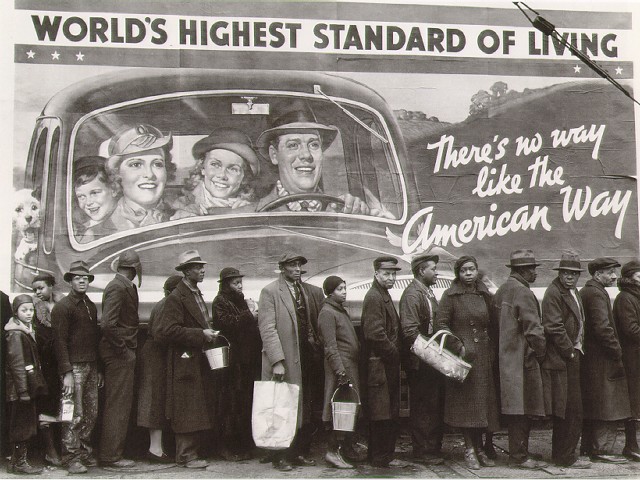
This 1937 photo by Margaret Bourke-White of a breadline in front of a triumphant "American Way" poster shows the irony of American claims of economic supremacy -- especially for blacks and other minorities.

There's No Way Like The American Way
(The photo was taken in the aftermath of the Louisville flood, but scenes just like it could have been repeated in thousands of places every day throughout the Depression.)

Scan courtesy of Masters of Photography.
Source here.

Monday, September 18, 2006

Jewish pirates

They're Jewish, and they're pirates! Many of the old-time pirates of history were Jews, often motivated by the wish for vengeance for the horrors committed against their fellow Jews by the Spanish Inquisition.

For example, Jean Lafitte, also known as "The Corsair", was a pirate who commanded an army of 1000 men during the War of 1812. After leaving New Orleans, he established a base in Texas, and spent much of the Mexican war of independence raiding Spanish ships. He was also a Sephardic Jew and a refugee from Spain, and his maternal grandfather was put to death by the Spanish Inquisition for "Judaizing". Yet when Hollywood came to tell his story, in the 1958 movie starring Yul Brynner, his Jewish heritage was completely ignored.