Forty years ago today, the Apollo 11 Luna Lander touched down on the surface of the Moon. NASA astronauts Neil Armstrong and Buzz Aldrin became the first two people to walk on another astronomical body.
We could do this forty years ago. Today, would we have the passion or the technology?
Showing posts with label science. Show all posts
Showing posts with label science. Show all posts
Monday, July 20, 2009
Forty years ago

Saturday, March 08, 2008
Singing cosmos
How cool is this? The northern lights sing:
It's safe to say that the majority of scientists who do research in this field are skeptical of the notion that the aurora's dazzling light show has its own built-in soundtrack, but while visiting Lapland, Hill worked closely with a geophysicist who does: Esa Turunen of the SGO, whose research focuses in part on scientifically establishing the audibility of the phenomenon. Certainly the aurora borealis produces sounds in space, and those sounds are monitored and recorded regularly by observatories all over the globe, including the SGO. But the sounds heard on Earth are probably more local in origin.
Field instruments are finally sensitive enough to capture these weird sounds for empirical analysis, hampered a bit by the fact that the sounds only occur during the most intense geomagnetic activity. The Helsinki University of Technology (HUT) has an Auroral Acoustics program that statistically analyzes field recordings of auroral acoustics and compares them to a "control group" of recordings from nights when there was no geomagnetic activity. It's an ongoing project, but to date, findings support the anecdotal evidence: the sounds are real, they strongly correlate with particularly intense auroral displays, and they are produced locally, although scientists remain mystified by the exact mechanism doing the producing.

(Click image for full view.)
More here.
Sunday, December 30, 2007
Family walking on all fours
National Geographic has an article about a Kurdish family where five out of the nineteen siblings in one family walk on all fours instead of upright.
Scientists who have studied the three sisters and two brothers insist that it is not a hoax.
Uner Tan, a Turkish neurophysiologist, has studied them and believes they are "evolutionary throwbacks" to our ancestors. A team of German scientists led by Stefan Mundlos believes they have found the precise gene which has knocked out their ability to walk upright.
It's not clear what they mean by "the" gene that controls bipedalism: walking on two legs successfully requires many features, both anatomical and mental, and knocking out just one of them will cause the whole system to break. To take an extreme example, it's hard to walk upright if you have no legs. Less extreme example: the move to bipedalism would have required changes to our hips and backs. Our backs are still not completely evolved to suit our upright stance, which is why people are prone to back problems. Comparing us to our cousins (gorillas, orangutans, chimps and bonobos) shows that we have significantly longer legs than they do, relative to our body-size. The evolution of bipedalism would have required all these features to evolve more-or-less in lockstep (albeit presumably in fits and starts), and it isn't credible that there is a single gene that controls them all.
Nevertheless, certainly there could be a single gene -- or many single genes -- that the lack of could disable bipedalism. If you remove the accelerator cable from a car, the car won't move, but that isn't to say that the accelerator cable is the thing that makes cars move forward.
After studying the family, the British evolutionary psychologist Nicholas Humphrey pointed out that the genetic mutation alone wouldn't be sufficient to cause the lack of bipedalism. He gives equal credit to a family that was accepting of the children's strange gait, and making no efforts to cajole them into standing upright. Sensible, so far. But then he goes on:
"This is for real," Humphrey said. "You only have to look at the calluses on the hands of the young man [Huseyin] to see he's been on his hands for a very long time."
Why single out Huseyin? Don't the other four siblings have calluses on their hands? And walking on your hands is hardly the only way to make them callused.
I don't have any specific reason to expect a hoax, but calluses on the hands of one of the five siblings is hardly a reason to give the all-clear. Nevertheless, in the absence of any specific reason to expect a hoax, I think it is worth treating it as genuine.
The behavior could potentially reveal much about our own evolution, Humphrey says.
"Here we've got a living example of how it might be for a member of our species to walk on four legs," he said.
Most experts assume that the quadruped ancestors of humans walked in a similar way to apes such as gorillas and chimpanzees.
But the Turkish brothers and sisters walk on only their wrists or the heels of their hands, with their fingers held off the ground, the researchers say. This position appears to have saved their fingers from damage; the sisters, for instance, engage in both crochet and embroidery.
Chimps, our closest living relatives, use their whole hands and fingers for walking.
"Chimpanzees basically wreck their fingers by walking on them," Humphrey said.
[...]
"I think this new evidence, suggesting that [early-human ancestors] walked on their wrists, is much more plausible and interesting," Humphrey said.
I question this completely. Chimpanzees wreck their fingers? Chimps have very good manual dexterity, I'd need to see some support for this astounding claim before accepting it.
But even if correct about chimpanzees, Humphrey's claim that the siblings walk only on the heels of their hands isn't supported by the evidence available. The article has one photo of four of the siblings walking. In it, you can clearly make out just two hands on the ground, and in both of them, the people are clearly using their entire hand, fingers and all.

(Click image for full view.)
The photographic evidence contradicts Humphrey's claim, and calls into doubt Uner Tan's conclusion that this is a viable model of pre-bipedal human movement.
If you try it for yourself, I'm confident you'll find that it is impossible to do what the researchers claim. With the heel of the hand, or the palm, flat on the ground, it is virtually impossible to bend the fingers back far enough to keep them off the ground. There's maybe a couple of millimetres give in the finger joints, and it is quite tiring. There are basically three ways of hand-walking: with open hands flat on the ground; on closed fists; or on the knuckles of the fingers, as apes do when knuckle-walking. I do not believe there is any evidence at all, either in anatomically modern humans or any plausible ancestor, for a mode of quadrupedal walking where the fingers are held up off the ground.
There is no doubt at all that human development is complex. The five siblings in question all display a range of congenital deficiencies, include mild mental retardation and lack of balance. It is absolutely possible that whatever genetic damage the five siblings have -- and it might be as little as a single gene -- could lead to them doing the "bear crawl" into adulthood.
But I am extremely skeptical that this gives us any insight into human evolution. For Uner Tan to describe this as "backward evolution" is as absurd as it would be to describe Tay-Sachs disease as backwards-evolution, or sufferers of Huntington's Disease as "evolutionary throwbacks" to an otherwise unsuspected ancestor. The siblings are clearly broken. They're not a throwback to "primitive Man". The most one could say is that, possibly, early pre-bipedal ancestors of human beings may not have had the gene which the siblings are missing. But that's not the same thing: if you rip out the computer chip from a modern Ford Fiesta you don't get a Model T Ford, you get a broken Fiesta.
(Unlike modern cars, biological organisms are astonishingly good at continuing to work with bits missing. As fragile as living things are, we're also incredibly resilient.)
Update, January 3rd: More information here.
Sunday, September 09, 2007
Why is there something rather than nothing?
One of the supposed "deep" questions that (we're told) only religion can answer is the question, Why is there Something rather than Nothing? Science might be able to explain the workings of the universe, but it can't explain why the universe exists, or so the philosophers and priests say.
But why shouldn't the universe exist? It's been assumed at least as far back as Leibniz that "nothing" is simpler than "something", that nothingness "just happens" but to get the material universe you need to do a bit more work.
But that's just an assumption. Why shouldn't there be Something rather than Nothing? Perhaps the best answer to the question is "Well, why not?". Maybe there can't fail to be Something. There's Something because there cannot fail to be Something.
There's no reason to prefer the assumption that nothingness is simpler than something. We have no experience of nothingness. Nothingness is not the same as a lack of some particular object. There is nowhere we can go or to point to and say "Look, there's nothing. It needs no explanation. Now, how did something form from it?"
We once believed that "Nature abhors a vacuum". Although we now know that it is relatively easy to remove all the matter from a volume of space, indeed most of the universe is a low-grade vacuum, we could easily revise the old saying as "Nature abhors Nothingness". Everywhere you go, there are electromagnetic and gravitational fields -- and even if you could shield a volume of space from them (how???) you can't avoid having space and time itself. Getting space-time isn't hard, it's already there. Getting the nothingness in the first place is hard.
It isn't as if nothingness floated around in space for millions of years before suddenly exploding into something in the Big Bang. Time and space themselves began in the Big Bang. There was no "before the Big Bang". The very question "what happened before the Big Bang?" is meaningless, like "what's north of the North Pole?".
We shouldn't make the mistake of assuming that Something needed to be somehow created from Nothingness. Maybe the natural state of being is that Something is easy and Nothingness would be the hard thing to explain -- except that naturally if there was Nothing we wouldn't be there to ask why there was Nothing rather than Something.
(We wouldn't be where?)
There is no justification for the priests' assumption that only God or Gods can explain why there is Something rather than Nothing. Consider: suppose we said that God created the universe from Nothing. But hang on a second -- we had just agreed that Nothing existed. How does God fit into Nothing? Isn't God Something? If you're going to say that God existed, why not just accept that the universe existed and be done with it?
"How do you get Something from Nothing?"
"Well, start with Nothing, then add one God that you had prepared earlier, and voilà! you have Something."
Cosmic Variance has more:
Ultimately, the problem is that the question — “Why is there something rather than nothing?” — doesn’t make any sense. What kind of answer could possibly count as satisfying? What could a claim like “The most natural universe is one that doesn’t exist” possibly mean? As often happens, we are led astray by imagining that we can apply the kinds of language we use in talking about contingent pieces of the world around us to the universe as a whole. It makes sense to ask why this blog exists, rather than some other blog; but there is no external vantage point from which we can compare the relatively likelihood of different modes of existence for the universe.
So the universe exists, and we know of no good reason to be surprised by that fact.
If you spend some time reading the Stanford Encyclopedia of Philosophy article, you may notice the knots philosophers have tied themselves into by confusing privatives like "holes" with actual things. Our human penchant for reification, as useful as it can be, also confuses us.
Tuesday, September 04, 2007
Information gathering for ATLAS
If the Internet itself was created by the US military to be a redundant, highly-resistant to damage information network, the World Wide Web was created to allow physicists to share data from experiments in subatomic partical physics.
CERN, the birthplace of the WWW, is about to start a series of experiments which will push the boundaries in information gathering, processing and sharing beyond anything ever attempted before. Three-Toed Sloth discuss the incredible engineering work needed for the ATLAS experiments on subatomic particles, and the vast amounts of data the experiments will collect: petabytes -- millions of gigabytes -- per second. Almost twenty years ago, CERN gave us the Web. What will we get in another twenty years?
Monday, July 23, 2007
There are no stars!!!
Oh noes!!! There is no stars, the moon landing must have been faked on a sound stage!!1
Heh heh heh.
For the real reason there are no stars, see Phil Plait's Bad Astronomy site.
Friday, July 20, 2007
38 years ago today
On this day in 1969, Apollo 11 astronauts Neil Armstrong and Edwin "Buzz" Aldrin landed on the Moon's Sea of Tranquility to become the first human beings to walk on another astronomical body.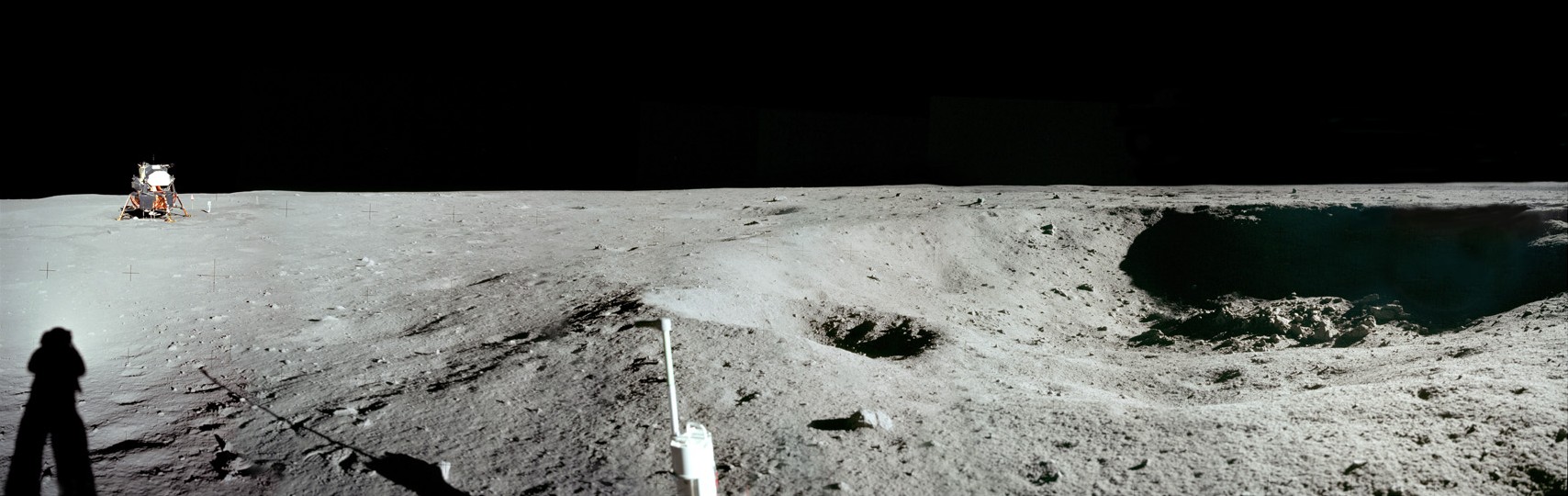
Monday, March 26, 2007
Io and Jupiter
This makes an excellent desktop wallpaper: the moon Io passing in front of Jupiter.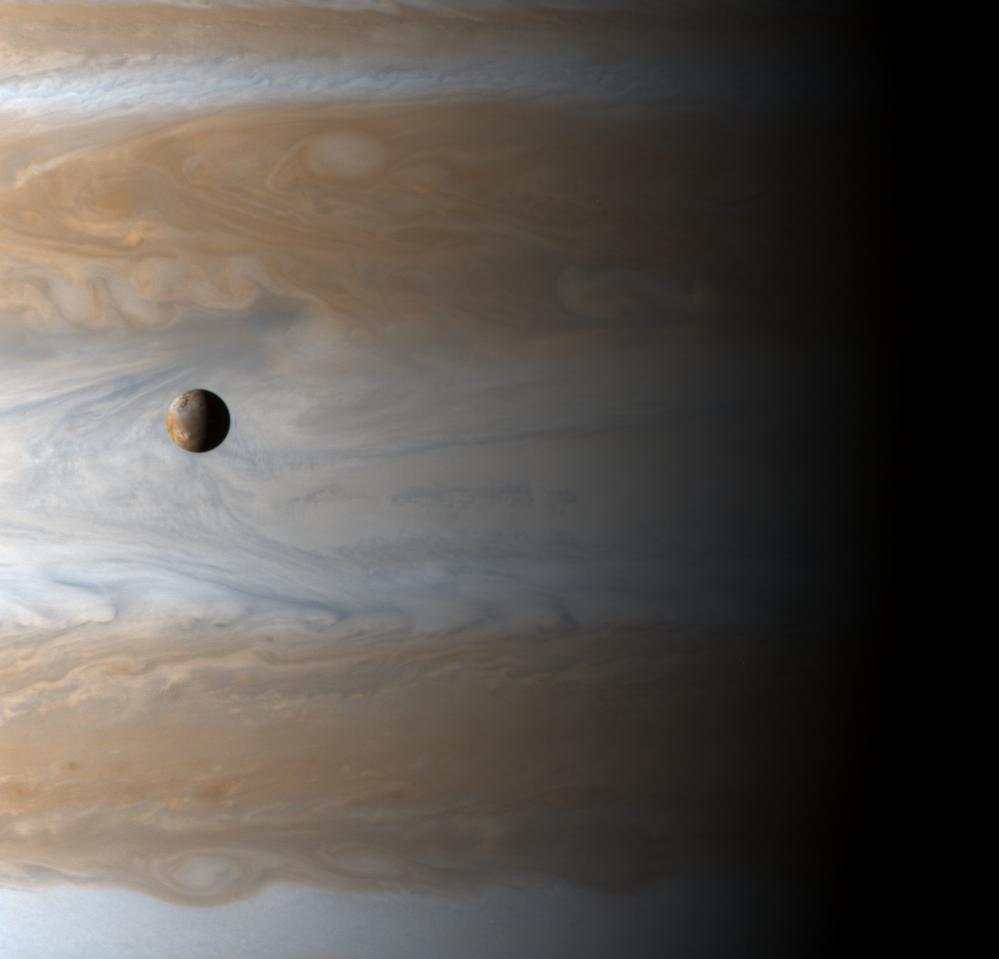
NASA's website says:
The image is deceiving: there are 350,000 kilometers -- roughly 2.5 Jupiters -- between Io and Jupiter's clouds. Io is the size of our Moon, and Jupiter is very big.
Thursday, February 15, 2007
Evolution, arrogance and stupidity
PZ Myers discusses some common Creationist misunderstandings about evolution, and points out that while they are often based on deep, fundamental errors of how the world works (dare I say it, stupid questions) others are not stupid at all, but reveal insight and good reasoning ability.
PZ contrasts the typical stupid Creationist question "If we evolved from monkeys, why are there still monkeys around?" with an insightful question about why animals evolved with two eyes. How did they know that one eye is not enough for depth perception and therefore they'd need two eyes?
The answer, and it's not an obvious one, is that two eyes is an accident of developmental biology. As PZ explains, paired structures (two lungs, two arms, two legs...) are a natural consequence of the way cells grown under bilateral symmetry:
It's harder to generate single structures than paired structures with that kind of symmetry, and the real question is how the anterior-posterior and dorsal-ventral axis is generated…and it's not an easy one to answer!
The real problem isn't that Creationists are stupid, because they generally aren't. Ignorant, maybe, but that's not the problem either. Millions of people have no idea of how to raise cattle for beef, but you don't see them protesting that hamburger and steaks are impossible.
PZ puts the blame firmly on arrogance:
The common theme in creationist objections, in the letters I get, in the whole damn culture war, is that creationists arrogantly assume that their ignorance is shared and that it is a valid data point in our explanations of the world. It isn't the scientists who are the arrogant ones in this debate, it's people who come out of 6th grade sunday school utterly convinced that they have all the answers.
PZ is right as far as it goes, but where does that arrogance come from? These people, as a rule, would never dream that they understand how televisions or DVD players work, or imagine that know how to repair bagpipes. Why are they so arrogant about biology?
Two factors: firstly, people have deep intuitions about other living creatures. That folk biology is a set of heuristics that enabled our ancestors to make a good living predicting the behaviour of the natural world over the short-term period of a generation or two. Consequently, we have a deep inherent prejudice for trusting that dogs will beget more dogs. This is so strong, that it took mankind thousands of years to come up with the idea of evolution, even while they were busily using selective breeding to evolve domestic plants and animals from their wild ancestors.
While we might have an inherent prejudice for folk biology, our intellects can over-ride that. And that's were the second factor comes in. Religion. Some religious memes give people deeply felt emotional needs that conflict with facts (be they facts of biology or anything else). Other religious memes give people the totally undeserved certainty that they know the Truth, the Whole Truth and Nothing But The Truth.
Combine the heady mix of false certainty and emotional commitment given by religion with ordinary garden-variety ignorance, plus the human prejudice for folk biology, and you get the Creationist arrogance about science.
Being secure and feeling secure
Bruce Schneier has written an excellent essay on why we human beings so often get security wrong: we worry about the wrong thing, protect against minor risks while ignoring major threats, and otherwise have our feelings of security diverge radically from our actual security.
(See also Schneier's blog entry about it.)
Monday, February 12, 2007
Happy Darwin Day
The 198th anniversary of Charles Darwin's birth is today. The people behind Darwin Day intend his birthday to be a celebration of human curiosity and ingenuity, and the benefits of scientific knowledge which they lead to.
Monday, January 15, 2007
Squid the weeds of the sea
PZ Myers has a fascinating post discussing the life of squid. He points out that, unlike most other animals, they just keep growing until they die -- which is generally pretty soon. He describes them as weeds of the sea: they grow fast, live hard, and die leaving a beautiful corpse. At least, beautiful to the beasties that survive by eating dead squid.
Monday, January 08, 2007
War of the Worlds
One of NASA's scientists, Dirk Schulze-Makuch, has revealed that the two Viking space probes that visited Mars in 1976-77 probably killed native-born Martians.
Fortunately, those natives were microbes, and unable to retaliate by (for example) firing heat-rays or disintegrator beams at the Earth.
The Viking probes were designed to search for ordinary Earth-like microbes. Biologists of the 1970s were unaware of the great range of biochemistries exhibited by the so-called extremophiles, and the tests looking for Martian life probably would have killed them.
Last month, scientists excitedly reported that new photographs of Mars showed geologic changes that suggest water occasionally flows there -- the most tantalising sign that Mars is hospitable to life.
In the 1970s, the Viking mission found no signs of life. But it was looking for earth-like life, in which salt water is the internal liquid of living cells. Given the cold dry conditions of Mars, that life could have evolved on Mars with the key internal fluid consisting of a mix of water and hydrogen peroxide, said Dirk Schulze-Makuch, author of the new research.
That's because a water-hydrogen peroxide mix stays liquid at very low temperatures (minus 55 degrees celsius), does not destroy cells when it freezes, and can suck scarce water vapour out of the air.
Monday, January 01, 2007
Creationist logical reasoning
PZ Myers discusses a Creationist with some major misconceptions about evolution:
Every time I talk to creationists, I'm always stunned at the depth of their misconceptions. There are always the same old boring arguments that are ably dismissed with a paragraph from the Index to Creationist Claims, but there are also occasions when they get, errm, creative, and unfortunately they always take your gape-mouthed I-can't-believe-you-are-so-stupid-that-you-said-that reaction as a triumphant vindication that they must be right.
Orac takes a right-wing idiot to task, and I don't need to jump in—he's done a fine job dismantling him—but I made the mistake of actually reading the ghastly blog article he's criticizing, and even worse, reading some of the comments there. The very first comment will make your jaw drop at the combination of sublime arrogance and impenetrable stupidity. There's a list of 7 objections to evolution, all wrong, but I'll spare you and show just the first.If any two species chosen at random share a common ancestor, would that not imply that every living creature today was ultimately derived from one singular "Mother-Beast"? Just what did this creature look like (I imagine a bulbous sphere, fourteen stories in diameter, with various heads sticking out all over: cow, porcupine, squid, human, etc. Most are confused; none are happy.)
This person learned everything they needed to know about evolution from playing with Mr Potato Head at the age of 4, and has not progressed since. They have not bothered to read word one of any actual science text, but are still convinced that they can accurately summarize evolutionary theory.
It seems a particular habit -- no, compulsion -- of Creationists that the less they understand about evolution, they more they insist that they have discovered the bullet-proof flaw in it which will bring the whole ediface crashing down. The Certainty of Ignorance.
Reading the average Creationist is an experience rather like going to a car mechanic to get squealing brakes looked at. He nods sagely, then pops open the boot (the trunk for you Americans reading this), pours a bottle of oil all over your spare tyre, and exclaims "there you go, that oughta fix it". Mother-Beast indeed.
But in fairness, I can understand where the Mother-Beast concept came from. It isn't just a bizarre fantasy, invented from whole cloth. It actually makes logical sense, given the assumptions Creationists tend to share.
I don't quite understand why, but some years ago Creationists came up with the assumption that "information can never be created, only destroyed". For reasons that escape me, this meme has become exceedingly popular amongst the ignorant. It is obviously false -- by any reasonable definition of information, information gets created and destroyed all the time, and not just by intelligent agents either. There's more information in an oak tree than in the acorn it grew from.
But given this bizarro assumption of "conservation of information", then logically the earliest ancestor must have had contained all the "information" from every creature that ever lived.
See? Perfectly logical, apart from the inconvenient fact that the first assumption is a total load of bollocks. The laws of logical reasoning, like computers, suffer from Garbage In, Garbage Out:
- All men are tubs of strawberry yoghurt.
George Bush is a man.
Therefore George Bush is a tub of strawberry yoghurt.
If your assumptions are garbage ("the brakes are in the spare tyre, and information can never be created"), your conclusions are garbage.
This illustrates why I get impatient with people who dismiss Creationists as merely "stupid" and "brainless" -- it isn't just lack of brain power, it is often a particular sort of highly logical, deeply intellectual stupidity. It often includes a big chunk of self-deception: consciously or unconsciously, they choose their assumptions to give the conclusion they want, no matter whether that conclusion is true or even plausible, and refuse to question those assumptions, even in the face of evidence that George Bush is not a tub of strawberry yoghurt, for fear that they will have to abandon those conclusions.
In other words, Creationism isn't about logic, or intelligence, or science. It's about emotion, mostly fear and self-perception. Find a way to break through the emotional barriers, and eventually, the anti-evolution meme will die. Look at how all but the tiniest nutcase fringe of Creationists have abandoned the Biblical ideas that the Earth is flat with four corners, held up by pillars, and that the sun moves around the Earth.
Thursday, December 28, 2006
Dawkins "not really a scientist"
Speaking as somebody who studied the hard sciences, including physics, at University (and graduated too, I might add), there are very few things more pathetic and sad than a physicist trying to pull rank on a biologist.
One of those things, though, is a physicist trying to lecture a biologist about complexity. Puh-lease. The fundamental objects in physics are particles like photons and electrons, which obey simple, regular mathematical equations that you can easily write down, like E = mc2. The fundamental objects in biology are animals and plants with exceedingly complex and complicated behaviours. Try writing down a mathematical equation to describe the growth of rose bush, or the behaviour of a rabbit, or even a single DNA gene.
Physicist John Barrow was awarded the 2006 Templeton Prize for his pop-science/religion writings. Challenged by biologist Richard Dawkins over some of his claims, Barrow ignored the substance of Dawkins' argument and went straight for the ad hominem fallacy:
"You have a problem with these ideas, Richard, because you’re not really a scientist. You’re a biologist."
(Quoted from William Dembski's blog.)
[Aside: for a look at the maturity of William Dembski, one of the elders of the Intelligent Design movement, check out this.]
This sad little episode, I think, demonstrates the intellectual emptiness of Barrow, not withstanding that he is a highly educated physicist and no doubt a very good writer. But, when push comes to shove, he is incapable of defending his religious ideas except by flinging mud. And worse, he fails to realise that if his accusation is true, if Dawkins (like other biologists) isn't a scientist, what does that say about him, that he is incapable of answering Dawkins' challenge?
Saturday, December 16, 2006
The Final Authority
Surely this has to be a spoof? Perhaps not -- there is no limit to nuttery.
The author of this website has decided that, on the basis of Biblical authority, the Earth must be stationary. The Sun naturally moves around the Earth (like a million tonne battleship being spun around on a string by a two-year-old). The author also has a bee in his bonnet over the name of the American continents. Or should I say, "Cabotia".
There's more: Hitler had a hydrogen bomb, big enough to devastate the entire UK, but it was stolen by the Americans and tested in Alaska, causing a tsunami. Naturally enough, the 2004 Boxing Day tsunami in Indonesia was also caused by the Americans -- following orders from the Jesuits.
You can't parody stuff like this! Summing up the author's level of misunderstanding and confusion about scientific knowledge is this quote, from the stationary Earth page:
Many people consider the Encyclopedia Britannica the FINAL AUTHORITY on all scientific matters.
Wednesday, November 29, 2006
A new synthesis in reproductive biology
It's time to rethink this whole reproduction thing. It's just a theory.
Reproductive Biology - A New Synthesisby M. A. Charlatan, M.S., Ph.D., D.Phil, M. Div(A position paper commissioned by the Indescribable Institute)Abstract
Commonly-accepted theories in science are not subject to radical re-evaluation except in rare instances (see Kuhn for a fuller discussion). We here at the Indescribable Institute believe that the time is ripe for such a major paradigm shift in the current field of Reproductive Biology - namely, challenging the notion that reproduction (commonly defined as the "production of new individuals" or "perpetuation of a given species") occurs via currently-accepted mechanisms such as "fertilization of egg by sperm" and "36-38 week gestational period" which come under the umbrella of "Sexual Reproduction." Given the numerous inherent problems with the Theory of Sexual Reproduction, we propose that alternate theories such as the Stork Theory, the Cabbage Patch Theory and the Found Beneath a Bridge Hypothesis are deserving of fuller investigation, and should be taught as part of any meaningful biological curriculum at the high school or college level.
Further details here.
Tuesday, November 21, 2006
Breakdown of elephant culture
Elephants are one of the most intelligent, sensitive animals on the planet, perhaps even approaching human intelligence and emotion. They understand about death, communicate constantly. They can plan ahead, foresee their own mortality, suffer unhappiness and comfort fellow elephants in pain. They live in societies, not just mere herds.
Elephants, when left to their own devices, are profoundly social creatures. [...] Young elephants are raised within an extended, multitiered network of doting female caregivers that includes the birth mother, grandmothers, aunts and friends. These relations are maintained over a life span as long as 70 years.
[...]
When an elephant dies, its family members engage in intense mourning and burial rituals, conducting weeklong vigils over the body, carefully covering it with earth and brush, revisiting the bones for years afterward, caressing the bones with their trunks, often taking turns rubbing their trunks along the teeth of a skull’s lower jaw, the way living elephants do in greeting. If harm comes to a member of an elephant group, all the other elephants are aware of it.
And we're driving them insane.
The last century has seen Homo sapiens fighting an undeclared war against elephants, with machine guns and chainsaws. We're taking their land, sprinkling their habitat with landmines, machine-gunning them and taking their teeth. Even if they don't have human intelligence, they are certainly intelligent enough to understand. Like most intelligent animals, elephants learn from their families, their mother and aunties, from older elephants. In other words, they have a society. And we're ripping that social fabric apart. It is no surprise that they are fighting back: not just isolated attacks against individuals, but carefully planned attacks on entire villages, executed like military raids, showing an almost human grasp of tactics.
Biologists studying elephants have recognised the same signs of chronic trauma in elephants that human victims of war and violence suffer from. Like human beings, elephants in the wild are showing violent, confused behaviour. As the New York Times reports, since the 1990s males in South Africa's Pilanesberg National Park and the Hluhluwe-Umfolozi Game Reserve have been raping and killing rhinoceroses. Like human beings in dysfunctional societies, elephants are also committing violence against their own: in another national park, up to 90% of male elephant deaths are due to attacks by other male elephants, fifteen times higher than the rate in more stable communities.
"Everybody pretty much agrees that the relationship between elephants and people has dramatically changed," Bradshaw told me recently. "What we are seeing today is extraordinary. Where for centuries humans and elephants lived in relatively peaceful coexistence, there is now hostility and violence. Now, I use the term 'violence' because of the intentionality associated with it, both in the aggression of humans and, at times, the recently observed behavior of elephants."
[...]
For a number of biologists and ethologists who have spent their careers studying elephant behavior, the attacks have become so abnormal in both number and kind that they can no longer be attributed entirely to the customary factors. [...] what we are now witnessing is nothing less than a precipitous collapse of elephant culture.
But, even in the midst of this trauma and violence, elephants display an amazing sensitivity. They might be killing us, we might be killing them, but they treat us as equals. After killing a villager, the elephants took his body and treated it to the same careful funeral rites as they would give to one of their own.
When a group of villagers from Katwe went out to reclaim the man’s body for his family’s funeral rites, the elephants refused to budge. Human remains, a number of researchers have observed, are the only other ones that elephants will treat as they do their own. In the end, the villagers resorted to a tactic that has long been etched in the elephant’s collective memory, firing volleys of gunfire into the air at close range, finally scaring the mourning herd away.
Wednesday, November 08, 2006
Mamas, don't let your babies grow up to be Cow Boys...
PZ Myers has the most audacious, only half tongue-in-cheek suggestion about stem-cell research yet: human clones, grown in cows.
I want to see the Pope's head explode when he sees it. I want David Cronenberg there with a camera, cackling happily.
I want the researchers to announce in a press conference afterwards that their successful experiment was funded by the Department of Defense, Sony, the Church of Scientology, and a private donor.
I want that private donor to be Paris Hilton, who, on accepting her cooing new clone baby, declares that she just didn't want to go through that icky pregnancy and labor stuff. "It isn't haaawt," she'd say.
I want 100 million women to sit up and say, "What? I could outsource the nausea and bloating and pain and stretch marks and episiotomy to a cow? Sign me up!"
I want the phrase "family farm" to acquire rich new meanings. I want to see Bible Belt politicians lobbying for new fetus farming subsidies.
I want gay men to rejoice, and become the primary market for this procedure.
I want to hear snooty young bluebloods declare cows déclassé, and that they'd had their little Brittany gestated in a Kentucky thoroughbred.
The scientific/biological problems aren't simple, but still... exploding Pope heads. Shweeeet!
And from Pharma Bawd in the comments:
Of course, the big groups who are against stem cell research are already against this sort of animal-human hybrid. But wouldn't it be interesting if we transferred the cow nucleus into the human cell at the same time we transferred the human nucleus into the cow cell? Then we could play a version of three-card-monty:
"Where's the soul now?"
Monday, November 06, 2006
Sometimes a quote says it all
With friends like this guy, free-thinkers hardly need to say a word.
Reverend Ray Mummert is a paster from Dover, PA. During the 2005 Dover School Board controversy, creationist Mummert was quoted as saying:
"We've been attacked by the intelligent, educated segment of the culture"
Sometimes the fish just jump outta the water to grab the hook...
Subscribe to:
Posts (Atom)