Tuesday, January 02, 2007

Grey Naughtiness

This just goes to show that when it comes to human sexuality, the range of behaviour is enormous.

The New York Times is running a story about the "Graying of Naughty", the growing kink market for middle-aged porn.

DE'BELLA — or Debbie, as everybody calls her — decided late in life to become a porn star. This year she turned 50, time, she knew, to chase her dream.

"I love sex," she explained, biting into a Burger King special before embarking on her scene for the day at a rented house in the San Fernando Valley. She was wearing a bright pink satin and black chiffon nightie with a matching thong and heavy makeup.

"I decided I wanted to do something different," she said. "I'd been working behind the scenes, and my friends said: 'Why not do movies? Have some fun, and get paid for it?' "

So she has. Since May, De’Bella (she did not want her real name published) has used days off from her job as an administrative assistant at a sex-related entertainment company, Platinum X, to shoot about 30 scenes, with men mostly 19 and 20 year old.

And while she is sort of a novelty — appearing on "The Howard Stern Show" to talk about her new career — it is no longer unusual (hey, Hollywood, pay attention) to see women, and men, of a certain age performing in sex movies.

[...]

The biggest change is in the sexual desirability of women old enough to be the viewer's mother. It has been fueled in part by pop culture's embrace of the sexy 40-something women of "Desperate Housewives" and "Stacy's Mom," the 2003 hit song about a teenager's mother who "has got it going on."

[... ]

The director, Urbano Martin, points his camera strategically, scarcely disguising his boredom. "I shoot specialty films," he explains during a break in filming, adding that he has been in the business for 17 years. "Fat women, old women, hairy girls — all kinds. We feed the niche."

The market for beautiful, airbrushed young women "is oversaturated," he says. "This is more normal people, more meat on the bone, like what you have at home."

Asking why on technical forums

If you spend any time on technical mailing lists or newsgroups, you'll often come across conversations that go something like this:

    "How do I frabulate the transfibulator?"

    "Why do you want to do that?"

    "Why do you care? Just tell me how to frabulate the transfibulator!"


Why should people on technical lists care about the why? Why not just answer the question?

Firstly, and most importantly, because people have an ethical obligation not to give bad advice.

It is foolish to assume that every random poster on the Internet or Usenet is a responsible, intelligent, clear-thinking, sufficiently cautious adult who knows what they are doing. In fact, if you were going to play the odds, you'd bet on them being the complete opposite. This is even true on many of general purpose technical mailing lists (although perhaps not so much on the more elite lists). If frabulating the transfibulator carries risks or serious costs, then the chances are very good that the person asking about it isn't aware of those risks.

It is one thing to give a straight technical answer if it seems that the poster knows what they're doing. There's no reason not to tell someone how to shoot themselves in the foot if they are fully aware of the consequences of doing so; it is another thing altogether if their post indicates that they haven't thought it through and have no idea that they are even pointing the gun at their foot.

If somebody asks for help writing a rotor-based encryption engine (like the World War Two Enigma), it would be sheer irresponsibility to answer their technical question without pointing out that Enigma was broken back in the 1940s and is not even close to secure today. So ask "Why do you want to do that?". If the answer is "I'm storing confidential medical records in a database", then you can gently apply the cluebat. It might be your own medical records you prevent from being stolen. But if the answer is "I'm doing it to obfuscate some data in a game, I know this is weak encryption, but it is good enough for a game", then that's a horse of a different colour.

The second reason for asking "why?" is that it is extremely common for people to ask the wrong question because of a misunderstanding or misapprehension. Some time ago I read an exchange of posts on comp.lang.python started by a programmer who was looking for a faster method to access items in a list. Eventually somebody asked him "Why?", and it turned out that he had assumed that Python lists are linked lists and that item access was a very slow procedure. In fact, Python lists are smart arrays, and item access is exceedingly fast.

If folks had merely answered his technical question, he would have solved a non-problem, learnt nothing, and ended up with slow and inefficient code. His real problem wasn't "How do I this...?". His real problem was that he was labouring under false information, and by asking "Why do you want to do this?", people helped him to solve his real problem.

Monday, January 01, 2007

Gerald Ford

After the recent death of former American President Gerald Ford, historian Juan Cole has published a retrospective of Ford's presidency, with the emphasis on his foreign policy:

He was against just assassinating people, and insisted on warrants for the wiretapping of US citizens.

All presidents make errors, and some abuses occurred on Ford's watch, though they often were initiated by Kissinger. But Ford faced with no illusions the challenges of his era, of detente with the Soviet Union, continued attempts to cultivate China, the collapse of Indochina, the fall-out of the 1973 Arab-Israeli War, and the beginnings of the Lebanese Civil War. Ford was right about detente, right about China, right about Arab-Israeli peace, right about avoiding a big entanglement in Angola, right to worry about nuclear proliferation (one of his worries was the increasing evidence that the Middle East had a nuclear power, Israel, and India was moving in that direction).

Ford's challengers on the Reagan Right were wrong about everything. They vastly over-estimated the military and economic strength of the Soviet Union (yes, that's Paul Wolfowitz). They wanted confrontation with China. They dismissed the Arab world as Soviet occupied territory (even though the vast majority of Arab states was US allies at that time) and urged that it be punished till it accepted Israel's territorial gains in 1967. They insisted that the Vietnam War could have been won.

But despite its illusions and Orwellian falsehoods, the Reagan Right prevailed. Ford only momentarily lost to Carter. Both of them were to lose to Reagan, who resorted to Cold War brinkmanship, private militias, death squads, offshore accounts, unconstitutional criminality, and under the table deals with Khomeini, and who created a transition out of the Cold War that left the private militias (one of them al-Qaeda) empowered to wreak destruction in the aftermath. The blowback from that Reaganesque era of private armies of the Right helped push the US after 2001 toward an incipient fascism at which Ford, the All-American, the lawyerly gentleman, the great Wolverine, must have wept daily in his twilight years.

[Note: "Wolverine" is a reference to Ford's early career as a footballer, not to the superhero of the same name.]

Cole paints a pretty picture of Ford, and I suppose it could even be true. Ford was unique in one sense, he was the only American president in recent times who gained power without being elected into office. That made him different from all the other rabid stoats who clawed and kicked their way into power by whatever means it took.

But only a little different: Ford may not have been elected president, but he was elected into an exceedingly senior position in the Republican Party. He might have been old-school conservative, but he was only a Good Guy in comparison to the team of criminals and czarists who have stolen the Republican Party. When push came to shove, Ford's foreign policy was no less ruthless than any other American president of the last century: long on the rhetoric of virtuousness, short on actual virtue. It has taken the reckless imperialist George Bush Junior to make Ford seem appealing: Ford, to his credit, was sensible and pragmatic, which is probably the best we can hope for in the president of the USA. But, whether driven by Ford or by Kissinger, the Ford administration continued the grand old tradition of the USA, of putting short term selfish gains ahead of long term benefits.

Cole's article does a good job of showing Ford's policy successes, but before we made Ford into a saint of old-fashioned virtuous conservativism, let's remember what else he and his administration did. He pardoned his former boss, the crook Richard Nixon, preventing justice from being done. Neither he nor Kissinger voluntarily ended the pointless war in Vietnam, it took the Congress to force his hand.

He gave the okay to Indonesian president Suharto -- who had massacred hundreds of thousands of political enemies when he came into power -- to invade East Timor, leading to the killing of a quarter or a third of the East Timor population. Not only did Ford give Suharto a nod and a wink to invade, but he provided material support for the invasion, such as ground-attack planes.

Despite Ford's otherwise admirable attempts to bring Israel to the negotiating table, his administration nevertheless opposed moves by the U.N. Security Council to reach a peace settlement in the Middle East. And he gave Rumsfeld and Cheney their start in politics.

And of course, in the end Ford displayed remarkable cowardice towards the GOP czars who came after him. What good did his tears for the sins of Reagan and Bush do for his country? Why didn't he speak up while he was still alive?

Ford might have been less wicked than the Republican presidents who followed him, and possibly even the Democrats, but in my heart of hearts I can't see terribly much to admire in him.

Creationist logical reasoning

PZ Myers discusses a Creationist with some major misconceptions about evolution:

Every time I talk to creationists, I'm always stunned at the depth of their misconceptions. There are always the same old boring arguments that are ably dismissed with a paragraph from the Index to Creationist Claims, but there are also occasions when they get, errm, creative, and unfortunately they always take your gape-mouthed I-can't-believe-you-are-so-stupid-that-you-said-that reaction as a triumphant vindication that they must be right.

Orac takes a right-wing idiot to task, and I don't need to jump in—he's done a fine job dismantling him—but I made the mistake of actually reading the ghastly blog article he's criticizing, and even worse, reading some of the comments there. The very first comment will make your jaw drop at the combination of sublime arrogance and impenetrable stupidity. There's a list of 7 objections to evolution, all wrong, but I'll spare you and show just the first.

If any two species chosen at random share a common ancestor, would that not imply that every living creature today was ultimately derived from one singular "Mother-Beast"? Just what did this creature look like (I imagine a bulbous sphere, fourteen stories in diameter, with various heads sticking out all over: cow, porcupine, squid, human, etc. Most are confused; none are happy.)

This person learned everything they needed to know about evolution from playing with Mr Potato Head at the age of 4, and has not progressed since. They have not bothered to read word one of any actual science text, but are still convinced that they can accurately summarize evolutionary theory.

It seems a particular habit -- no, compulsion -- of Creationists that the less they understand about evolution, they more they insist that they have discovered the bullet-proof flaw in it which will bring the whole ediface crashing down. The Certainty of Ignorance.

Reading the average Creationist is an experience rather like going to a car mechanic to get squealing brakes looked at. He nods sagely, then pops open the boot (the trunk for you Americans reading this), pours a bottle of oil all over your spare tyre, and exclaims "there you go, that oughta fix it". Mother-Beast indeed.

But in fairness, I can understand where the Mother-Beast concept came from. It isn't just a bizarre fantasy, invented from whole cloth. It actually makes logical sense, given the assumptions Creationists tend to share.

I don't quite understand why, but some years ago Creationists came up with the assumption that "information can never be created, only destroyed". For reasons that escape me, this meme has become exceedingly popular amongst the ignorant. It is obviously false -- by any reasonable definition of information, information gets created and destroyed all the time, and not just by intelligent agents either. There's more information in an oak tree than in the acorn it grew from.

But given this bizarro assumption of "conservation of information", then logically the earliest ancestor must have had contained all the "information" from every creature that ever lived.

See? Perfectly logical, apart from the inconvenient fact that the first assumption is a total load of bollocks. The laws of logical reasoning, like computers, suffer from Garbage In, Garbage Out:

    All men are tubs of strawberry yoghurt.
    George Bush is a man.
    Therefore George Bush is a tub of strawberry yoghurt.

If your assumptions are garbage ("the brakes are in the spare tyre, and information can never be created"), your conclusions are garbage.

This illustrates why I get impatient with people who dismiss Creationists as merely "stupid" and "brainless" -- it isn't just lack of brain power, it is often a particular sort of highly logical, deeply intellectual stupidity. It often includes a big chunk of self-deception: consciously or unconsciously, they choose their assumptions to give the conclusion they want, no matter whether that conclusion is true or even plausible, and refuse to question those assumptions, even in the face of evidence that George Bush is not a tub of strawberry yoghurt, for fear that they will have to abandon those conclusions.

In other words, Creationism isn't about logic, or intelligence, or science. It's about emotion, mostly fear and self-perception. Find a way to break through the emotional barriers, and eventually, the anti-evolution meme will die. Look at how all but the tiniest nutcase fringe of Creationists have abandoned the Biblical ideas that the Earth is flat with four corners, held up by pillars, and that the sun moves around the Earth.

Scratch a free-marketeer...

...and find an enemy of private property.

Stephen J. Dubner of Freakonomics recently blogged about an interesting study of the used-book market.

Or rather, Dubner thinks it might be interesting, but since it costs US$695 he hasn't actually read the report.

That sounds interesting, doesn’t it? We’ve touched on related subjects here and here; Judy Chevalier and Austan Goolsbee wrote a paper about the market for used textbooks. Even closer to home, as far as the trade publishing industry is concerned, is this paper by Anindya Ghose, Michael Smith, and Rahul Telang, which argues that — despite the publishers’ fears — the sale of used books does not cannibalize new book sales, and in fact a robust used market may help the new book market since a book, once read, retains more of its value.

But what I want to comment on is not Dubner's post itself, but one of the comments left by a reader. "GamblingEconomist" starts off with the free market party line, defending the price of the report:

Why does it seem strange that industry research would be expensive? How are those in the industry supposed to make their decisions without market research? Peer reviewed economics publications don’t always fit the bill.

but then rapidly shows his(?) true colours:

I hope that nobody sells it on ebay because the report is likely licensed to the purchaser for his/her own use and is not meant to be duplicated and/or resold.

Let's get this straight: he's not talking about copyright infringement. From context, he's talking about re-selling a physical copy of the report. He's hoping that nobody can re-sell the report -- or to put it another way, he hopes that the report is not the property of those who buy it.

He's talking about one of the most fundamental attributes of the free market, without which the concept of "private property" is meaningless: once you buy something, it is yours, to do with as you wish, including selling it.

You would think I'd be immune to this by now, but I never cease to be angered at the double-standards of so many of the supposed "free-market" proponents who are happy to gut the principle of private property by messing with the first-sale doctrine. To these people, there are two classes of individuals in the world: those who own property, and those who merely licence it.

And you can bet that in their minds, they intend to be in the first class.

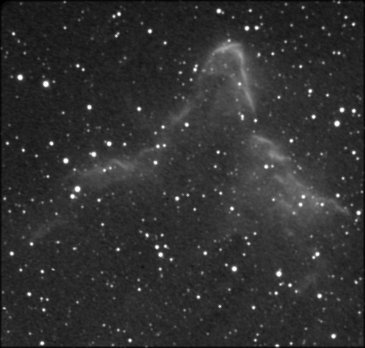
The Auditors are real

Proof undeniable that the Auditors of Reality are real:

Auditor in space

(Click for full size image.)


Originally found here, thanks to Robert Long.

Sunday, December 31, 2006

Good riddance to a dictator

They hanged Saddam Hussein yesterday. I certainly won't mourn him, except in the sense that I disapprove of the death penalty, and I consider his trial was barely better than a kangaroo court. When you consider the circumstances of his trial, the defence lawyers who were assassinated, the rush to return a guilty verdict, and now the unholy haste to kill him, this wasn't the finest hour of international justice.

But if you step back and consider the bigger picture, this was a death that will accomplish very little beyond a personal feeling of closure to his victims and enemies. (No doubt Mad King George will be grinning right about now.) His death will make him a martyr to many. Even those who would cheerfully have slit his throat, like Osama bin Laden, will no doubt be using Saddam's execution as "proof" (by which I mean propoganda) that the Iraqi government is nothing but a puppet of the Americans, killing Iraq's sons for the benefit of the USA.

It would have been better for Saddam to spend the rest of his life in jail as a warning to other dictators: you won't go down in a blaze of glory, shouting defiance at your enemies, you'll become irrelevent, unmissed, slowly drifting into old age and senility.

Be that as it may, whether Saddam's death would be more or less of a deterrent to others, one thing is absolutely certain: it will have no real effect on the Iraqi civil war. Unrepentent Baathists looking to put Saddam back in power have never been more than bit players in the Iraqi tragedy.

[sarcasm] However, on the plus side, at least now I no longer have to fear Saddam's invisible nuclear, chemical and biological weapons! [/sarcasm]

Professor Juan Cole has a detailed list of the top ten ways that the USA helped build Saddam's dictatorship. If you'd rather a brief overview, set to Bing Crosby's Thanks for the memories, Eric Blumrich has a very well done Flash slideshow.

Update, 1st Jan 2007 11:45pm:
The New York Times (DNA sample required) has a moving report on Saddam's execution. I hate to say it, but the old monster went to his death with more dignity and grace than his executioners showed. He was defiant until the end, and his bravery will surely give more ammunition to at least one side of the civil war.

Underarm hair

Echidne has a good rant about the conservative obsession with female body hair:

A recent wingnut cartoon adventure story (read: incitement towards civil war) has the picture [below] about the horrible enemies of all right-thinking wingnuts: animal rights activists and I guess the animals they protect. They're coming to get you and your Bible!

But look at the stubble on the woman's legs. That is a signifier that she is a feminist, a feminazi, a woman who will probably eat her children. She's having leg hairs! Eek. She probably has hairy armpits, too. Pardon me while I vomit.

Animal Rights Terrorists
(Click for larger image.)

I'm as much a product of my culture as the next person, so I'm not going to discuss the aethetics of body hair (female or male!) except to note that I was surprised to see letters to American Playboy running four to one in favour of centerfolds with neatly trimmed pubic hair instead of completely shaved. What interests me more is the sociology of the armpit wars.

Especially fascinating is the double-standard of the American conservatives, who on the one hand declare that the nature of women is not just biologically fixed but that it is God-given right and proper that it be so -- except for body hair. Woman who choose to keep their natural, "god-given" body hair and not shave it off are at best freaks and unnatural, and at worse evil.

Just think about that. It is unnatural to not actively remove your natural body hair.

How does this belief differ from the horrific tribal belief widespread across Africa, the Middle East and Indonesia that it is unnatural for women to keep their external genitalia? Of course shaving hair off is not the equivalent of permanently removing bits of your flesh, and there is a vast gulf between the social pressure to shave (whether women's legs or men's faces) and the sometimes forced practice of female genital cutting, but I'm talking about the attitute behind it. In both cases, it is natural to be unnatural, or if you prefer, unnatural to be natural.

Of course, it isn't just women who feel the sting of conservative social disapproval. In conservative circles, men who grow their hair long as god intended (why else would hair continue to grow after it reached the length of a short-back-and-sides?) are disparaged and suffer vituperation -- despite the Biblical precedent of Samson, and traditional drawings of Jesus Christ with long hair. It wasn't that long ago that long-haired men risked physical attack if they wandered into the wrong conservative area.

Beards, for some reason, come and go as fashion, and apart from the occasional outlawing of beards by (say) Russian czars, I don't know of any period in recent Western history when men suffered more than the lightest social disapproval for their facial hair or lack of it. (Although that disapproval can be pretty severe: try running for election as president with long hair.)

Another interesting factor is the double-edged way that conservatives use body hair as a weapon against women. If a woman shaves, then clearly she's (at least partially) submitting to particular social conventions. Any particular woman may or may not care about that -- after all, not all social conventions are bad. I don't see the social convention that people of both sexes shower and keep clean as particularly oppressive. But if a woman chooses to buck the convention, it gives conservatives two angles of attack: on the one hand, unshaven legs and armpits become a sign that the person isn't a real woman, that they are ugly, manly, unable to attract a man and therefore their entire motives become suspect: "they're just an angry man-hating feminazi".

But on the other hand, and at the same time, they are also condemned for wasting their time on silly trivialities. To the conservative mind, female body hair is simultaneously a trivial matter of grooming not worth getting upset about and a significant symbol of femininity that colours not only the entire personality of the woman but also the credibility of her message. It is as if somebody said "Oh, I don't care what the mathematics says, Professor Hawking's theories about quantum mechanics are all nonsense -- just look at the tie he is wearing!"

Hmmm. I'm reminded that Australia's Prime Minister, then Leader of the Opposition, rose massively in opinion polls when he started plucking his eyebrows. As Mrs Impala reminds me, we're all baboons obsessed with pink bottoms really.

Saturday, December 30, 2006

The RIAA according to McSweeney's

McSweeney's has parody letter of demand from the RIAA:

If you would prefer not to be stripped of your home and dignity, please send us $3,750 in the return envelope. If your toddler has been named in this lawsuit, explain to them that the fruits of their labor as an adult will go to pay a debt that will ultimately lead to their death at a young age due to their inability to afford medical insurance. Toddlers never understand that, but they'll get the point if you make them cry. If your household pet has been named in this lawsuit, it will be euthanized. If you are a 13-year-old girl, do not expect that the bad publicity in the past has made us hesitant to sue little girls—it has only made us hate you even more. If you, your household pet, or your toddler did not commit any of the acts above, then we will sue you and ruin your life forever for lying. Then we will sue you again, because it's not about the money anymore. It's about revenge.

Hogfather redux

After my review of Hogfather, I thought I should follow up with a shorter one from Mrs Impala. I agree with it entirely.

When it was good, it was very nearly very good, and when it was bad, it was am-dram [amateur dramatics].

Eighteen words to express what I took 1400 words to say. I guess we can see who is the wordsmith of this family.

Pink fluffy slippers

Conversation in the car tonight as Mrs Impala and I returned home from delivering a kitten to her home:

    Me:Was that woman jogging...?
    Mrs Impala:Yes she was.
    Me:She was jogging in fluffy...?
    Mrs Impala:Yes. Fluffy slippers. Fluffy pink slippers.
    Me:She was jogging in fluffy pink slippers. Well, it takes all kinds.
    Mrs Impala:Unfortunately.

Thursday, December 28, 2006

Dawkins "not really a scientist"

Speaking as somebody who studied the hard sciences, including physics, at University (and graduated too, I might add), there are very few things more pathetic and sad than a physicist trying to pull rank on a biologist.

One of those things, though, is a physicist trying to lecture a biologist about complexity. Puh-lease. The fundamental objects in physics are particles like photons and electrons, which obey simple, regular mathematical equations that you can easily write down, like E = mc2. The fundamental objects in biology are animals and plants with exceedingly complex and complicated behaviours. Try writing down a mathematical equation to describe the growth of rose bush, or the behaviour of a rabbit, or even a single DNA gene.

Physicist John Barrow was awarded the 2006 Templeton Prize for his pop-science/religion writings. Challenged by biologist Richard Dawkins over some of his claims, Barrow ignored the substance of Dawkins' argument and went straight for the ad hominem fallacy:

"You have a problem with these ideas, Richard, because you’re not really a scientist. You’re a biologist."

(Quoted from William Dembski's blog.)

[Aside: for a look at the maturity of William Dembski, one of the elders of the Intelligent Design movement, check out this.]

This sad little episode, I think, demonstrates the intellectual emptiness of Barrow, not withstanding that he is a highly educated physicist and no doubt a very good writer. But, when push comes to shove, he is incapable of defending his religious ideas except by flinging mud. And worse, he fails to realise that if his accusation is true, if Dawkins (like other biologists) isn't a scientist, what does that say about him, that he is incapable of answering Dawkins' challenge?

Wednesday, December 27, 2006

Hogfather

The (long-)awaited television adaptation of Terry Pratchett's Hogfather was shown on SkyOne in the UK on December 17th and 18th. Part One was the most successful SkyOne production ever, with 2.6 million viewers. Part Two wasn't quite so successful, but 1.5 million viewers is nothing to sneeze at.

Thanks to the miracle of bittorrent remote viewing, I managed to watch Hogfather in the comfort of my home in Australia, many weeks before it is due to be broadcast here.

As a huge fan of Terry Pratchett's Discworld series, I was looking forward to this programme, but not without a certain amount of trepidation. What if they mucked it up? You might not be able to make a Savile Row suit out of hessian sacking, but the best materials in the world won't help if the tailor can't sew.

So, with great relief, let me say that Hogfather didn't suck. Nor did it blow. It didn't even bite. Am I damning the show with faint praise? Yes and no -- it could have been better, but it was good enough that I wasn't disappointed. I give the first episode a generous B- and the second a conservative B+, for an overall mark of B, or if you prefer, a Distinction.

To my mind, the highlights of the show were Marc Warren and Michelle Dockery as Teatime and Susan. Warren's Teatime was off-putting and disturbing in all the right ways. So many people have commented on the similarities of Warren's performance to Johnny Depp's version of Willy Wonka that it would be amiss of me not to do so as well. Teatime's Wonka-esque voice, the inappropriate laughter, and the skewed way he looked at the world made the character so much more than just another nasty bad guy. After Warren's excellent role in the Doctor Who episode Love and Monsters (an episode I didn't especially like, but that's another story), he is certainly an actor I'll be watching out for in the future.

Likewise, Michelle Dockery was excellent as Susan, although probably a little more attractive (roaw!) than Pratchett's concept. Well, it is television, and the conventions of television are such that the female lead must be a hottie. Fortunately, Dockery is not just a pretty face: she can act, and succeeded in capturing the essence of Susan: slightly put-upon, slightly more than slightly annoyed, determined, independent, and a real Hero despite her wish to be "normal". Unwilling she might be, but when a job needs to be done, you won't find her wanting.

I was pleased that they managed to capture Susan's wild and uncontrollable hair without going for the crazed dandelion look of Paul Kidby's drawings.

Death was amazingly believable. Ian Richardson, who did the voice of Death, did a truly excellent job. I had always imagined Death as speaking like James Earl Jones (Darth Vader) on steroids, but Richardson's performance won me over. The 6'7" Dutch actor who played death, Marnix van den Broeke, did a fine job: Death moves likes an animated "skellington" should, animated without being alive, every movement deliberate and careful. And Death of Rats was as cute as a tiny skeletal rat could be.

David Jason's portrayal of Albert was also well done. It wasn't the Albert of Pratchett's novels, who is edgy and quite nasty and on the side of good for purely selfish reasons, but it was an Albert. A gentler Albert, like the slightly disreputable kindly uncle you wished you had, a bit of a chancer but still a rough diamond, and always good for a laugh. So not the terrible head of Unseen University from the days when being a wizard meant using magic to turn your enemies into wisps of slightly greasy smoke.

The choice to play Albert as comedy relief actually did work, but it did mean that one of the great lines from the book fell completely flat in the movie. In the book, when Albert introduces himself as the pixie "Uncle Heavy", there is genuine menace in it. In the movie, it just comes across as pathetic. Good ole Albert trying to be tough? Don't make me laugh. As wonderful as the line is, it should have been left out of the movie.

And that illustrates one of the problems with the film adaptation: it followed the book too slavishly at times, which meant that those poor benighted souls who have never read the book would often be confused. Adapting a novel for the screen requires more than merely cutting entire scenes because they won't fit within the time constraints.

Take the introductory voice-over, about the Big Bang and the Discworld, which was taken virtually word-for-word from the novel. In the book, it worked. As a narration, yawn. Especially since it was repeated on the second night.

It was disappointing that so many wonderful scenes from the book had to be left out, like the old boots and shoelaces. Of course you can't fit the entire book into a three-hour movie, but I'm sure there are many gems on the cutting room floor, and even more that never even made it into the script. That's why it is such a pity that the entire narration was repeated at the start of part two. Between the "Previously On Hogfather..." recap, and the repeated narration, episode two lost all of eight minutes. Eight precious, precious minutes, which would have been more than long enough for the beggars' feast. Programmes like Buffy and Battlestar Galactica manage to run through their "Previously on..." in under a minute, and they sometimes show scenes from two or three years previously.

And what was with the narration "a midwinter festival bearing a remarkable similarity to your Christmas"? Breaking the fourth wall works when it works, but breaking it to insult the viewer's intelligence does not work. ("What? The Hogfather is like Father Christmas??? Who would have guessed?")

But I don't wish to pick at every little weakness of the show. It is enough to mention a few of the things that could have been done better. Some of the scenes felt like they were being performed on a stage instead of filmed for television. The two media are very different, and what works on the stage doesn't work on television. Nigel Planer overacted in his role as Sideney the wizard, treating it as pantomime instead of television. So did Tony Robinson in his minor role as department store owner Crumley. The actor playing Medium Dave Lilywhite was merely adequate, but Chickenwire was grossly mishandled. Chickenwire in the novel is supposed to be a vicious criminal, streetwise and tough. We saw virtually none of that in the movie. At least Medium Dave looked tough; Chickenwire didn't even do that much.

The wizards, sadly, were mostly played as doddering, frightened old men, especially in the first half, without capturing any of their magisterial greatness, or their argumentative personalities. They improved slightly in the second half, and Archchancellor Ridcully did a fine job in both episodes. (Like Albert, Ridcully wasn't quite the Ridcully from the books, but he was a Ridcully.) So did Ponder Stibbons, and Hex was a fine piece of the filmmaker's art. It was amazing how much emotion a Rube Goldberg machine and an animated skeleton can put into a conversation. And the Eater of Socks was very well done indeed.

I prefer to emphasise the glass half full, so I'll say no more about the flaws. I liked the show, despite them. The minor characters of Violet and the Oh God of Hangovers were done very well. Death's final confrontation with the Auditors was filled with real power and emotion. For a skeleton with no facial expression, Richardson and van den Broeke made Death come alive, pun intended. They came close to the remarkable performance of Hugo Weaving in V For Vendetta, and I consider that high praise indeed.

In my opinion, Hogfather is one of the more difficult Discworld novels to adapt to the screen. It has a number of intertwining subplots and is more explicitly philosophical than many other Discworld novels. To really get the best from the story, the reader needs to know the characters of Susan, Death and Albert from previous books. SkyOne were aiming very high by choosing Hogfather as their first Discworld production. Having aimed so high, it isn't so surprising that they fell short of perfection, but what they accomplished was well worth watching. Let's hope that they will learn the right lessons from this, and the next Discworld movie will be better still, with a bigger budget, and a director who will do things my way.

Saturday, December 23, 2006

Lucky socks

Thought for the day:

I find it appalling and terrifying that a species capable of creating and deploying weapons of mass destruction panics because it can't find its lucky socks on a Thursday morning. -- Mrs. Impala

Friday, December 22, 2006

This year in review

Cartoonist Tom Tomorrow's This Modern World has a review of the major events of 2007:

Senator Trent Lott on Iraq

Part One
Part Two
This Modern World archives

Thursday, December 21, 2006

Murder in Baghdad

One of the more egregiously stupid Internet memes (in the actual sense, not in the stupid LiveJournal sense of a quiz or survey) going around is the flood of chain letters claiming that Iraq is no more dangerous than Washington DC. If you've got pro-Iraq war friends, you've probably seen some of them. They use statistics to prove that living in Washington DC was -- and maybe even still is -- more dangerous than living in Iraq.

And by prove I mean mislead.

John Rogers of Kung Fu Monkey had something to say about the claims. Actually, he has two things to say: a nice version, and a not-so-nice version.

The nice version looks at the numbers, corrects the misleading use of statistics -- is it an accident that the pro-war zealots are averaging the death rate over chaotic murderous Baghdad and peaceful Kurdistan? yeah, sure it is -- and comes up with some conservative estimates for the yearly death rate in Baghdad:

544 murders per 100,000 in Baghdad versus 80 in Washington at the most lawless. (Today, Washington's murder rate is "merely" 35 per 100,000.)

Comparing apples with apples, Baghdad is at least fifteen times more dangerous than Washington D.C., and that only counts the risk of murder, not of kidnapping, torture or maiming.

One thing which surprised me was the equivalent figure for US troops in Iraq: 602 deaths per 100,000 per year. Given the low profile the media has for casualties, I was shocked that it is as high as that -- but I'm even more shocked that the risk to civilians in Baghdad is merely 10% lower than the risk to hated foreign occupiers.

The not-so-nice version... well, let's just say that Rogers' questions the sanity of anyone who unfavourably compares U.S. cities with a place where car bombs regularly kill hundreds of people, where virtually every single day the corpses of torture victims are found with electric drill holes through their bodies.

Rogers asks:

[...] denying reality Is. Not. Helping. We can't have a conversation about what to do next as long as a chunk of this country keeps clapping its hands and wishing hard. Hey, somebody wants to argue we need to stay for ten years, fine, lay it out. I'm open to the idea (I'm a Powell guy, what can I say). But how am I supposed to take this seriously when some people in the same breath try a bunch of statistical shell-games to show everything's just hunky-dory?

Two from "Sadly,No!"

Two interesting posts from Sadly,No:

  1. The Apocalypse

    Pastor Swank writes about the differences between Christian and Muslim conceptions of the apocalypse. The gist of the column is, our apocalypse makes sense because we’re us, but the Muslims’ is crazy because they’re them.


  2. Dear Abby

    DEAR ABBY: My problem is an interesting one. I am the president of a country I’ll call “The Untitled Tapes of Harmonica.” Our troops are currently fighting a war in another country, called “Iran.” Things aren’t going so well right now but, like most Harmonicans, my administration wants to succeed in Iran because we understand success in Iran would help protect the Untitled Tapes in the long run. Our goal is clear: a democratic and peaceful Iran that represents all Iranis.

    But my real problem is with my father [...]

Wednesday, December 20, 2006

Nihilism

Apologies for the stick-figure style, but this cartoon sums up my basic philosophy nicely.

Nihilism

(Click image to see full-sized version.)

The cartoon is by Randall Munroe and is published under a Creative Commons licence. The original can be found here.

Tuesday, December 19, 2006

Pretexting

"Pretexting" is a name for a particular type of old-fashioned fraud: it is when a person calls another party and pretends to be somebody else in order to get information under false pretenses. Morally and ethically it is fraud, but a legal gray area in some places. California was considering a bill to explicitly make pretexting illegal.

Until the MPAA stepped in and said they needed to commit fraud to protect their bottom-line.

Plural of virus

There are many schools of thought on the question of what is the plural of virus. Or to be precise, seven schools of thought.

The first is that virus is an irregular noun, derived from the Latin word for "poison", and therefore we need to make it a plural in the same way we would with syllabus/syllabi, fungus/fungi or cactus/cacti: "viri".

The second school of thought is that "viri" is bogus, because that in fact is the Latin word for men, not poisons, and therefore we need to make virus plural by dropping the -us ending and adding two i's, just like the Romans did with filius/filii (son/sons): "virii".

The third school of thought is that the word is virus and not virius, and anyone who would hallucinate an extra i in the word is obviously a nutter. There is no recorded use in Latin of virus being used in the plural: it is an uncountable word, like air[1] or bravery, and so didn't take a plural.

Therefore, like chassis, corps, deer, moose, sheep (and sometimes fish) the plural is the same as the singular: "one virus, two virus".

The fourth school of thought is that saying two virus is just wrong, no matter what the rules for bloody 4th declension uncountable nouns are, and that perhaps virus in the original Latin was like corpus/corpora, opus/opera and genus/genera: "virora".

The fifth school of thought is that the plural of virus, like certain other Greek words, should be "vire".

(This is the point where the first four schools of thought batter the fifth school with a Clue Stick, because virus was not a Greek word.)

The sixth school of thought is that "virorum" sounds about right, if virus was a second declension neuter noun, which it wasn't, and if we thought to correct the Romans' own spelling, which we don't.

The seventh school of thought is that we aren't ancient Romans, and the English word virus is not the Latin word meaning poison, and we aren't obliged to follow the Latin rules of making words plural any more than we are obliged to follow Latin grammar.

Therefore virus is a regular noun, and we make it a plural using the same rule used for words like bus/buses and campus/campuses.

So there you have it: seven possibilities, all of which (with the exception of virii, which is just dumb) have respectable rationalisations, although the one for "vire" is really stretching it.

Viri, virii, virus, virora, vire, virorum and viruses. Which is correct?

When faced with a difficult question like this, there is only one way to decide:

GOOGLE FIGHT!!!

http://www.googlefight.com/

Obviously we can't include "virus", because any search we do will find the singular as well as the plural. Besides, while virus to the Romans was an uncountable noun, like "fun" or "information", in the modern English sense it is countable. So virus is out on a technical disqualification.

On with the Googlefight! Last word standing is the winner!

Round One:
VIRI defeats VIRII 2,380,000 to 711,000

Round Two:
VIRI thrashes VIRORA 2,380,000 to 582

Round Three:
VIRE defeats VIRI 4,400,000 to 2,380,000

Round Four:
VIRE soundly defeats VIRORUM 4,400,000 to 267,000

Round Five:
VIRUSES tramples VIRE into the ground, stomping it flat and doing a little victory dance over its bloody corpse with a comprehensive 50,900,000 to 4,400,000 massacre.

But wait... fight officials are investigating the participants for the illegal use of acronyms, place-names and words in Foreign to bulk up their scores. So let's repeat the Googlefights with more focused terms:

COMPUTER VIRII defeats COMPUTER VIRI 313,000 to 144,000
COMPUTER VIRII defeats COMPUTER VIRORA 313,000 to 135
COMPUTER VIRII defeats COMPUTER VIRE 313,000 to 187,000
(Vire isn't so tough without all those place-names, hey?)
COMPUTER VIRII defeats COMPUTER VIRORUM 313,000 to 14,800
COMPUTER VIRUSES defeats COMPUTER VIRII 18,700,000 to 313,000

The results speak for themselves: despite apparently 313,000 over-educated but not-quite-as-educated-as-they-thought Latin-philes and/or L33t5, VIRUSES is the overwhelming winner. And all is well with the world.


Aside: this exercise is an interesting example of the growth of the 'Net. I had originally done these Googlefights back on 23 November 2004, with considerably different results:


Word20042006
viri 389,000 2,380,000
virii 426,000 711,000
virora 309 582
vire 397,000 4,400,000
virorum 35,000 267,000
viruses 11,700,000 50,900,000


[1] Air in the sense of what we breathe. "Airs and graces" seems to be the only exception, and that is merely a figurative sense. Back

Monday, December 18, 2006

The power of ridicule

Blogger Brian Flemming quotes a reader discussing the power of ridicule to make serious social changes:

I think we should not underestimate the power of embarrassment. The book Freakonomics briefly discusses the way the Ku Klux Klan lost its subscribers, and the example is instructive. A man named Stetson Kennedy, almost single-handedly it seems, eroded the prestige of the Ku Klux Klan in the 1940s by joining them and then leaking all of their secret passwords and goofy lingo to the people who were writing "The Adventures of Superman" radio show. Week after week, there were episodes of Superman fighting the Klan, and the real Klan's mumbo jumbo was put out all over the airwaves for people to laugh at. Kids were playing Superman vs. the Klan on their front lawns. The Klan was humiliated by this, and was made to look foolish; and we went from a world in which the Klan was a legitimate organization with tens of millions of members – many of whom were senators, and even one president – to a world in which there are now something like 5,000 Klansmen. It's basically a defunct organization.

Saturday, December 16, 2006

The Final Authority

Surely this has to be a spoof? Perhaps not -- there is no limit to nuttery.

The author of this website has decided that, on the basis of Biblical authority, the Earth must be stationary. The Sun naturally moves around the Earth (like a million tonne battleship being spun around on a string by a two-year-old). The author also has a bee in his bonnet over the name of the American continents. Or should I say, "Cabotia".

There's more: Hitler had a hydrogen bomb, big enough to devastate the entire UK, but it was stolen by the Americans and tested in Alaska, causing a tsunami. Naturally enough, the 2004 Boxing Day tsunami in Indonesia was also caused by the Americans -- following orders from the Jesuits.

You can't parody stuff like this! Summing up the author's level of misunderstanding and confusion about scientific knowledge is this quote, from the stationary Earth page:

Many people consider the Encyclopedia Britannica the FINAL AUTHORITY on all scientific matters.

Friday, December 15, 2006

Your shoes are spying on you

Bruce Schneier blogs about a surveillance system that automatically tracks people by their shoes.

Don't toss your loafers away and go barefoot just yet: it can't track any shoes, just the particular combination of Nike + iPod Sport Kit.

Schneier writes:

To me, the real significance of this work is how easy it was. The people who designed the Nike/iPod system put zero thought into security and privacy issues. Unless we enact some sort of broad law requiring companies to add security into these sorts of systems, companies will continue to produce devices that erode our privacy through new technologies. Not on purpose, not because they're evil -- just because it's easier to ignore the externality than to worry about it.

Wednesday, November 29, 2006

A new synthesis in reproductive biology

It's time to rethink this whole reproduction thing. It's just a theory.

Reproductive Biology - A New Synthesis
by M. A. Charlatan, M.S., Ph.D., D.Phil, M. Div
(A position paper commissioned by the Indescribable Institute)
Abstract
Commonly-accepted theories in science are not subject to radical re-evaluation except in rare instances (see Kuhn for a fuller discussion). We here at the Indescribable Institute believe that the time is ripe for such a major paradigm shift in the current field of Reproductive Biology - namely, challenging the notion that reproduction (commonly defined as the "production of new individuals" or "perpetuation of a given species") occurs via currently-accepted mechanisms such as "fertilization of egg by sperm" and "36-38 week gestational period" which come under the umbrella of "Sexual Reproduction." Given the numerous inherent problems with the Theory of Sexual Reproduction, we propose that alternate theories such as the Stork Theory, the Cabbage Patch Theory and the Found Beneath a Bridge Hypothesis are deserving of fuller investigation, and should be taught as part of any meaningful biological curriculum at the high school or college level.

Further details here.

The Internet killed the talk-show wuss

Ezra Klein has noticed an interesting shift in television talk-show guests, one which may bring balance to an industry dominated by Right-wing ideologues. Thanks to the ability of the Internet to distribute short videos very efficiently, the incentives for "playing nice" and not fighting back while some lying sleeze misrepresents you is rapidly disappearing.

Say you were going on Fox News (or whatever) a decade ago. And say you delivered a whipping to the host. The host, the show, and likely the network would be loathe to invite you back while, simultaneously, just about no one would ever know the beating you delivered. So you'd lose your channel into the media without any commensurate reward for your performance.

Conversely, for liberals going on television now, a smackdown of a conservative host can be distributed and replayed virtually endlessly [...] Suddenly, picking the fight has become a surer way to notoriety and name recognition than playing nice in hopes of an invitation back. And that's been a decidedly healthy shift.

It is too much to hope that it will lead to some actual intelligent debate on American television, but at the very least it will lead to some real balance.

Outsmarting the torturers

One of the often-repeated arguments in favour of torture is that, without it, We[1] can't convince Them[2] to tell us what they are planning to do. Without torture, how can we gather information to fight those who would harm us?

The assumption is that information we gather via torture is trustworthy information, useful to know. But is that the case?

A report in the Guardian shows that not only is the information gathered through torture suspect, but it can actually be counter-productive. A dedicated, self-sacrificing individual can out-smart the torturers and actually game the system -- and terrorist groups have no difficulty recruiting dedicated, self-sacrificing individuals.

According to "Omar Nasiri" (a pseudonym), a double-agent who has been secretly spying on al Qaeda for seven years, the al Qaeda operative Ibn Sheikh al-Libi successfully planted false information to US interrogators, telling them that al Qaeda had been training Iraqis.

Libi was captured in November 2001 and taken to Egypt where he was allegedly tortured. Asked on BBC2's Newsnight whether Libi or other jihadists would have told the truth if they were tortured, Nasiri replies: "Never".

Asked whether he thought Libi had deliberately planted information to get the US to fight Iraq, Nasiri said: "Exactly".

Nasiri said Libi "needed the conflict in Iraq because months before I heard him telling us when a question was asked in the mosque after the prayer in the evening, where is the best country to fight the jihad?" Libi said Iraq was chosen because it was the "weakest" Muslim country.

It is common sense that, whatever your enemy wants most, you should try the hardest to deny to them. But common sense is obviously not very common amongst the chicken-hawks of the American neo-con movement. Osama bin Laden was desperate for a war of civilizations between the West and Islam, and instead of denying him that war, the US has virtually handed it to him on a platter by invading Iraq. And let's not forget that Iraq, with its secular government, legal protection of non-Muslims, and women's relative freedom, was one of the few examples of an Arab nation that wasn't ruled (implicitly or explicitly) by the mullahs, and hence one of the targets of bin Laden's hatred.

Five years after Sept 11, Osama bin Laden has fooled the Americans into overthrowing Iraq's secular leader. Anger and hatred against the West is greater than ever. Bin Laden might have sacrificed a few thousand men in Afghanistan, but he's gained something far more important: a war between cultures and one of the most significant nations in the Arab world under the sway of the Mullahs. Even if they aren't necessarily bin Laden's Mullahs, the US has destroyed a secular nation that kept church and state separate and replaced it with one that has the two intimately connected.

I don't mean to exaggerate al Qaeda's victory -- the war certainly isn't going all their way. In the chaos of Iraq, there are many armed parties, and according to credible information from the CIA, less than 4% of the fighters owe allegiance to bin Laden.

But instead of opposing bin Laden's wishes, the Bush administration has spent the last few years handing him just what he wanted. The incident with Libi shows the sort of judo al Qaeda uses: use your enemy's strength against them.

But the tactical significance is that information gathered under torture is not only immoral (more for what it does to us than out of any goody-goody concern for the health and well-being of any specific man who would cheerfully stick a knife in us in a second) but it is also useless. It is untrustworthy information. If the Libi incident was not evidence enough, the evidence from past witch-trials is significant. Under torture, innocent people will lie and condemn themselves and others; and guilty people can game the system, plant false information, and sucker us into doing their wishes.

Faking actual physical evidence of al Qaeda training Iraqis would have been very difficult, probably far too difficult for al Qaeda to do convincingly. But they can lie. Lying is easy, and lying is even easier when you are being tortured, because the more you tell the torturers what they want to hear, the less you will be tortured.

But had Libi told the truth, that al Qaeda was not training Iraqis, that Saddam Hussein was doing his best to arrest or kill al Qaeda operatives, he would have just been tortured even more.


[1] "The Good Guys": people who like kittens and love their kids and never torture their enemies. Back

[2] "The Bad Guys", people who eat kittens and stomp on their kids' heads and ... torture their enemies... um... Back

Random number generators

"Anyone who uses arithmetic methods to produce random numbers is in a state of sin."
-- John von Neumann.

Paradise Poker has an interesting page on how they generate random numbers for their Internet casinos, and why most random number generators can't shuffle even a small list of items properly. For example, a standard deck of cards can be shuffled 52! different ways (more than 1067, or ten thousand billion billion billion billion billion billion billion). A 32-bit random number generator can generate at most four billion combinations -- clearly inadequate.

Tuesday, November 21, 2006

Breakdown of elephant culture

Elephants are one of the most intelligent, sensitive animals on the planet, perhaps even approaching human intelligence and emotion. They understand about death, communicate constantly. They can plan ahead, foresee their own mortality, suffer unhappiness and comfort fellow elephants in pain. They live in societies, not just mere herds.

Elephants, when left to their own devices, are profoundly social creatures. [...] Young elephants are raised within an extended, multitiered network of doting female caregivers that includes the birth mother, grandmothers, aunts and friends. These relations are maintained over a life span as long as 70 years.

[...]

When an elephant dies, its family members engage in intense mourning and burial rituals, conducting weeklong vigils over the body, carefully covering it with earth and brush, revisiting the bones for years afterward, caressing the bones with their trunks, often taking turns rubbing their trunks along the teeth of a skull’s lower jaw, the way living elephants do in greeting. If harm comes to a member of an elephant group, all the other elephants are aware of it.

And we're driving them insane.

The last century has seen Homo sapiens fighting an undeclared war against elephants, with machine guns and chainsaws. We're taking their land, sprinkling their habitat with landmines, machine-gunning them and taking their teeth. Even if they don't have human intelligence, they are certainly intelligent enough to understand. Like most intelligent animals, elephants learn from their families, their mother and aunties, from older elephants. In other words, they have a society. And we're ripping that social fabric apart. It is no surprise that they are fighting back: not just isolated attacks against individuals, but carefully planned attacks on entire villages, executed like military raids, showing an almost human grasp of tactics.

Biologists studying elephants have recognised the same signs of chronic trauma in elephants that human victims of war and violence suffer from. Like human beings, elephants in the wild are showing violent, confused behaviour. As the New York Times reports, since the 1990s males in South Africa's Pilanesberg National Park and the Hluhluwe-Umfolozi Game Reserve have been raping and killing rhinoceroses. Like human beings in dysfunctional societies, elephants are also committing violence against their own: in another national park, up to 90% of male elephant deaths are due to attacks by other male elephants, fifteen times higher than the rate in more stable communities.

"Everybody pretty much agrees that the relationship between elephants and people has dramatically changed," Bradshaw told me recently. "What we are seeing today is extraordinary. Where for centuries humans and elephants lived in relatively peaceful coexistence, there is now hostility and violence. Now, I use the term 'violence' because of the intentionality associated with it, both in the aggression of humans and, at times, the recently observed behavior of elephants."

[...]

For a number of biologists and ethologists who have spent their careers studying elephant behavior, the attacks have become so abnormal in both number and kind that they can no longer be attributed entirely to the customary factors. [...] what we are now witnessing is nothing less than a precipitous collapse of elephant culture.

But, even in the midst of this trauma and violence, elephants display an amazing sensitivity. They might be killing us, we might be killing them, but they treat us as equals. After killing a villager, the elephants took his body and treated it to the same careful funeral rites as they would give to one of their own.

When a group of villagers from Katwe went out to reclaim the man’s body for his family’s funeral rites, the elephants refused to budge. Human remains, a number of researchers have observed, are the only other ones that elephants will treat as they do their own. In the end, the villagers resorted to a tactic that has long been etched in the elephant’s collective memory, firing volleys of gunfire into the air at close range, finally scaring the mourning herd away.

Monday, November 20, 2006

Why does Captain America hate America?

A nation is nothing! A flag is nothing but a piece of cloth!!
Captain America

"Professor Fury" writes about an old Captain America comic book he first read in 1984 where old wing-head himself proclaims "America is a piece of trash". Strong words for the super-patriot meant to embody everything pure and good about the USA.

America is a piece of trash
Fury writes:

I've written before that Captain America planted the seeds of my eventual liberalism. Those seeds were planted over a number of issues, but this one is probably the most central, the moment where the notion that just because someone wrapped themselves in a flag, it didn't mean they understood anything about America or had its best interests at heart, that sometimes the people who shouted "AMERICA" the loudest understood its meaning the least. Such an obvious point, I'd like to be able to say, but it's one that our nation struggles with daily, so I guess it's not. I'm not exaggerating when I say that this issue provoked some severe cognitive dissonance in young pre-fessor Fury, especially during the dialogue-laden final showdown between the two Caps. It was easy for me to lose track of who I was supposed to be rooting for, identical as they were and uncertain as I was about which one was saying what.

[...]

"America is a piece of trash!" I kid you not, that freaked this flag-waving 9-year-old way the heck out. More importantly, it created in me an new awareness of the distinction, and the great distance, between the geographical America and the ideal America. Americans and Germans essentially the same? This was not the lesson that comics had heretofore imparted.

There is a vast gulf between the ideal of America, the America of "Truth, justice and the American Way", and the real America, which is merely yet another grubby neo-imperial power that frequently spits on its ideals for short-term selfish gain to entrenched special interests.

Despite the machinations of the Pentagon and White House, despite the casual bigotry and cruelty of the American heartland, despite the greed and heartlessness of Wall Street, the American ideal is still a powerful one, and icons like Captain America still have power to grip us. For, unlike the laughable patriotism of (say) Hulk Hogan's Real American, Captain America's patriotism isn't about putting other countries down, or even for that matter of putting the USA up on a pedestal, "my country, right or wrong". Captain America's patriotism is to the ideals of liberty, freedom, justice and opportunity that America -- the ideal America, the America of mythology -- stands for, and if the real American turns against those ideals, Cap will be the first to stand and fight, not for his country, but for his ideals.

Sunday, November 19, 2006

Mission Accomplished flushed down the Memory Hole

How curious. The giant "Mission Accomplished" banner from Bush's 2003 aircraft carrier speech is no longer visible in the official Whitehouse video.

Not that the White House would try to edit history. It must be one of those coincidences...

Saturday, November 11, 2006

Worst. Week. Ever.

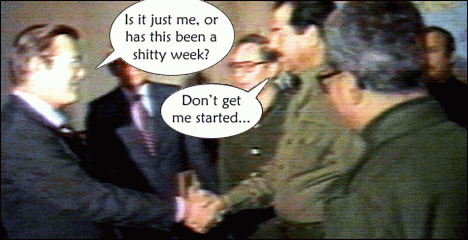
Back in the 1980s, American wanted a friendly dictator in the Middle East as a barrier against Iran, and Saddam wanted to buy weapons, including the raw materials to build chemical weapons, from American companies. It was a match made in the Pentagon, and Ronald Reagan made Donald Rumsfeld special envoy to Iraq with instructions to do everything possible to ensure Iraq didn't lose their war against Iran.

Which makes this week's events all the sweeter:

Worst. Week. Ever.

Thursday, November 09, 2006

Rumsfeld's successor

Rumsfeld is out, and Bush has named a new Secretary of Defence: Bob Gates, long time CIA man.

Naturally, he has been given a glowing endorsement :

Independent Counsel found insufficient evidence to warrant charging Robert Gates with a crime for his role in the Iran/contra affair. Like those of many other Iran/contra figures, the statements of Gates often seemed scripted and less than candid. Nevertheless, given the complex nature of the activities and Gates's apparent lack of direct participation, a jury could find the evidence left a reasonable doubt that Gates either obstructed official inquiries or that his two demonstrably incorrect statements were deliberate lies.

Meanwhile, CNN has a profile of Gates here. Pretty bland stuff, and absolutely nothing memorable.

Especially not his role in Iran-Contra, which was once considered newsworthly, but now has dropped down the memory hole.

(Thanks to Billmon.)

Wednesday, November 08, 2006

Mamas, don't let your babies grow up to be Cow Boys...

PZ Myers has the most audacious, only half tongue-in-cheek suggestion about stem-cell research yet: human clones, grown in cows.

I want to see the Pope's head explode when he sees it. I want David Cronenberg there with a camera, cackling happily.

I want the researchers to announce in a press conference afterwards that their successful experiment was funded by the Department of Defense, Sony, the Church of Scientology, and a private donor.

I want that private donor to be Paris Hilton, who, on accepting her cooing new clone baby, declares that she just didn't want to go through that icky pregnancy and labor stuff. "It isn't haaawt," she'd say.

I want 100 million women to sit up and say, "What? I could outsource the nausea and bloating and pain and stretch marks and episiotomy to a cow? Sign me up!"

I want the phrase "family farm" to acquire rich new meanings. I want to see Bible Belt politicians lobbying for new fetus farming subsidies.

I want gay men to rejoice, and become the primary market for this procedure.

I want to hear snooty young bluebloods declare cows déclassé, and that they'd had their little Brittany gestated in a Kentucky thoroughbred.

The scientific/biological problems aren't simple, but still... exploding Pope heads. Shweeeet!

And from Pharma Bawd in the comments:

Of course, the big groups who are against stem cell research are already against this sort of animal-human hybrid. But wouldn't it be interesting if we transferred the cow nucleus into the human cell at the same time we transferred the human nucleus into the cow cell? Then we could play a version of three-card-monty:

"Where's the soul now?"

US Congressional elections

My prediction?

Despite all the polls, despite all the voter dissatisfaction, despite Iraq, the Republicans will manage to hold on to control of Congress. Karl Rove will, once again, pull a rabbit out of the hat and find a "miracle".

And, yet again, the mainstream US media will be utterly, completely uninterested in widespread evidence of voting fraud, both electronic and the old-fashioned sort of dirty trick.

The one thing that might save the day for democracy is an unexpectedly high number of electronic voting machine glitches, causing some polling stations to resort to paper ballots. (Although, more often it just caused frustration and delays... hmmm, I wonder where these glitches are happening...)

=== Update ===
Seems I may have been too pessimistic. The results coming in at Talking Points Memo suggest that the Democrats might grab control. See post 010948 and up.

Still, even if the Dems win, it won't be a sea-change. They'll still be committed to running Iraq as an American puppet state, still committed to corporate corruption, still committed to giving tax breaks to polluters, still committed to letting religious extremists set the political agenda. The best we can hope for is a return to Clintonesque America, which was no picnic if you weren't rich and white (or just mega-rich).


=== Second update ===
It looks like the election was a rout. There's Republican blood running in polling stations all over the country (figuratively speaking), and there's every chance that the Democrats will have control of both Houses of Congress for the first time since Jimmy Carter.

Oh man, I have never been so happy to be wrong! Even if it doesn't usher in a new Golden Age of peace and love and justice for all, it is a great sign that Americans haven't completely turned to the dark side.

Monday, November 06, 2006

Thought of the day

Courtesy of Mrs Impala, who is using the LookXP theme with icewm on her Linux PC:

It is easier for a rich man to pass through the eye of a camel than for an end user to find the fraking text editor in the Look XP "aplications" menu.

Well, actually she didn't say fraking, but I've been watching a lot of Battlestar Galactica lately.

LookXP, for reasons which presumably made sense to a programmer who had never actually used a PC, grabs all the KDE and Gnome "Start Menu" items (many dozens or hundreds of items, split over a dozen or so submenus), merges them, shuffles them, sorts them according to the phase of the moon, and dumps the entire listing of hundreds of applications into one enormous scrolling menu.

Putting a bad interface into a graphical menu doesn't mean you have a good interface, it just means you have a bad interface in a graphical menu. I don't know what that's so hard for a certain kind of developer to understand.

Sometimes a quote says it all

With friends like this guy, free-thinkers hardly need to say a word.

Reverend Ray Mummert is a paster from Dover, PA. During the 2005 Dover School Board controversy, creationist Mummert was quoted as saying:

"We've been attacked by the intelligent, educated segment of the culture"

Sometimes the fish just jump outta the water to grab the hook...

Sunday, November 05, 2006

Fifth of November

Remember, remember the fifth of November,
The gunpowder, treason and plot,
I see of no reason why gunpowder treason
Should ever be forgot.


V for Vendetta

Friday, November 03, 2006

Stories in just six words

Wired has a collection of short stories written by science fiction, fantasy and horror writers. These are seriously short stories: just six words each.

Some of them are actually quite good. But they aren't stories. A story has a beginning, a middle and an end; a story has a plot, and one or more protagonists. These don't have any of those elements, not really. But they do communicate something, perhaps not a plot, perhaps an event or a feeling or an image. In just six words, they paint a picture in words.

Or, to put it another way:

Six words. Not story. Word picture.

I'm no statistician

I'm no statistician, but I'm pretty sure this is correct:

pacman chart

(Click image for larger view.)

Shamelessly stolen from here.

I need a word

I need another word for minimise, but I'm not sure whether lessenate or smallify best captures the connotations of minimise.

Thursday, November 02, 2006

The illusion of choice

Like many children of the 70s, I was raised on a diet of American cartoons. Despite being one of the least funny or entertaining cartoons I've ever seen, I strongly remember a Warner Brothers cartoon where a sophisticated city mouse took his country bumpkin cousin to meet a professor mouse. In between being chased and almost eaten by a cat, Herr Professor Mouse taught bumpkin mouse all about supply and demand, capitalism and the free market. Ho hum.

And yet, a quarter of a century on, I still remember it.

The cartoon was made in the glory days of post World War Two America, when it looked like capitalism and the Free Market would usher in a paradise on Earth. Naturally, one of the biggest selling points to the new middle class (or at least working class with disposable income) was the ability of capitalism to provide consumers with more choice.

Unfortunately, much of that choice is illusionary, as Michael O'Hare explains.

However, the potential variety of inventory in most big stores is an illusion, and the less specialized they are the more this is true. Take CompUSA, which does have a presence near you, and many thousand square feet of it. CompUSA has a computer that watches sales like a hawk, and ruthlessly prunes slow-moving items, so the large rack of cables actually has no specialized or rare ones, but twenty hooks with the same five fast movers, the cables you already have two or three of . If you want something the least bit arcane, you are out of luck, because the maximum straight-face selling price of a special item does not capture its real value to the customer. I believe CompUSA no longer stocks any SCSI cables in its stores at all, though it has every known brand of blank CD in five different package sizes each.

Of course in general we have more choice today, thanks to free markets, than (say) the old Soviet Union could offer its citizens. But much of that choice is trivial: in Australian supermarkets I can can choose between twenty different brands of soap offering fifty nominally different scented soap, but most people would be hard pushed to really tell them apart and there is not one unscented soap amongst them.

Free markets don't necessarily lead to freedom of choice, and that freedom of choice is vulnerable to supply-driven changes, leaving demand unfulfilled or removed.

A classic example of this was the appalling and limited food in the UK for much of the post-Industrial Revolution period. The need for cheap food which could be stored for long periods to feed the city workers quickly lead to a reliance on cheap, stodgy, bland (apart from salt, sugar and grease) preserved foods. Canning technology accelerated the process, leading to a generation which neither had the ability nor the wish to buy varied food, which destroyed demand. Reduced demand caused even less supply, and so on 'round the vicious circle the British went. Only the upper classes had the ability or desire for "exotic food", and even then the limit was French for the real nobs and Indian for those who had served in the subcontinent and got a taste for it.

Only the post-WW2 influx of migrants who refused to give up their traditional foods broke the vicious circle.

The ever-increasing concentration of retail sales in the hands of a few near monopolies risks repeating the British experience, but not just with food. O'Hare's example is with hardware; other examples are easy to find. There is a paralysing choice of (say) cars out in the market, but they are virtually all the same. The choice is between the green jelly mould or the red jelly mould with the pizza tray (spoiler) on the back. But where is the real innovation and real choice? A few smart cars, a few giant gas-guzzling Hummers for idiots, and that's it.

Fear the awesome power of lutefisk

An oldie, but a goodie:

If you can taste the difference between caviar on a cracker and ketchup on a Kit-Kat while blindfolded, you have not had enough aquavit to be ready for lutefisk. Return to step one.


From http://www.ecst.csuchico.edu/~atman/ic/lutefisk.html.

Sunnis and Shiites

Out of the horror and bloody chaos of Iraq is a sign that moderate Shiite and Sunni Muslims are moving closer together against the radicals.

Recently, Saudi Arabia sponsored the Mecca Declaration, a joint ruling from Iraqi Shiite and Sunni clerics forbidding Muslims to shed the blood of another Muslim. Naturally enough, the radicals aren't paying any attention to the ruling. But the ruling is still significant. As Juan Cole writes:

Be that as it may, the declaration is historic. According to al-Sharq al-Awsat [Ar.], it maintains that the differences between Sunnis and Shiites are a matter of personal interpretation (ta'wil), not a difference over basic principles (usul). To have such a declaration sponsored by Saudi Arabia, which adheres to the Wahhabi branch of Islam that was historically negative toward Shiites[,] is a conceptual revolution. The statement has implications for Sunni-Shiite relations in Saudi Arabia, Bahrain, Lebanon, Syria, Yemen, Afghanistan, Pakistan, etc.-- not just in Iraq.

Events in Iraq demonstrated that Western Powers could use the Sunni-Shiite divide to help overthrow governments, dominate major countries in the region, and even break up whole countries. The regional elites are increasingly deciding that Sunni-Shiite ecumenism is necessary to avoid more of these disasters.

In times of crisis, the black-and-white knife-edge clarity of vision offered by fundamentalists and radicals is attractive, but crises eventually pass, even the most red-hot tempers cool, and people get sick of the killing. Despite our flaws, we are a cooperative species -- mostly. We talk, we engage in dialog and compromise.

After every generation of bloodshed, there is a generation that is less radical, more interested in butter than guns, willing to talk and trade, and prepared to reconcile their differences with yesterday's enemy. The tragedy of Homo sapiens is that we are so rarely able to learn from our errors before repeating them, but learn from them we do, for a while.

But not if you are working for the Bush administration, where it seems that ignorance and inability to learn from history is a job prerequisite. As Billmon reports, even the top people charged with dealing with the Middle East terrorism threat are ignorant of the differences between Shiite and Sunni:

Let's review. We have:

  1. The head of the FBI's national security branch

  2. The Vice Chairman of the House Intelligence subcommittee on technical and tactical intelligence

  3. The Chairwoman of the House Intelligence subcommittee charged with overseeing the C.I.A.’s recruiting efforts in the Islamic world

And they each know less -- probably much less -- about the most critical religious divide in the Middle East (the same one that is currently getting U.S. soldiers killed at the rate of about three a day) than your average commentator at Little Green Footballs.

Billmon puts it down to the same old Imperial mentality:

Even the British, renowned for the caliber of their imperial civil service, usually operated in stunning ignorance of the people and cultures they ruled over, certainly so in the case of the Arab world. Which is probably why they, too, were so often taken by surprise -- by the Sepoy Mutiny, the Battle of Isandlwana, the Easter Rising, the Iraq revolt, Palestinian resistance to Zionism, the list goes on and on.

Wednesday, November 01, 2006

Separated at birth - Teatime and Alex

Sky One is making a two-part film adaption of Terry Pratchett's Hogfather, and it looks grand -- some real quality British actors are involved.

But they've really out-done themselves with the actor playing Jonathan Teatime, who has managed to capture the uniqueness of Teatime with a generous jollop of the iconic Alex from A Clockwork Orange.

But don't just take my word for it. Check out these twins separated at birth:

Teatime and Alex

Three post rule

One of the disadvantages of Internet communication is its tendency towards Wild West shoot-first-ask-questions-later behaviour. Regulars to any group (be it a mailing list, a Usenet group, or regular readers of a blog) often fly off the handle at the slightest provocation, jumping down the throats of newcomers for the smallest infraction of the unspoken rules.

PZ Myers of Pharyngula has a rule to manage this problem, which I call the Three Post Rule: nobody is to attack anybody else even if they say Jehovah until they have been given three posts to clarify their ideas.

PZ gives a hypothetical example:

  1. Stranger: I think all women are chattel.
    Old hand: Pardon me, friend, but are you using humor, irony, sarcasm, or satire? Are you perhaps about to expand on a deeper philosophical point?

  2. Stranger: No, I just think women are meant to serve my needs.
    Old hand: This sounds like a most unfortunate and disagreeable belief. Why should you hold such a demeaning attitude?

  3. Stranger: Because the Bible, which is the literal word of God, tells me so.
    Old hand: [Smashes whiskey bottle over stranger's head. General brawl commences.]

Democrat hoax revealed!

Thank goodness for reasonable conservative Jon Swift, who has discovered a shocking, despicable conspiracy by the Democrats to make President Bush seem like a liar over whether or not his Iraq policy has ever been to "stay the course":

As a rebuttal to President Bush's statement that his strategy in Iraq has never been "stay the course," Think Progress offered six links to purported statements the President made over the last two years saying that we should "stay the course." Every one of these links went to the same website, whitehouse.gov. The site claims to be the "official" site for the President but of course anyone could set up a spoof website and make such a claim. A "whois" search gives no information about the anonymous owner of this domain. But if you search this site on the Wayback Machine at the Internet Archive you discover something very interesting. Take a look at what the site looked like in 1997. Before it claimed to be the "official" site for the Bush White House, this site was actually a brazen propaganda arm of the Clinton Administration!

To see the depths of Democrat perfidy, visit the Think Progress website.

Leave nothing but footprints

If humanity disappeared today, how long would it take for all traces of us to disappear? Suprisingly little time.

Doom timeline
Click image for larger view.

I could argue with some of the details from the timeline. E.g. endangered species begin recovering "immediately"? That's simplistic thinking -- sure, the immediate pressure on them will be reduced, but they still have to survive the years or decades it takes for their habitats to recover.

Similarly, it is foolish to imagine that methane will disappear from the atmosphere in the short term. So long as there are vast prairies and savannahs with vast herds of grazers, there will be methane. And don't forget the fungi and termites.

But despite these flaws, it is humbling to realise that virtually all traces of humanity would disappear after a mere fifty thousand years. After 200,000 years, even the most stable of man-made chemicals will have decayed or transformed. With the exception of some of the more long-lasting radioactive waste, in less than a quarter of a million years there won't be a sign we ever existed. We'd be lucky to even leave a fossil or two. Possibly the last trace of humanity could be a few footprints and pieces of machinery on the Moon.

It took about a quarter of a million years to go from Homo erectus to Neil Armstrong on the moon, and it could take the same again for virtually every trace of humanity to disappear from the Earth. Half a million years from appearance to disappearance. It gives you pause for thought to remember that life on Earth is about four billion years old, old enough to have seen eight thousand non-human civilizations rise, fall and disappear. There is no evidence for any of these, and good (well, moderately good at least) reason to expect that there were none, but if there were, chances are we wouldn't know.

(Original source of the timeline: http://www.treehugger.com/files/doom_1.php)

Children's Discworld books

I'm always amazed at readers who see Terry Pratchett's Wee Free Men and The Amazing Maurice And His Educated Rodents (to name just two) as children's books. I understand why the publishers choose to market them to children, especially Maurice. That's just marketing, and nobody expects marketing to reflect actual reality, merely commercial reality.

But it is the Discworld readers who make the same claim that perplex me. Have they actually read the books with their eyes (and minds!) open? Or just the blurb on the back? I just don't see that there's anything light about these books -- they are equally grown-up as the "adult" Discworld books. They contain the same major themes, the same tight plotting, the same quality of story-telling, the same ethical issues. There's nothing childish about A Hat Full of Sky or Maurice.

Sure, the main protagonists are children, or animals, rather than adults; the novels themselves are shorter, and divided into chapters (all the better for parents to say to their children "I'll just read to the end of the chapter", according to PTerry himself). Mere details. The heart and soul of the books are every bit as grown-up as Carpe Jugulum or Night Watch, just packaged in a more child-friendly format.

Long novels aren't just for grown-ups (witness the popularity of Lord of the Rings amongst children), nor are short novels just for children. If adults can read books where the protagonist is male or female, human or alien or robot, then why can't they read books where the protagonist is a child? We've all been children at some time in our life (with the exception of Mrs Impala, hat hat hat), but not all of us have been grown-ups or robots.

The protagonist of Wee Free Men, Tiffany Aching, is just nine in elapsed years, but much older in uncommon sense. Book reviewers, librarians and parents who don't look beyond her chronological age say Wee Free Men is a children's book. I say, a fie on them! Pratchett's shorter novels aren't children's books at all, they are stealth adult fiction wrapped in the format of children's books, suitable for children of all ages from 7 to 77.

Web of mystery

    "Not only is the universe stranger than we imagine, it is stranger than we can imagine." -- Sir Arthur Eddington.


Recently a 60 acre (24 hectare) field in British Columbia became home to millions of tiny spiders which spun an enormous, 60 acre web. Biologist Brian Thair was quoted as saying:

"It was astounding to see," he said. "I couldn't believe my eyes. From two kilometres away it looked like a sheet of wet aluminium. It was the size of several city blocks. I have never in my 30 years as a biologist seen anything like this, in terms of quantity of spiders and quantity of web. Nothing even remotely approaching this."

I still aten't dead

I've been busy, not dead. Nothing terribly exciting. Move along, nothing to see here, go read some of my other posts.