Wednesday, September 27, 2006

How To Switch To Windows

Over the last four or five years, there has been a virtual flood of journalists, familiar with Windows and little else, who have tried to migrate to Linux. Generally they fumble ham-fistedly with the system for a few hours or days, then self-importantly declare that Linux isn't ready for the desktop.

Long-time Linux user Matthias Endler decided to go the other way. As a Linux user, how easy is it to migrate to Windows?

I’ve heard of a new Operating System called Microsoft Windows the other day and wanted to give it a try because it is said to be easy to use and intuitive. Unfortunately the author offers no live-cd to test everything before I have to install. Instead of downloading it from the Internet as I always do I had to go to the computer store and buy it for a price of €150. There is also a so called "Professional Edition" but it would cost even more. [...]

[...] The Internet Explorer doesn’t have a popup filter and seems to attract ads and after fifteen minutes my taskbar looked like a battlefield full of spam. I had to close every window manually. My former Browser Firefox had tab-functionality included but IE seems to have own browsing rules and standards. But that was just the beginning: When I wanted to chat with my friends I found out that Windows Messenger doesn’t support ICQ, AIM, TOM and Jabber. I was forced to create a so called MSN-Account to continue but I refused.

(Sometimes the author's language is a little clumsy, but I believe English is not his native tongue, so a little understanding is in order.)

Beyond the satire, there are a couple of serious points: complaints that some system or another is not easy to use often merely means it is different from what the complainer is used to. Ease of use often also focuses on making simple things easy to do, at the expense of making complicated things impossible (or at least very difficult): a hammer is easy to use, but if you are used to having access to a complete tool box, having to use nothing but a hammer makes things harder to do, not easier.

Vancouver's drug policy

Salon reports on Vancouver's harm-minimization program for drug users. Three years ago, infectious disease was rampant amoung Vancouver's addicts, with diseases like hepatitis and AIDS at risk to spread to the wider population. The streets were littered with discarded needles and trash, and sometimes corpses: an average of three people died in the streets from overdoses every week.

But since Vancouver started the Insite legal injecting room program, things have turned around radically. The streets are cleaner, disease is under control, people are no longer dying, drug use in the streets is reduced and the number of addicts seeking help and entering rehabilitation programs has increased.

A banker by trade, Allen was helping run a community campaign to secure Insite's future. "Just seeing the renewed optimism of the neighborhood has been amazing," he told me. "It's been a dramatic change over the last three years. I remember a person dying almost every day out here. One of your neighbors was always in mourning."

[...]

Rising support for the policy north of the border agitated Washington. Shortly after Insite gained Canadian federal approval, President Bush's drug czar, John P. Walters, slammed the program as immoral. "There are no safe injection sites," he declared, calling Vancouver's policy "a lie" and "state-sponsored personal suicide."

Since Insite opened, there has not been a single death inside or connected to the facility among the more than 7,200 individuals who have used it -- including at least 453 people who have overdosed.

Unlike American conservatives, who often act as if it is their personal mission from God to see to it that as many people die from drug abuse as possible, many of the initially skeptical Canadian conservatives have been won over by the success of the programme. Even the police like it, as it helps keep the streets safe and frees them from harrassing two-bit junkies, giving them more time to go after the major dealers.

"I guess you see what you see," [the officer] said. I mentioned how different the area appeared to be since my prior visit, which elicited a sliver of a polite smile. "It's a lot better out here now," he said.

"I think the police often feel like they're shoveling water in terms of street-level dealers," said West, the Insite coordinator. He suggested the police were more interested in focusing on bigger drug traffickers operating in the city. In the neighborhood around Main and Hastings, more critical to the police department's role in the harm-reduction strategy is maintaining public order and safety. "They're really quite supportive of the site," West added. "They know it's another tool that helps them do their job."

"If somebody's dealing drugs right in front of an officer, I can assure you they'd be dealt with," said Constable Howard Chow, speaking by phone from the public affairs office of the Vancouver P.D. He noted that the squad assigned to the Downtown Eastside, one of the city's most volatile sectors, regularly conducts surveillance and sweeps to bust dealers. But he acknowledged there were priorities. "Is simple possession as harshly looked upon as trafficking, for example? No. Those officers are often inundated with calls down there. We use the resources where they're most needed." He added, "We support the site in terms of the medical research, and helping see that through for its potential benefits. We don't comment on the right or wrong of it -- that's not up to us."

Nor has the programme lead to an increase in robberies and other crimes, as conservatives initially feared. Instead, many property crimes decreased.

Another major plus is the savings to the healthcare system. Preventing just twelve addicts from contracting AIDS will pay for the programme's operating expenses for a year.

Despite all the scientific evidence that safe injecting rooms reduce the harm of drug abuse, people still worry about "the message" it sends.

There are other, less tangible considerations that can stand in the way of opening a safe injection site. "Plenty of people are going to feel like it sends the wrong message about a neighborhood," said Mark Kleiman, a former policy director in the U.S. Department of Justice who now heads the Drug Policy Analysis Program at UCLA. "Would you want one of these next door to you?"

Still, Kleiman says the potential benefits are undeniable. "Nobody's going to start using heroin because you've opened a safe injection site. Assuming you can keep crime in control, I don't see much downside," he said. "But there is a big upside in terms of public health and public order -- I'm not surprised this has worked well in Vancouver. So is it a good idea for us to try this? Certainly."

[...]

The Bush administration has often spoken of a "compassionate conservative" approach to social crises, but has emphasized only so-called faith-based and abstinence programs. Might they look at the results in Vancouver and consider exemption from federal drug laws for city governments under siege from drug-related disease and urban blight?

"Don't be ridiculous," Kleiman said flatly. "They're completely unserious about drug policy. It's an issue that's all about liberal-bashing to them, and playing to their base. I haven't seen them do anything counter to their own prejudices just because the science says they should."

Despite multiple calls seeking comment on Insite's results and legal status, Walters and the White House Office of National Drug Control Policy did not provide any response.

Community leader George Chow, now a city councilor, initially opposed the programme, running as an independent on a campaign of opposition to the injecting site.

Three years later, Chow has changed his mind:

"It was a fear of the unknown -- people were afraid such a facility would bring in more chaos," Chow said, speaking by phone from his office at City Hall. "After three years that has not happened, even with an increase in the homeless. Without this facility the drug problem would have been far more out of control. There would be an even bigger problem with HIV transmission and other issues."

Chow spoke with measured but unambiguous praise of the program. Insite has had a huge impact on the neighborhood, he said, though it certainly hasn't solved all its problems. "There is no easy solution," he said. "I think a lot of people still look at this as a moral issue, and it's challenging -- but as a councilor, I believe we have to do all we can to deal with these health and social issues. This is most important, to work toward practical solutions."

And what of other drug hubs such as Toronto and Montreal? "I would advocate for a national plan, with more facilities like this in other cities," Chow said. "Not just an injection site, but also including treatment and education programs. This, of course, requires more money and resources."

Tuesday, September 26, 2006

Windows XP -- if we only knew then

The Washington Post discusses Windows XP's upcoming fifth anniversary, and notes that if Microsoft knew back in 2001 what it now knows, it would (should have?) delayed the release of XP to fix a lot of major problems.

This operating system has needed a steady diet of patches to stay close to healthy. On a machine with a September 2001-vintage copy of Windows XP Home Edition, installing every bug-fix released as of August ballooned its Windows directory from 987 megabytes to 2.43 gigabytes.

You can think of Windows XP as a house with a second floor built of spackle, wood filler and duct tape.

And even with all those updates, the operating system has met only a few of its goals while falling short of others in a catastrophic manner. And it's done so for reasons that can't all be blamed on XP's design or Microsoft's own actions. That, in turn, means that its long-delayed replacement, Windows Vista -- now due to ship in January -- may run into the same problems.

[...]

Software that looks ugly can work ugly, and XP has been too forgiving of that as well. The operating system has done little to ensure that programs move in and move out in an orderly manner; they can throw supporting files and data all over the hard drive, then leave the junk behind when software is uninstalled. As a result, something that should have been fixed in Win 95 -- the way Windows slowly chokes on the leftovers of old programs -- remains a problem.

Microsoft also did nothing to make the system registry -- the collection of settings that constitutes a single, system-wide point of failure -- less of a nightmare. It should have slain that dragon five years ago, instead of waiting to move away from it in Vista.

Microsoft did get one aspect of system maintenance right in XP -- software updates -- although it needed to ship a major system patch first. With the changes that Service Pack 2 brought in August 2004, you don't have to touch a single setting to have Windows get the latest fixes for you.

But Microsoft has had trouble getting users to trust its automatic updates. Some of the suspicion can be understood (remember how Microsoft installed its "Windows Genuine Advantage Notifications" anti-piracy software through this mechanism), but it becomes self-defeating when people keep copies of XP in a less-secure state because they think somebody in Redmond is out to get them.

[...]

The root problem is XP's inability to police the conduct of any program. Its default "administrator" setup grants the user and every application the run of the entire system.

That's why each new Windows-transmitted disease -- such as invasive spyware like Aurora or MoviePass.tv -- is so hard to eradicate. The only guaranteed cure for such infections is to reformat the hard drive and reinstall everything from scratch.

Monday, September 25, 2006

Hoodwinked Americans

Glenn Greenwald, writing for Salon, asks why it is that 31% of Americans still believe that Saddam Hussein was behind the September 11 attacks, even after President Bush has publically admitted that he had absolutely no connection at all with the attacks?

"Because they're stupid" is too pat an answer. Yes, many of them are just dumb, but even dumb people can follow the bouncing ball. The President has admitted that Saddam wasn't involved, why won't people listen?

(Not that he would admit making a mistake -- no, the story now is that nobody ever suggested Saddam was involved, no sir-e, Bush has no idea where people got that ridiculous idea. Maybe the terrorists suggested it.)

Still, even if almost one third of Americans believe this falsehood, things are much improved compared to September 2003 when 69% of the country was convinced that Saddam was behind the attacks.

What does it say about the potency of the Bush administration's propaganda abilities that this myth was believed by so many Americans in the first place, and that it still endures quite vibrantly? And is there any more potent evidence of the profound failure of the American media to fulfill its central function of informing the citizenry and exposing government falsehoods than the fact that America went to war while most of the country believed this fiction, and that almost one-third of Americans continue to believe it? Regardless of one's ideological orientation, shouldn't it be considered highly disturbing -- to put it mildly -- that such a large percentage of the electorate believes in rank fiction with regard to such critical matters?

The Bush administration can't take all the credit, or blame, for the endurance of this lie. There are deeper things at work. After all, it was just a few months ago that a poll showed that 30% of Americans couldn't remember what year the 9/11 attacks happened.

That's right. Just shy of five years after September 11 (the defining moment of the last half decade, the day "everything changed") and almost one third of Americans didn't know what year it happened. (It is too much to hope that it was the same one third that believe Saddam was the mastermind behind the attacks.)

6% gave an earlier year, 8% gave a later year, and 16% admitted that they had no idea whatsoever. An additional 5% couldn't even name the date and month correctly.

The real reason for the Iraq invasion

Raising McDonalds

GPL wins another court battle

So much for all those people who insist that the GPL has never been validated in court. The GPL has just been upheld again, in Frankfurt, where D-Link got slapped for breaking copyright law by failing to live up to the GPL.

On September 6, 2006 the district court issued its judgement, confirming the claims by gpl-violations.org, specifically its rights on the subject-matter source code, the violation of the GNU GPL by D-Link, the validity of the GPL under German law, and D-Links obligation to reimburse gpl-violations.org for legal expenses, test purchase and cost of re-engineering.

More details here.

Batteries, airlines and security

Pilot Patrick Smith, writing for Salon, points out that the airline security rules for batteries and laptop computers make good sense, and asks why so many of the other airline security rules make so little sense.

Smith points out that laptop batteries are a serious fire risk for airplanes. This isn't a hypothetical risk: pilots fear onboard fire more than almost any other accident, and planes have crashed from fires. Batteries used by Dell and Apple laptops have recently been catching fire -- a frightening nuisance on the ground, a deadly danger at 10,000ft. Consequently, when airlines banned or put restrictions on laptop batteries, the restrictions are based on real risks.

The same can't be said for other security measures used by the airports. Chicken Little rules airport security there, creating ineffectual, pointless and invasive "security" acts to pretend to defend against pretend dangers. With all the sound and fury, it is frightening just how ineffective it all is: despite all the baggage checks, despite sniffer dogs and strip searches and all the rest, one month ago yesterday a 21 year old student flew home to the USA from Argentina with a souvenier stick of dynamite in his baggage. (What was he thinking? Oh wait -- male, 21, student -- he wasn't.) The dynamite wasn't discovered until after the plane landed in Houston.

In response, security at Argentinian airports was tightened. Have they increased the number of sniffer dogs checking baggage? There is no evidence they have. Instead, once again small safety scissors are being seized from people's carry-on luggage, even though the American Transportation Security Administration (TSA) allows scissors with rounded tips.

Smith notes:

Because a person smuggled dynamite inside a checked suitcase, we're going to take kiddie scissors and tiny cans of shaving cream from your carry-ons. That sounds suspiciously like TSA thinking, so I have to wonder who, exactly, has ordered up this rigmarole? Was it Argentina's call, or have America's homeland security wizards asked foreign airports to enhance their inspections? (Later, when I try to find out, nobody in Washington or Buenos Aires returns my calls or e-mails.)

Smith points out the sheer craziness of the ban on liquids:

Before heading over to be frisked and wanded, I notice the man has taken my shaving cream and placed it on the floor with a small pile of similar contraband. You'll see this same thing at airports in America: heaps of shampoo, toothpaste, soap, bottled water, cups of coffee, jumbled into bins to await disposal. Logic would dictate this material needs to be carefully removed and destroyed. After all, it's potentially hazardous. If you're taking somebody's shaving cream, the presumption has to be that perhaps it's not shaving cream after all, but instead something dangerous. Otherwise, why is it prohibited? And some of those liquid bombs we've been hearing so much about are concocted from highly unstable chemicals, meaning they need to be handled very carefully.

So what happens to this stuff? Does the bomb squad come in every evening and cart it away in steel casks? Don't be ridiculous. It's hurled into the trash. The line of reasoning goes like this: We already know these items are harmless, but we're going to take them anyway. Later, after you leave, we will dump them down the drain.

Are you feeling safer?

Millions of sheeple across the US are, completely oblivious to that every growing pile of supposedly deadly liquid explosive right next to the line they are standing in. What's important is that the TSA does something: confiscate scissors that couldn't cut paper, seize cups of coffee, or stick their finger in their ear and cry "Wibble wibble wibble!", it is all the same to the half-wits who can't distinguish between doing something and doing something right.

In another column, Smith pointed out yet another example of stupid security theatre:

For instance, TSA's new carry-on rules aren't just stupid, they are so stupid that it's hard to believe the agency hasn't yet been called to the carpet. As I learned a week ago traveling to San Francisco, not only is it forbidden to bring a beverage through the security checkpoint, it is forbidden to bring a beverage that has been purchased in the secure zone onto a plane. The lack of logic is absolutely maddening: If somehow saboteurs were able to get a workable liquid explosive into the gate-side Burger King, and from there into the hands of a passenger accomplice, could they not do the same with other forms of explosives -- or for that matter with knives, guns, pipe bombs and bags of anthrax? Airlines have begun making public address announcements encouraging passengers to finish their drinks in time for boarding. The sight of businessmen, clustered at the mouth of the boarding bridge, gulping down coffee at final call was equally amusing and pathetic.

Just how invasive, expensive and pointless will this faux security have to get before the American public and airlines will grow some backbone and follow the lead of British and European airlines?

Me, I'm betting nothing less than compulsory strip searches and straightjackets for all passengers will do the trick.

The people you see in the big city

First, there was the young lady, 20-ish, with an obviously fake blonde dreadlock wig that looked all the world like an alien facehugger on her head.

Then there was the 30-something woman dressed in clothes that looked like a paedophile's wet dream. If she had been 17, she might just have got away with wearing them.

And then there were the two oh-so-daring goths, he with his oh-so-radical inverted cross around his neck, her with her nihlistic tee-shirt reading "Death is our future".

And last but certainly not least was the power-suited business man, looking like a cross between Gordon Gekko and Donald Trump on his way to a hostile takeover of an orphanage, walking a miniature poodle.

I saw all these people in the space of less than a city block.

Iraq for Sale

At a time when America is sending its sons and daughters to fight for freedom, nothing is more important than their ability to do the job right. Right?

Not in Iraq, where America's Czar George II has presided over levels of treasonous corruption at levels not seen since the Russians fought the Crimean War.

From charging the US military $100 to ineptly wash a bag of laundry (and getting officers to reprimand soldiers who do their own laundry in the sink) to overseeing interrogation at Abu Ghraib, these military contractors are wasteful, undertrained, and grotesquely expensive. Greenwald's film features footage of bonfires built to destroy improperly ordered vehicles, computers and other equipment that the contractors purchased at taxpayer expense -- since these contractors are compensated on a "cost-plus" basis, they get paid more for wasting money than saving it.

Another are where they scrimp is on the safety and training of their own personnel. They hire inept translators who give bad intelligence to the military. They send their front-line workers -- such as truckers recruited from the US -- into battle-zones without military escorts or armor. Meanwhile, the "savings" realized by putting untrained people in charge of interrogation at Abu Ghraib (Greenwald shows a single-page "interrogation manual" that consists of little cartoons with a short sentence under each) are not used to provide better equipment for US soldiers -- they sleep in infectious tents, drink untreated toxic water, and eat improperly prepared food, thanks to the likes of Halliburton, whose stock doubles and redoubles every year the Iraq war goes on.

I'm just waiting for the day that the first grunt "frags" a Halliburton company rep by rolling a grenade into his tent hotel room.

Best sellers

PZ Myers over at Pharyngula is chortling over the UK best sellers on Amazon: Richard Dawkin's The God Delusion at #1, Terry Pratchett's Wintersmith at #2, and something called The World of Karl Pilkington at #3.

I'm fascinated to see that six days before the offical release date of Wintersmith, it has already hit #2 on amazon.co.uk. A little birdie who got her hands on a pre-release copy tells me it is perhaps the best of the Tiffany Aching books yet. To borrow a pun from an TV adaptation of an earlier Discworld novel, you might say this novel is bigger than cheeses.

Sunday, September 24, 2006

Emergency contraception and the war on women

As part of the American Taliban's war on women, it is getting harder and harder to get contraceptives of all sorts. But access to emergency contraceptives is especially hard to get, as Ohio resident Biting Beaver found:

"But see, the problem is that we have 4 doctors here right now but only one of them ever writes EC prescriptions. But see, the thing is that he'll interview you and see if you meet his criteria. Now, I called the pharmacy but I also talked to him and well....*clears throat*....you can come down and try to get it. You know, if you meet his criteria he'll give you a prescription, I mean, there's really no harm in trying." [...]

[...] "You know, you'll just have to have an interview with him and he'll see if you meet his criteria. He'll only be on duty until 2pm today though and you should ask for him if you decide to come down because he's really your only chance."

I sigh and thank him before hanging up. I know exactly what he was telling me. If I wasn't raped and wasn't married then too damn bad for me.

[...] I called every hospital in every surrounding county and none of them would prescribe me EC. Not even ONE. [...]

I found that the more hospitals and clinics and doctors I called the more ashamed I became. Yep, you heard right. I was feeling ashamed at being such an unworthy dirty whore. Well, at least in the eyes of all these hospitals and doctors and clinics. I cried, then I sweated, then I cried some more, then I called some more.

[...]

I have been asked about my sexual practices. Whether I'm 'monogamous' or 'in a relationship' if I'm married, if I have kids, how many kids I have, if I was raped or 'traumatized' but there wasn't ONE question about my health. Not one.

Thanks to BoingBoing.

That isn't to say that it is only male doctors and phamacists who are trying to roll the clock back to before safe, effective contraceptives were available. There is no shortage of self-hating women who think that sex is a sin that needs to be punished too. It was Biting Beaver's regular doctor, a woman, who refused to write her a prescription.

I've written about a similar story before.

This clearly demonstrates a particular mode of failure that free markets are subject to. It isn't common, and tends to happen only with so-called "morality" issues, but it can happen -- especially if people who hold a certain immoral viewpoint deliberately take jobs in the medical industry so they can force their immoral vision of pregnancy as punishment onto the rest of us. It needs no grand conspiracy, just a lot of like-minded people who are "trying to make a difference".

And unlike (say) vegans becoming butchers so they can preach to the meat-eaters, it isn't economically self-correcting. A butcher who doesn't sell meat for moral reasons will go broke and be replaced by a butcher who will sell meat; a chemist who refuses to sell contraceptives has a thousand other products to live off, the loss of a few products is only a small cost.

Incredibly, twenty-four percent of Ohio hospitals won't provide emergency contraceptives even to rape victims.

There was one small ray of sunshine in this lousy story: one of the blog readers wrote:

Everytime I hear a story like yours, it reaffirms my committment to see school through. I would be proud to be a pharmacist that women knew they could come to for help.

The more we shine light on the monsters, the more we encourage people to reject their toxic memes.

Windows Media Player DRM worse than ever

The Inquirer has an article about the new restrictions added to Windows Media Player.

Your DRMed music is tied to a single PC, so you can't move it. You can no longer backup your licences to another machine, and if your PC dies, or if you simply replace it, say goodbye to your music.

One thing which is interesting is a quote from Microsoft:

"If the file is a song you ripped from a CD with the Copy protect music option turned on, you might be able to restore your usage rights by playing the file. You will be prompted to connect to a Microsoft Web page that explains how to restore your rights a limited number of times."

Microsoft's Media Player will, by their own admission, take away your rights to use your own property. Can't get any clearer than that.

I'm surprised that Microsoft would admit this in such explicit, clear language. What's going on? A tiny little act of rebellion from a Microserf who hates what he's doing?

It also implies that Microsoft tracks who is playing what files. You have to ask Microsoft permission to play songs from your own CDs.

This is why people prefer to download mp3s of random quality from the Internet, even when they have access to legal content, even free legal content: because so many legal sources of music come with copy protection, digital restrictions, access control, and other methods of taking away people's control over their own computers.

Nothing up her sleeve

This is definitely not safe for work.

Magician Ursula Martinez has a twist on the old disappearing hanky trick. She makes the hanky disappear from her hand and reapper in her jacket, so she takes the jacket off. Then the hanky disappears again, reappearing in her skirt, so off comes the skirt. And so on, until there is nowhere else for the hanky to hide, thus combining magic with another of my favourite things.

Well, no clothing for the hanky to hide in.

The video clip is here, and her website is here. (Thanks to Les the Stupid Evil Bastard for the link.)

It is really simple, basic magic, but that's what virtually all magic is about: misdirection and showmanship -- or in this case, showwomanship. Literally.

Callgirl of Cthulhu

Safe for work, unless you work for Christian Taliban or Feminist Nazis. (Although the rest of the artist's website isn't necessarily SFW.)

Head of Callgirl of Cthulhu statue

Link.

One of the really impressive things about this statue is that it isn't some dinky 9" statuette, it is lifesize:

Statue and artist

Web feedback form

A friend of mine who preferred to remain anonymous passed this on to me, with permission to post it for the world to see.

He had been trying to purchase a product from Officeworks' website, but the site said it was unavailable over the Internet, only direct from stores, and to call a number to find out which stores had stock. Unfortunately, the number they gave wasn't connected.

So he tried to send them a message via a form on their website. Naturally enough, being a multi-bazillion dollar company, the software they are using is broken, and it deleted his message when he tried to send it because he didn't fill in enough information. Which led to this message being sent:

    This is my SECOND attempt to send this. The first time was to notify you that your catalog contains an error. Product ID CHH5606 says "Not available at all locations, call 13 15 05 for details" but that phone number is not connected. First rule of successful marketing: get your own phone number right.

    I'm also writing to say that your brain-damaged software deleted my message when I clicked send, just because I didn't specify my last name. YOU DON'T NEED MY LAST NAME TO ANSWER AN EMAIL. If I wanted you to know my last name, I would have told you.

    And even if you did need to know it, it is rude and stupid beyond belief for the software to delete everything I typed because I left something out. What sort of C-grade pile of crap software are you people running? You probably spent tens of millions of dollars on it too, and the moron responsible for the project probably got a promotion. What a joke.

Damn straight. In fact, according to Australian privacy legislation, Officeworks is skating on awfully thin ice if they force people to leave their name in order to make a random enquiry. Imagine doing that to a phone enquiry -- "I'm sorry sir, I can't answer your questions unless you tell me your full name."

Why is Iran so unconcerned?

Billmon has a few things to say about the possible (likely?) invasion of Iran.

He quotes Colonel Sam Gardiner about "the filter":

When I discuss the possibility of an American military strike on Iran with my European friends, they invariably point out that an armed confrontation does not make sense -- that it would be unlikely to yield any of the results that American policymakers do want, and that it would be highly likely to yield results that they do not. I tell them they cannot understand U.S. policy if they insist on passing options through that filter. The "making sense" filter was not applied over the past four years for Iraq, and it is unlikely to be applied in evaluating whether to attack Iran.


He also asks the very important question, with the USA banging the drums of war and looking to pick a fight, why is Iran acting so unconcerned?

It finally occurred to me that I may have been looking at this the wrong way. I’ve been thinking about an American air strike as the Cheney Administration's way of kicking over the table and ending the chess match. But the Iranians may see it as simply another move on the board -- a disastrously bad move they could then exploit to improve their position.

It’s not so much that the Iranians want the Americans to attack their country, but they may be fully prepared to deal with it and use it to their own Machiavellian advantage -- not just politically and diplomatically, but also to advance their alleged nuclear ambitions. They may even be counting on it. If this is correct, their initial reaction to a U.S. air strike may be surprisingly restrained.

I have to say, I've been wondering the same thing. Given Iran's ambition to be a major power, and given that the USA has made it abundantly clear that they can and will attack non-nuclear powered nations, why isn't Iran going full tilt to produce nuclear weapons? By all non-partisan accounts, Iran has no nuclear weapons program -- and yet it seems logically that they should.

Could it be that Iran was serious when they rejected the use of nuclear weapons as immoral and against the teachings of Islam? Maybe -- but surely that only holds for using nuclear weapons against civilians. That shouldn't prevent them using The Bomb against enemy combatants in self-defence, say by using a 20 KT bomb to destroy an American aircraft carrier or two.

Possibly even in pre-emptive self-defence, now that President Bush has made hitting back first acceptable behaviour.

Could it be that they know that they can't build nuclear weapons, not in the current political climate, and so are trying to turn their technical failure into a moral advantage? Maybe, but I doubt that Iran is less technically capable than Pakistan and India, and I wouldn't be surprised to learn that there were elements in China that thought that a nuclear armed Iran would be a good thing.

Billmon's post makes a lot of sense to me. It is his idea that Iran is playing a high risk, but high gain, game here: they are steeling themselves to take a bloody nose now, for a free rein in two or three years:

Having launched a massive, unprovoked attack on another country and suffered the inevitable blowback (skyrocketing oil prices, recession, disaster in Iraq, global condemnation) would the United States have the political will to do it again in one or two or three years time?

It is a long post, but one worth reading.

Saturday, September 23, 2006

Those dangerous terrorists

Billmon reminds us about those dangerous, scary terrorists locked up in Guantanamo Bay:

It's hard to picture Haji Nasrat Khan as an international terrorist. For a start, the grey-bearded Afghan can barely walk, shuffling along on a three-wheeled walking frame. His sight is terrible -- he squints through milky eyes that sometimes roll towards the heavens -- while his helpers have to shout to make themselves heard. And as for his age -- nobody knows for sure, not even Nasrat himself. "I think I am 78, or maybe 79," he ventures uncertainly, pausing over a cup of green tea.

Yet for three and a half years the US government deemed this elderly, infirm man an "enemy combatant", so dangerous to America's security that he was imprisoned at Guantánamo Bay.


It's important for Americans and others across the world to understand the kind of people held at Guantanamo. These aren't common criminals, or bystanders accidentally swept up on the battlefield -- we have in place a rigorous process to ensure those held at Guantanamo Bay belong at Guantanamo.

George W. Bush, September 6, 2006
White House Address

Book reviewers

Wandering around the Internet at random, I came across a site reviewing books in the "Alien" and "Alien Versus Predator" franchise. Here are a pair of brief extracts from two reviews. Take note that the reviewers are by the same person, on the same page. Is it any wonder that reviewers have such a low reputation?

Aliens Vs. Predator: Hunter's Planet
[...] A thrilling and compelling story about two alien monsters battling it out [...] An awesome read full of action and twists. If you liked Aliens vs Predator: War, you'll love this.

Aliens Vs. Predator: War
After years of bemoaning David Bischoff's awful AVP: Hunter's Planet, [...]

Sigh. Just... sigh.

Friday, September 22, 2006

Being good while doing evil

Remember the good old days when people remembered that you can't be good if you do evil?

Maher Arar is a Canadian citizen who was arrested by the US during a stop-over at JFK Airport on his way home from a holiday in Tunisia. Arar was, without evidence, shipped off to Syria to be tortured under a program known as 'extraordinary rendition'.

He explained what happened:

So, on the third day when they didn't find anything, third or fourth day, they -- in my view, they just wanted to please the Americans, and they had to find something on me. So, because I was accused of being an al-Qaeda member, which is nowadays synonymous with Afghanistan, they told me, "You've been to a training camp in Afghanistan." And I said, "No." And they started beating me. And I said -- well, I had no choice. I just wanted the beating to stop. I said, "Of course, I've been to Afghanistan." I was ready to confess to anything just to stop the torture.

He was held for over a year before seeing his family again.

After a two year enquiry, the Canadian government has declared Arar an innocent man, with the judge who led the enquiry blasting the US government for sending him to be tortured in Syria. He also criticised the faulty and misleading information given to the US by Canadian authorities.

With Arar in the news in the USA, the religious right is standing firm on their conviction that torture is nothing to be ashamed of. Of course, don't actually call it torture -- even these moral weasels aren't so degenerate to come out and be honest about what they want. Instead, they mince words and talk about "alternative interrogation techniques", and pretend to be confused about what torture is. They've even suggested that Republican John McCain, who actually has been tortured while a prisoner of war, should tone down his opposition to the practice if he wants to win elections.

If torture was really acceptable, why be so shy about the fact that they use it? The Gestapo and the KGB was never shy about their use of torture.

Wisco from Griper Blade has this to say about those who have thrown their lot in with torturers:

Here's what I think of those who favor torture of terrorist suspects -- they are, to a man, cowards. They have no principles, no morals, only a concern for themselves and their safety. They are the same fools who'd throw out all of our rights to 'protect our freedom', while either forgetting or willfully ignoring the fact that, with every right we lose, we become less free. They don't stand for the principles of freedom and liberty -- no matter how easily those words spill out of them when you poke them. They'd rather live as prisoners than expose themselves to even the slightest risk of dying as free people.

[...]

They can argue that torture makes us safer, but how safe can you be said to be when your government can whisk you off to a secret prison for an indefinite period of abuse and human rights outrages? And do it without any trial or any appeal. Once you get your finger caught in that secret prison machine, you literally enter into a lawless system in which you have no rights at all. Think about it -- there is nothing to prevent this from happening to pretty much anyone. No safeguards, no oversight. How safe does that make you?

Oh the irony

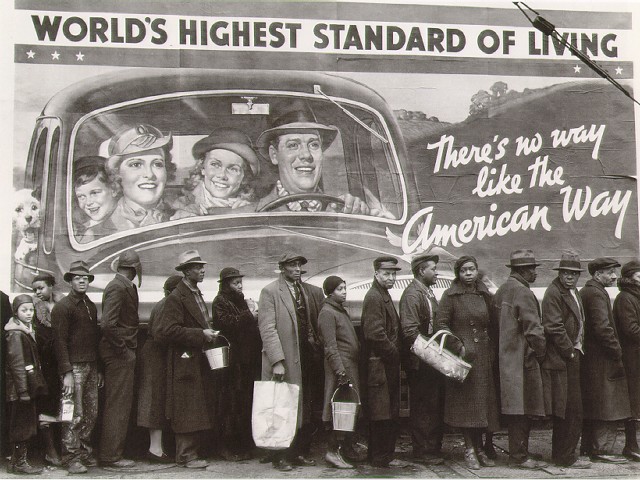
This 1937 photo by Margaret Bourke-White of a breadline in front of a triumphant "American Way" poster shows the irony of American claims of economic supremacy -- especially for blacks and other minorities.

There's No Way Like The American Way
(The photo was taken in the aftermath of the Louisville flood, but scenes just like it could have been repeated in thousands of places every day throughout the Depression.)

Scan courtesy of Masters of Photography.
Source here.