Wednesday, November 29, 2006

Outsmarting the torturers

One of the often-repeated arguments in favour of torture is that, without it, We[1] can't convince Them[2] to tell us what they are planning to do. Without torture, how can we gather information to fight those who would harm us?

The assumption is that information we gather via torture is trustworthy information, useful to know. But is that the case?

A report in the Guardian shows that not only is the information gathered through torture suspect, but it can actually be counter-productive. A dedicated, self-sacrificing individual can out-smart the torturers and actually game the system -- and terrorist groups have no difficulty recruiting dedicated, self-sacrificing individuals.

According to "Omar Nasiri" (a pseudonym), a double-agent who has been secretly spying on al Qaeda for seven years, the al Qaeda operative Ibn Sheikh al-Libi successfully planted false information to US interrogators, telling them that al Qaeda had been training Iraqis.

Libi was captured in November 2001 and taken to Egypt where he was allegedly tortured. Asked on BBC2's Newsnight whether Libi or other jihadists would have told the truth if they were tortured, Nasiri replies: "Never".

Asked whether he thought Libi had deliberately planted information to get the US to fight Iraq, Nasiri said: "Exactly".

Nasiri said Libi "needed the conflict in Iraq because months before I heard him telling us when a question was asked in the mosque after the prayer in the evening, where is the best country to fight the jihad?" Libi said Iraq was chosen because it was the "weakest" Muslim country.

It is common sense that, whatever your enemy wants most, you should try the hardest to deny to them. But common sense is obviously not very common amongst the chicken-hawks of the American neo-con movement. Osama bin Laden was desperate for a war of civilizations between the West and Islam, and instead of denying him that war, the US has virtually handed it to him on a platter by invading Iraq. And let's not forget that Iraq, with its secular government, legal protection of non-Muslims, and women's relative freedom, was one of the few examples of an Arab nation that wasn't ruled (implicitly or explicitly) by the mullahs, and hence one of the targets of bin Laden's hatred.

Five years after Sept 11, Osama bin Laden has fooled the Americans into overthrowing Iraq's secular leader. Anger and hatred against the West is greater than ever. Bin Laden might have sacrificed a few thousand men in Afghanistan, but he's gained something far more important: a war between cultures and one of the most significant nations in the Arab world under the sway of the Mullahs. Even if they aren't necessarily bin Laden's Mullahs, the US has destroyed a secular nation that kept church and state separate and replaced it with one that has the two intimately connected.

I don't mean to exaggerate al Qaeda's victory -- the war certainly isn't going all their way. In the chaos of Iraq, there are many armed parties, and according to credible information from the CIA, less than 4% of the fighters owe allegiance to bin Laden.

But instead of opposing bin Laden's wishes, the Bush administration has spent the last few years handing him just what he wanted. The incident with Libi shows the sort of judo al Qaeda uses: use your enemy's strength against them.

But the tactical significance is that information gathered under torture is not only immoral (more for what it does to us than out of any goody-goody concern for the health and well-being of any specific man who would cheerfully stick a knife in us in a second) but it is also useless. It is untrustworthy information. If the Libi incident was not evidence enough, the evidence from past witch-trials is significant. Under torture, innocent people will lie and condemn themselves and others; and guilty people can game the system, plant false information, and sucker us into doing their wishes.

Faking actual physical evidence of al Qaeda training Iraqis would have been very difficult, probably far too difficult for al Qaeda to do convincingly. But they can lie. Lying is easy, and lying is even easier when you are being tortured, because the more you tell the torturers what they want to hear, the less you will be tortured.

But had Libi told the truth, that al Qaeda was not training Iraqis, that Saddam Hussein was doing his best to arrest or kill al Qaeda operatives, he would have just been tortured even more.


[1] "The Good Guys": people who like kittens and love their kids and never torture their enemies. Back

[2] "The Bad Guys", people who eat kittens and stomp on their kids' heads and ... torture their enemies... um... Back

Random number generators

"Anyone who uses arithmetic methods to produce random numbers is in a state of sin."
-- John von Neumann.

Paradise Poker has an interesting page on how they generate random numbers for their Internet casinos, and why most random number generators can't shuffle even a small list of items properly. For example, a standard deck of cards can be shuffled 52! different ways (more than 1067, or ten thousand billion billion billion billion billion billion billion). A 32-bit random number generator can generate at most four billion combinations -- clearly inadequate.

Tuesday, November 21, 2006

Breakdown of elephant culture

Elephants are one of the most intelligent, sensitive animals on the planet, perhaps even approaching human intelligence and emotion. They understand about death, communicate constantly. They can plan ahead, foresee their own mortality, suffer unhappiness and comfort fellow elephants in pain. They live in societies, not just mere herds.

Elephants, when left to their own devices, are profoundly social creatures. [...] Young elephants are raised within an extended, multitiered network of doting female caregivers that includes the birth mother, grandmothers, aunts and friends. These relations are maintained over a life span as long as 70 years.

[...]

When an elephant dies, its family members engage in intense mourning and burial rituals, conducting weeklong vigils over the body, carefully covering it with earth and brush, revisiting the bones for years afterward, caressing the bones with their trunks, often taking turns rubbing their trunks along the teeth of a skull’s lower jaw, the way living elephants do in greeting. If harm comes to a member of an elephant group, all the other elephants are aware of it.

And we're driving them insane.

The last century has seen Homo sapiens fighting an undeclared war against elephants, with machine guns and chainsaws. We're taking their land, sprinkling their habitat with landmines, machine-gunning them and taking their teeth. Even if they don't have human intelligence, they are certainly intelligent enough to understand. Like most intelligent animals, elephants learn from their families, their mother and aunties, from older elephants. In other words, they have a society. And we're ripping that social fabric apart. It is no surprise that they are fighting back: not just isolated attacks against individuals, but carefully planned attacks on entire villages, executed like military raids, showing an almost human grasp of tactics.

Biologists studying elephants have recognised the same signs of chronic trauma in elephants that human victims of war and violence suffer from. Like human beings, elephants in the wild are showing violent, confused behaviour. As the New York Times reports, since the 1990s males in South Africa's Pilanesberg National Park and the Hluhluwe-Umfolozi Game Reserve have been raping and killing rhinoceroses. Like human beings in dysfunctional societies, elephants are also committing violence against their own: in another national park, up to 90% of male elephant deaths are due to attacks by other male elephants, fifteen times higher than the rate in more stable communities.

"Everybody pretty much agrees that the relationship between elephants and people has dramatically changed," Bradshaw told me recently. "What we are seeing today is extraordinary. Where for centuries humans and elephants lived in relatively peaceful coexistence, there is now hostility and violence. Now, I use the term 'violence' because of the intentionality associated with it, both in the aggression of humans and, at times, the recently observed behavior of elephants."

[...]

For a number of biologists and ethologists who have spent their careers studying elephant behavior, the attacks have become so abnormal in both number and kind that they can no longer be attributed entirely to the customary factors. [...] what we are now witnessing is nothing less than a precipitous collapse of elephant culture.

But, even in the midst of this trauma and violence, elephants display an amazing sensitivity. They might be killing us, we might be killing them, but they treat us as equals. After killing a villager, the elephants took his body and treated it to the same careful funeral rites as they would give to one of their own.

When a group of villagers from Katwe went out to reclaim the man’s body for his family’s funeral rites, the elephants refused to budge. Human remains, a number of researchers have observed, are the only other ones that elephants will treat as they do their own. In the end, the villagers resorted to a tactic that has long been etched in the elephant’s collective memory, firing volleys of gunfire into the air at close range, finally scaring the mourning herd away.

Monday, November 20, 2006

Why does Captain America hate America?

A nation is nothing! A flag is nothing but a piece of cloth!!
Captain America

"Professor Fury" writes about an old Captain America comic book he first read in 1984 where old wing-head himself proclaims "America is a piece of trash". Strong words for the super-patriot meant to embody everything pure and good about the USA.

America is a piece of trash
Fury writes:

I've written before that Captain America planted the seeds of my eventual liberalism. Those seeds were planted over a number of issues, but this one is probably the most central, the moment where the notion that just because someone wrapped themselves in a flag, it didn't mean they understood anything about America or had its best interests at heart, that sometimes the people who shouted "AMERICA" the loudest understood its meaning the least. Such an obvious point, I'd like to be able to say, but it's one that our nation struggles with daily, so I guess it's not. I'm not exaggerating when I say that this issue provoked some severe cognitive dissonance in young pre-fessor Fury, especially during the dialogue-laden final showdown between the two Caps. It was easy for me to lose track of who I was supposed to be rooting for, identical as they were and uncertain as I was about which one was saying what.

[...]

"America is a piece of trash!" I kid you not, that freaked this flag-waving 9-year-old way the heck out. More importantly, it created in me an new awareness of the distinction, and the great distance, between the geographical America and the ideal America. Americans and Germans essentially the same? This was not the lesson that comics had heretofore imparted.

There is a vast gulf between the ideal of America, the America of "Truth, justice and the American Way", and the real America, which is merely yet another grubby neo-imperial power that frequently spits on its ideals for short-term selfish gain to entrenched special interests.

Despite the machinations of the Pentagon and White House, despite the casual bigotry and cruelty of the American heartland, despite the greed and heartlessness of Wall Street, the American ideal is still a powerful one, and icons like Captain America still have power to grip us. For, unlike the laughable patriotism of (say) Hulk Hogan's Real American, Captain America's patriotism isn't about putting other countries down, or even for that matter of putting the USA up on a pedestal, "my country, right or wrong". Captain America's patriotism is to the ideals of liberty, freedom, justice and opportunity that America -- the ideal America, the America of mythology -- stands for, and if the real American turns against those ideals, Cap will be the first to stand and fight, not for his country, but for his ideals.

Sunday, November 19, 2006

Mission Accomplished flushed down the Memory Hole

How curious. The giant "Mission Accomplished" banner from Bush's 2003 aircraft carrier speech is no longer visible in the official Whitehouse video.

Not that the White House would try to edit history. It must be one of those coincidences...

Saturday, November 11, 2006

Worst. Week. Ever.

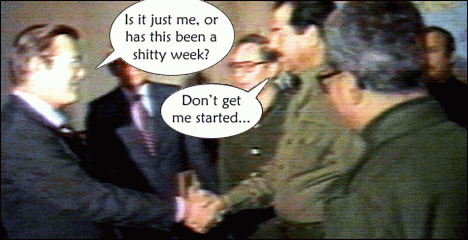
Back in the 1980s, American wanted a friendly dictator in the Middle East as a barrier against Iran, and Saddam wanted to buy weapons, including the raw materials to build chemical weapons, from American companies. It was a match made in the Pentagon, and Ronald Reagan made Donald Rumsfeld special envoy to Iraq with instructions to do everything possible to ensure Iraq didn't lose their war against Iran.

Which makes this week's events all the sweeter:

Worst. Week. Ever.

Thursday, November 09, 2006

Rumsfeld's successor

Rumsfeld is out, and Bush has named a new Secretary of Defence: Bob Gates, long time CIA man.

Naturally, he has been given a glowing endorsement :

Independent Counsel found insufficient evidence to warrant charging Robert Gates with a crime for his role in the Iran/contra affair. Like those of many other Iran/contra figures, the statements of Gates often seemed scripted and less than candid. Nevertheless, given the complex nature of the activities and Gates's apparent lack of direct participation, a jury could find the evidence left a reasonable doubt that Gates either obstructed official inquiries or that his two demonstrably incorrect statements were deliberate lies.

Meanwhile, CNN has a profile of Gates here. Pretty bland stuff, and absolutely nothing memorable.

Especially not his role in Iran-Contra, which was once considered newsworthly, but now has dropped down the memory hole.

(Thanks to Billmon.)

Wednesday, November 08, 2006

Mamas, don't let your babies grow up to be Cow Boys...

PZ Myers has the most audacious, only half tongue-in-cheek suggestion about stem-cell research yet: human clones, grown in cows.

I want to see the Pope's head explode when he sees it. I want David Cronenberg there with a camera, cackling happily.

I want the researchers to announce in a press conference afterwards that their successful experiment was funded by the Department of Defense, Sony, the Church of Scientology, and a private donor.

I want that private donor to be Paris Hilton, who, on accepting her cooing new clone baby, declares that she just didn't want to go through that icky pregnancy and labor stuff. "It isn't haaawt," she'd say.

I want 100 million women to sit up and say, "What? I could outsource the nausea and bloating and pain and stretch marks and episiotomy to a cow? Sign me up!"

I want the phrase "family farm" to acquire rich new meanings. I want to see Bible Belt politicians lobbying for new fetus farming subsidies.

I want gay men to rejoice, and become the primary market for this procedure.

I want to hear snooty young bluebloods declare cows déclassé, and that they'd had their little Brittany gestated in a Kentucky thoroughbred.

The scientific/biological problems aren't simple, but still... exploding Pope heads. Shweeeet!

And from Pharma Bawd in the comments:

Of course, the big groups who are against stem cell research are already against this sort of animal-human hybrid. But wouldn't it be interesting if we transferred the cow nucleus into the human cell at the same time we transferred the human nucleus into the cow cell? Then we could play a version of three-card-monty:

"Where's the soul now?"

US Congressional elections

My prediction?

Despite all the polls, despite all the voter dissatisfaction, despite Iraq, the Republicans will manage to hold on to control of Congress. Karl Rove will, once again, pull a rabbit out of the hat and find a "miracle".

And, yet again, the mainstream US media will be utterly, completely uninterested in widespread evidence of voting fraud, both electronic and the old-fashioned sort of dirty trick.

The one thing that might save the day for democracy is an unexpectedly high number of electronic voting machine glitches, causing some polling stations to resort to paper ballots. (Although, more often it just caused frustration and delays... hmmm, I wonder where these glitches are happening...)

=== Update ===
Seems I may have been too pessimistic. The results coming in at Talking Points Memo suggest that the Democrats might grab control. See post 010948 and up.

Still, even if the Dems win, it won't be a sea-change. They'll still be committed to running Iraq as an American puppet state, still committed to corporate corruption, still committed to giving tax breaks to polluters, still committed to letting religious extremists set the political agenda. The best we can hope for is a return to Clintonesque America, which was no picnic if you weren't rich and white (or just mega-rich).


=== Second update ===
It looks like the election was a rout. There's Republican blood running in polling stations all over the country (figuratively speaking), and there's every chance that the Democrats will have control of both Houses of Congress for the first time since Jimmy Carter.

Oh man, I have never been so happy to be wrong! Even if it doesn't usher in a new Golden Age of peace and love and justice for all, it is a great sign that Americans haven't completely turned to the dark side.

Monday, November 06, 2006

Thought of the day

Courtesy of Mrs Impala, who is using the LookXP theme with icewm on her Linux PC:

It is easier for a rich man to pass through the eye of a camel than for an end user to find the fraking text editor in the Look XP "aplications" menu.

Well, actually she didn't say fraking, but I've been watching a lot of Battlestar Galactica lately.

LookXP, for reasons which presumably made sense to a programmer who had never actually used a PC, grabs all the KDE and Gnome "Start Menu" items (many dozens or hundreds of items, split over a dozen or so submenus), merges them, shuffles them, sorts them according to the phase of the moon, and dumps the entire listing of hundreds of applications into one enormous scrolling menu.

Putting a bad interface into a graphical menu doesn't mean you have a good interface, it just means you have a bad interface in a graphical menu. I don't know what that's so hard for a certain kind of developer to understand.

Sometimes a quote says it all

With friends like this guy, free-thinkers hardly need to say a word.

Reverend Ray Mummert is a paster from Dover, PA. During the 2005 Dover School Board controversy, creationist Mummert was quoted as saying:

"We've been attacked by the intelligent, educated segment of the culture"

Sometimes the fish just jump outta the water to grab the hook...

Sunday, November 05, 2006

Fifth of November

Remember, remember the fifth of November,
The gunpowder, treason and plot,
I see of no reason why gunpowder treason
Should ever be forgot.


V for Vendetta

Friday, November 03, 2006

Stories in just six words

Wired has a collection of short stories written by science fiction, fantasy and horror writers. These are seriously short stories: just six words each.

Some of them are actually quite good. But they aren't stories. A story has a beginning, a middle and an end; a story has a plot, and one or more protagonists. These don't have any of those elements, not really. But they do communicate something, perhaps not a plot, perhaps an event or a feeling or an image. In just six words, they paint a picture in words.

Or, to put it another way:

Six words. Not story. Word picture.

I'm no statistician

I'm no statistician, but I'm pretty sure this is correct:

pacman chart

(Click image for larger view.)

Shamelessly stolen from here.

I need a word

I need another word for minimise, but I'm not sure whether lessenate or smallify best captures the connotations of minimise.

Thursday, November 02, 2006

The illusion of choice

Like many children of the 70s, I was raised on a diet of American cartoons. Despite being one of the least funny or entertaining cartoons I've ever seen, I strongly remember a Warner Brothers cartoon where a sophisticated city mouse took his country bumpkin cousin to meet a professor mouse. In between being chased and almost eaten by a cat, Herr Professor Mouse taught bumpkin mouse all about supply and demand, capitalism and the free market. Ho hum.

And yet, a quarter of a century on, I still remember it.

The cartoon was made in the glory days of post World War Two America, when it looked like capitalism and the Free Market would usher in a paradise on Earth. Naturally, one of the biggest selling points to the new middle class (or at least working class with disposable income) was the ability of capitalism to provide consumers with more choice.

Unfortunately, much of that choice is illusionary, as Michael O'Hare explains.

However, the potential variety of inventory in most big stores is an illusion, and the less specialized they are the more this is true. Take CompUSA, which does have a presence near you, and many thousand square feet of it. CompUSA has a computer that watches sales like a hawk, and ruthlessly prunes slow-moving items, so the large rack of cables actually has no specialized or rare ones, but twenty hooks with the same five fast movers, the cables you already have two or three of . If you want something the least bit arcane, you are out of luck, because the maximum straight-face selling price of a special item does not capture its real value to the customer. I believe CompUSA no longer stocks any SCSI cables in its stores at all, though it has every known brand of blank CD in five different package sizes each.

Of course in general we have more choice today, thanks to free markets, than (say) the old Soviet Union could offer its citizens. But much of that choice is trivial: in Australian supermarkets I can can choose between twenty different brands of soap offering fifty nominally different scented soap, but most people would be hard pushed to really tell them apart and there is not one unscented soap amongst them.

Free markets don't necessarily lead to freedom of choice, and that freedom of choice is vulnerable to supply-driven changes, leaving demand unfulfilled or removed.

A classic example of this was the appalling and limited food in the UK for much of the post-Industrial Revolution period. The need for cheap food which could be stored for long periods to feed the city workers quickly lead to a reliance on cheap, stodgy, bland (apart from salt, sugar and grease) preserved foods. Canning technology accelerated the process, leading to a generation which neither had the ability nor the wish to buy varied food, which destroyed demand. Reduced demand caused even less supply, and so on 'round the vicious circle the British went. Only the upper classes had the ability or desire for "exotic food", and even then the limit was French for the real nobs and Indian for those who had served in the subcontinent and got a taste for it.

Only the post-WW2 influx of migrants who refused to give up their traditional foods broke the vicious circle.

The ever-increasing concentration of retail sales in the hands of a few near monopolies risks repeating the British experience, but not just with food. O'Hare's example is with hardware; other examples are easy to find. There is a paralysing choice of (say) cars out in the market, but they are virtually all the same. The choice is between the green jelly mould or the red jelly mould with the pizza tray (spoiler) on the back. But where is the real innovation and real choice? A few smart cars, a few giant gas-guzzling Hummers for idiots, and that's it.

Fear the awesome power of lutefisk

An oldie, but a goodie:

If you can taste the difference between caviar on a cracker and ketchup on a Kit-Kat while blindfolded, you have not had enough aquavit to be ready for lutefisk. Return to step one.


From http://www.ecst.csuchico.edu/~atman/ic/lutefisk.html.

Sunnis and Shiites

Out of the horror and bloody chaos of Iraq is a sign that moderate Shiite and Sunni Muslims are moving closer together against the radicals.

Recently, Saudi Arabia sponsored the Mecca Declaration, a joint ruling from Iraqi Shiite and Sunni clerics forbidding Muslims to shed the blood of another Muslim. Naturally enough, the radicals aren't paying any attention to the ruling. But the ruling is still significant. As Juan Cole writes:

Be that as it may, the declaration is historic. According to al-Sharq al-Awsat [Ar.], it maintains that the differences between Sunnis and Shiites are a matter of personal interpretation (ta'wil), not a difference over basic principles (usul). To have such a declaration sponsored by Saudi Arabia, which adheres to the Wahhabi branch of Islam that was historically negative toward Shiites[,] is a conceptual revolution. The statement has implications for Sunni-Shiite relations in Saudi Arabia, Bahrain, Lebanon, Syria, Yemen, Afghanistan, Pakistan, etc.-- not just in Iraq.

Events in Iraq demonstrated that Western Powers could use the Sunni-Shiite divide to help overthrow governments, dominate major countries in the region, and even break up whole countries. The regional elites are increasingly deciding that Sunni-Shiite ecumenism is necessary to avoid more of these disasters.

In times of crisis, the black-and-white knife-edge clarity of vision offered by fundamentalists and radicals is attractive, but crises eventually pass, even the most red-hot tempers cool, and people get sick of the killing. Despite our flaws, we are a cooperative species -- mostly. We talk, we engage in dialog and compromise.

After every generation of bloodshed, there is a generation that is less radical, more interested in butter than guns, willing to talk and trade, and prepared to reconcile their differences with yesterday's enemy. The tragedy of Homo sapiens is that we are so rarely able to learn from our errors before repeating them, but learn from them we do, for a while.

But not if you are working for the Bush administration, where it seems that ignorance and inability to learn from history is a job prerequisite. As Billmon reports, even the top people charged with dealing with the Middle East terrorism threat are ignorant of the differences between Shiite and Sunni:

Let's review. We have:

  1. The head of the FBI's national security branch

  2. The Vice Chairman of the House Intelligence subcommittee on technical and tactical intelligence

  3. The Chairwoman of the House Intelligence subcommittee charged with overseeing the C.I.A.’s recruiting efforts in the Islamic world

And they each know less -- probably much less -- about the most critical religious divide in the Middle East (the same one that is currently getting U.S. soldiers killed at the rate of about three a day) than your average commentator at Little Green Footballs.

Billmon puts it down to the same old Imperial mentality:

Even the British, renowned for the caliber of their imperial civil service, usually operated in stunning ignorance of the people and cultures they ruled over, certainly so in the case of the Arab world. Which is probably why they, too, were so often taken by surprise -- by the Sepoy Mutiny, the Battle of Isandlwana, the Easter Rising, the Iraq revolt, Palestinian resistance to Zionism, the list goes on and on.

Wednesday, November 01, 2006

Separated at birth - Teatime and Alex

Sky One is making a two-part film adaption of Terry Pratchett's Hogfather, and it looks grand -- some real quality British actors are involved.

But they've really out-done themselves with the actor playing Jonathan Teatime, who has managed to capture the uniqueness of Teatime with a generous jollop of the iconic Alex from A Clockwork Orange.

But don't just take my word for it. Check out these twins separated at birth:

Teatime and Alex

Three post rule

One of the disadvantages of Internet communication is its tendency towards Wild West shoot-first-ask-questions-later behaviour. Regulars to any group (be it a mailing list, a Usenet group, or regular readers of a blog) often fly off the handle at the slightest provocation, jumping down the throats of newcomers for the smallest infraction of the unspoken rules.

PZ Myers of Pharyngula has a rule to manage this problem, which I call the Three Post Rule: nobody is to attack anybody else even if they say Jehovah until they have been given three posts to clarify their ideas.

PZ gives a hypothetical example:

  1. Stranger: I think all women are chattel.
    Old hand: Pardon me, friend, but are you using humor, irony, sarcasm, or satire? Are you perhaps about to expand on a deeper philosophical point?

  2. Stranger: No, I just think women are meant to serve my needs.
    Old hand: This sounds like a most unfortunate and disagreeable belief. Why should you hold such a demeaning attitude?

  3. Stranger: Because the Bible, which is the literal word of God, tells me so.
    Old hand: [Smashes whiskey bottle over stranger's head. General brawl commences.]