Friday, July 21, 2006
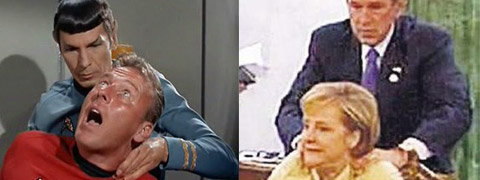

Windows uses pirate software
Windows XP ships with sound files which were created with a pirated copy of Sound Forge, cracked by the warez hacker "DeepzOne".
The evidence of this is surprisingly easy to find: look in the Windows\Help\Tours\WindowsMediaPlayer\Audio\Wav directory under Windows XP, and open up the WAV files in Notepad. Scroll to the end and you will find a reference in the sound file to DeepzOne.
The question is, what is DeepzOne's name doing in nine WAV files supplied with Windows XP? Lacking any other explanation, it seems on the face of it that the files were generated with a pirated copy of Sound Forge. Without further information from Microsoft, it is impossible to say whether it was a Microsoft employee or a freelancer who was responsible for that -- only the Windows Media Player team will know for sure, and so far they haven't said.
As "kaskangar" points out, there are deeper implications:
The topic still raises a moral problem, though, as Microsoft is quick to report every oh-so-minor success in the fight against piracy. In the wake of that move, the company also joined the BSA (Business Software Alliance), which has devoted itself to the "fight against software piracy" and persecutes violaters around the globe. But maybe BSA knows which office door it should knock on[.]
Thursday, July 20, 2006
The God Problem
Natalie Angier has a provocative and insightful article published by the Council for Secular Humanism, accusing scientists of hypocrisy and intellectual double-standards over the free-ride they give religion.
In other words, for horoscope fans, the burden of proof is entirely on them, the poor gullible gits; while for the multitudes who believe that, in one way or another, a divine intelligence guides the path of every leaping lepton, there is no demand for evidence, no skepticism to surmount, no need to worry. [...] How can a bench-hazed Ph.D., who might in an afternoon deftly purée a colleague's PowerPoint presentation on the nematode genome into so much fish chow, then go home, read in a two-thousand-year-old chronicle, riddled with internal contradictions, of a meta-Nobel discovery like "Resurrection from the Dead," and say, gee, that sounds convincing? Doesn't the good doctor wonder what the control group looked like?
Angier points out that scientists' silence, even accomodation, to the superstition and magic of "mainstream religion" is understandable as a survival reflex. Even if atheists don't get lynched in the USA (yet), the scientists fear for their jobs and their research grants.
But there is another, rational, reason why some scientists might choose to rip into astrology and Breatharianism while giving a nod and a wink to (say) the Rapture: choose your battles. The US is one of the most religious countries in the world. It is hard enough to get the average American to think naturalistically about everyday things with little emotional importance. But give up little baby Jesus?
They'd sooner give up their guns.
Well, some of their guns. One or two or the smaller calibre handguns. If they don't need them any longer.
Frankly, I don't see that strategy working. For fifty years American scientists have gone out of their way to accomodate mainstream religion, or at least not tackle it head-on. Even the Creationism wars are being fought on the basis that "science says nothing about God" (which is untrue: science says just as much about God as it says about the flying invisible pixies that make the Internet work). And after fifty years of that softly-softly approach, religious fundamentalism is on the rise in the US, and rationalism and naturalism are more and more being ignored, if not actively vilified. The few high-profile aggressively rational atheists like Richard Dawkins actually have people paying attention -- they might not like what they hear, but they listen, and some of them even understand.
Homeland insanity
The U.S. Department of Homeland Security, when it isn't busy arresting people for copyright infringement, has compiled a list of critical infrastructure sites and terrorist targets, in order to provide government funding for security.
As the Seattle Times is reporting, there are 77,000 "top terrorist targets" on this list. A few years ago there were 160.
The SuperMall in Auburn, Washington State (population about 36,000), has been listed as "critical infrastructure" by the Department of Homeland Security. That means it is considered vital for the operations of the USA. (Imagine, Joe Sixpack unable to get Krispy Kreme donuts for a few days. Civilization as we know it would collapse.) So critical a terrorist target is the SuperMall that the mall owners have been given $50,000 of tax-payers money to "improve security".
Also on the list of "critical infrastructure" are 1305 casinos, 700 mortuaries, 234 restaurants, an ice-cream parlor, a fishing tackle shop, an Amish popcorn factory, and a pile of trash in Houston.
Okay, I made up the one about the pile of trash.
Countdown to the Australian DMCA
Kimberlee Weatherall has written a detailed article about the current situation in Australia with our local DMCA, why it is vitally important for all Australians, how we could end up with bad copyright law, and a couple of suggestions for how we might avoid having that bad law forced on us.
In the USA, the DMCA has been a terrible law. Originally passed by the government under the expectation that it would lead to more innovation and creativity, it quickly became obviously that it was a failure in that regard. Instead it has had a chilling effect on scientific research and creative industries like the software industry. The DMCA has, effectively, made the US government the enforcer for certain major companies as they behave anti-competitively. When it comes to so-called "intellectual property" like copyright, the US government is strongly opposed to free markets, giving legal privilege to anti-competive technologies that wouldn't survive a month in a free market. The US government has been the bully-boy supporting the entertainment cartel's efforts to snatch away consumers' ordinary property rights and replace them with a limited "licence to use".
(When you own property, you can choose how, when and where you use it; the entertainment cartel doesn't want you to own that DVD, they want to sell you a licence to watch it under conditions they set, such as the particular type of player you are allowed to use.)
While the DMCA has caused plenty of misery among (for example) security researchers and computer scientists. Of course, misery loves company, and so the USA has forced the provisions of the DMCA onto trade partners like Australia. When negotiating the so-called Free Trade Agreement, it was made clear to our diplomats that the demand that we introduce the same sorts of draconian, foolish copyright laws as the US was not only non-negotiable, but it was the only non-negotiable demand in the entire treaty.
I could speculate as to why that might be -- after all, the US government isn't into suffering for its own sake. Let's just say that while innovation has suffered under the DMCA, not everybody welcomes innovation. Companies with large investments in outmoded business models fear innovation, because it stirs up the market, allows competition to flourish, and threatens their revenue stream.
Wednesday, July 19, 2006
No jokes please, this is serious
Paris Hilton is giving up sex for a year, so she can concentrate all her energy on herself.
Must ... resist urge ... to crack jokes ...
Incredible carved pencils
These amazing Japanese artists carve intricate shapes and little wooden chains out of pencils.
Thank goodness, twins are people too
New research into identical twins (also known as "clones") has determined that they see themselves as two individuals, not one soul in two bodies. This suggests strongly that when human clones (also known as "identical twins who happen to be born years apart") are born, they are unlikely to see themselves as the same person.
- Hitler's clone: "You're not my father! You're not me! I don't want to take over the world and kill all the Jews, that's so 1930s! I want to be a wildlife photographer and save the baby fur seals!"
As PZ Meyers says, there are far too many people who worry about this sort of nonsense. Maybe this will put some minds at rest.
112 comments in four seconds
Somebody posted 112 almost-identical comments in four seconds. I wonder whether it could have been a spam-bot? ("You think?")
Somehow Blogger switched the word-verification thingy off. Grrr. I hope this isn't going to be a regular thing, because it is a real pain to go through and delete all those spams.
Tuesday, July 18, 2006
Australia a laughing stock for our copyright law
Professor Joshua Gans from Core Economics explains why Australia is rapidly becoming a laughing stock for introducing new laws[1] which ban replaying of video tapes you've recorded from the television:
So when the government finally gets around to reforming the laws -- through deliberative thought -- you would think that the end solution would make some sense. Not so and Australia is becoming a world-wide laughing stock as a result.
[...]
As you can see here, by replaying even bits of television you are breaking the law. If you watch a program and then let your spouse [watch] it later you are breaking the law.
[1] Strictly speaking, the law has not actually been passed yet; however we've got the Federal Government's explanation of what they want the law to do, and they explicitly say that replaying recordings is forbidden. Back
Monday, July 17, 2006
Google Print
Meghann Marco, author of Field Guide to the Apocalypse, was so angry at her publisher's decision to sue Google over Google Print that she wrote an open letter offering Google encouragement.
Someone asked me recently, "Meghann, how can you say you don't mind people reading parts of your book for free? What if someone xeroxed your book and was handing it out for free on street corners?"
I replied, "Well, it seems to be working for Jesus."
Seems that all was not quite as it first seemed. While her publisher was suing Google, they were surreptitiously releasing books onto Google Print -- including, in February, Meghann's book.
Does this mean victory? I’m not sure. There is something troubling about the fact that it took public outcry for my books to be sent to programs that I wanted to participate in. I realize that I’m not Stephen King, but was this really a case of an author simply being ignored?
It will be interesting to see how Google Print survives the legal challenges against it. There is no doubt in my mind that it is to the benefit of the authors, as well as society as a whole, and that if copyright law prohibits something Google Print than in an intelligent world it should be copyright law that changes, not Google; but I fear that the opposite will happen. Time will tell.
Why hide the security lesson of Mumbai?
Bruce Schneier points out there is a serious, if minor, security lesson to be learnt from the Mumbai train bombings:
Two quotes:Authorities had also severely limited the cellular network for fear it could be used to trigger more attacks.
And:Some of the injured were seen frantically dialing their cell phones. The mobile phone network collapsed adding to the sense of panic.
(Note: The story was changed online, and the second quote was deleted.)
Cell phones are useful to terrorists, but they're more useful to the rest of us.
This is an important lesson. There is a tendency amongst certain "authorities" to distrust and be condescending to the public. Honesty and transparency is alien to their way of thinking, and it shouldn't be. The fear of a mobile phone signal triggering more attacks is ridiculous -- as far as I know, such an attack has never taken place, ever. Mobile phones are frequently used as timers to trigger bombs, but they don't need to be connected to the cellular network for that. Cutting off the network has zero benefit: it doesn't prevent further bombings (they can run off a timer, just like the original bombs). But it does have significant costs: not just the human cost of preventing the dying, injured and merely worried victims from calling their loved ones, but the more serious costs to first responders like ambulance. After Sept 11, the private networks used by police and fire departments broke down under the load, and the first responders relied on their personal mobile phones to communicate. Cutting off the cellular network imposes a significant burden on the already-struggling first responders.
Zero benefit, significant cost -- I'm not surprised that the clueless authorities would be in love with the idea of shutting off the mobile network. But I am surprised that the New Zealand "Stuff" website is a party in hiding that lesson by censoring their report.
Sunday, July 16, 2006
Two-faced kitten born
A kitten was born in Ohio earlier this week with two faces. 
NBC reports that the kitten, which is yet unnamed kitten but likely to be called "Tiger", is doing well and is feeding normally, despite having two faces on the one head.
One word stands out by its absence from the news report like Mt Fuji: mutant. I can't help but wonder why NBC choose to write "veterinarians don't understand why" the kitten was born that way rather than call it like what it is: a mutation, even if we don't know the precise cause of the mutation.
No free ride
Here is Part 1 of an interview with the legendary Vint Cerf talking about accusations that Google is getting a "free ride" from the Internet providers, and why the telcos' business plans are based on old (dare I suggest obsolete?) business models.
Somebody should remind AT&T CEO Ed Whitacre of the parable of the goose that laid the golden egg. People don't want bandwidth if there is nothing to download with it. AT&T made a nett income of almost $1.5 billion in the first quarter of 2006. But that's not enough: they want to strangle Internet technologies, charging them twice, three times, four times for the same service, because of some mental allergy to the concept of value-add -- Google pays for a service from AT&T, adds their own value, and makes money from the deal. Whitacre believes this is "getting a free ride". (Funny, I didn't notice AT&T providing Google with a server farm with thousands of PCs.)
This is prima facie evidence that one can become successful, rich company CEO of a giant multi-national corporation without having the foggiest concept of what a free market is or how it works. (Some would argue that, in a truly free market, executives like Whitacre would be earning a lot less money; but that's an argument for another day.)
Still, I think the telcos have got a point. I mean, when a carpenter buys timber and nails from his hardware supplier, and then builds furniture which he sells as a profit, he's "getting a free ride" too isn't he? Why shouldn't the hardware supplier get compensated for the carpenter's success? Sure, the supplier has already been compensated once, when the raw material was bought. But that was before they knew just what a great job the carpenter was doing. Now that they know he's talented and skillful, it's only right that they charge him extra. Stands to reason, right?
When a chef buys meat and vegetables, and creates a meal which he sells for a profit, surely that too is "getting a free ride"? Just because chef, like Google, has already paid his suppliers doesn't mean he shouldn't have to pay again and again.
That's what AT&T say, anyway.
Can the Kurds save Iraq?
The one tiny ray of light in the bloody mess that is the Iraqi civil war is that, so far, the Kurds have kept out of it. Is it possible that, as the violence continues to tear the country apart, that the Kurds could succeed in holding the factions back from the brink of all-out civil war?
Juan Cole suggests they might:
The Iraqis are at the brink of hot civil war again. It is one thing for people to be blown up indiscriminately by car bombers. It is quite another for neighborhood- or mosque-based militiamen to set up checkpoints in a nearby district and pull people out of their cars and homes, examine their identity cards for tell-tale family names and places of birth, and shoot them dead on the spot for being from the wrong sect of Islam.[...]
What if Kurdish troops were deployed in Baghdad under an Iraqi military command? The Kurds are not Arabs at all. They might be able to function as honest brokers between Sunni Arabs and Shiite Arabs. It is true that most of them are Sunnis. But most Kurds aren't Islamists and a lot of them belong to mystical Sufi orders or to socialist political parties. So their Sunnism isn't of a sort that would make them favor the Sunni Arabs. And, they had suffered a lot from some high Sunni Arabs in the Saddam regime. On the other hand, they are unlikely to tilt toward a hyper-Shiite group like Muqtada al-Sadr's Mahdi Army.
But would the Kurds do it? A spokesman for the Kurdistan Democratic Party is saying, "yes." He said that the deteriorating security situation in the capital "provokes the anxiety of the Kurdish parties, who fear that this escalation will lead to the widening of the scope of sectarian violence, will affect the situation in Kurdistan."
Adnan Dulaimi of the (Sunni fundamentalist) Iraqi Accord Front said only that the suggestion needed to be studied. It is clear that the Sunni Arabs would prefer the Kurdish troops to the special police commandos of the Interior Ministry, whom they consider little more than death squads.
Wishful thinking perhaps -- the Kurdish peshmerga is already spread very thinly keeping the north relatively violence free, and many Kurds still have deep scores to settle with Arab Iraqis. But for the sake of the Iraqi people, this may be the only hope they have.
Google and click fraud, updated
Earlier, I wrote about Google's CEO Eric Schmidt and some comments he made about click fraud.
Google's "offical blog" has further comments. I might paraphrase it as "Um, yeah, Eric said all that, but he was talking hypothetically, and besides we do actually aim to prevent click-fraud."
The ZDNet journalist who originally posted the information takes issue with Google's response.
Following the pirates
Author John Battelle discovered that pirated copies of his book The Search are on sale in Mumbai (Bombay) airport. His reaction?
Do I care about the piracy? No. No, no no. I care that someone in Mumbai cared enough to rip it off, and that someone there might be reading my stuff. That is just cool. Commercial markets always follow the free, or, well, the pirates in this case. Always.
Google searchers uncovers malware
PCWorld is reporting that a security firm has used Google's binary search to uncover about 2,000 malicious websites containing viruses or other malware. This is a useful new technique for finding and blocking malicious websites, although of course the usefulness of signature scanning to find malware is relatively limited.
Wal-Mart gives ZT the flick
Wal-Mart has recently changed their policies regarding shop-lifting, bringing them closer in line to other major American retail chains. Rather than a zero-tolerance approach, they no longer prosecute first-time shoplifters younger than 18 or older than 65 unless the goods stolen were worth more than $25 dollars.
Freakonomics writes:
For the store, the opportunity cost had come to severely outweigh the shoplifting cost. “J.P. Suarez, who is in charge of asset protection at Wal-Mart, said it was no longer efficient to prosecute petty shoplifters,” Michael Barbaro wrote in the Times. “’If I have somebody being paid $12 an hour processing a $5 theft, I have just lost money,’ he said. ‘I have also lost the time to catch somebody stealing $100 or an organized group stealing $3,000.’”
But, although the article doesn’t quite say so, I am guessing it was the pressure from police departments that truly forced Wal-Mart’s hand. The Times quotes Don Zofchak, police chief in South Strabane Township, Pa., as saying that Wal-Mart “would arrest somebody for stealing a pair of socks. I felt we were spending an inordinate amount of time just dealing with Wal-Mart.”
It wouldn’t surprise me if police in many small cities and rural areas had stopped responding to Wal-Mart’s daily requests to pick up their shoplifters, or at least grumbled mightily about having to do so. Wal-Mart has taken lots of heat for lots of reasons over the years—including, for instance, the fact that many of its low-wage employees also receive public assistance, which has led some critics to say that the U.S. Government in effect subsidizes Wal-Mart’s business. I can imagine how its old shoplifting policy may have led to even more damaging criticism—that Wal-Mart has turned local police forces into Wal-Mart police forces, preventing them from doing their real jobs.
The lesson from this is that there are trade-offs in all things. It doesn't make sense for Wal-Mart to potentially pay hundreds of dollars to prosecute the theft of a $5 or $10 item, not even when you consider the deterrent effect. And it certainly doesn't make sense for society to allow Wal-Mart's wants and needs to be given priority over the law-enforcement needs of the rest of society.
More on Boing Boing.
Box-office payola
Freakonomics discusses the economics of box-office sales figures, whether or not they get inflated, and why they usually sink like a concrete raft after a couple of weeks: in a nutshell, it's all about getting the movie on as many screens on the opening weekend as possible.
One of Freakonomic's readers, Scott Cunningham, makes an insightful comment, but then fails to draw the obvious conclusion and in fact draws the wrong conclusion:
But, it does make sense that studios would offer incentives for distributors. Movie demand is driven by information feedbacks because movies are differentiated products and willingness to pay depends on experience. [...]
But you can’t trick the public for long. De Vany shows how well the information conduits work. So I can’t imagine a rational distributor would pay theaters millions in lost revenue just to open the movie on many screens when the survival of a movie experiences a steep decline after the first week anyway.
He's got it completely backwards. It is precisely because you can't trick the public for long and ticket sales usually decline rapidly after the first week that the monster opening weekend is so vital. They need to generate as much hype and interest and ticket sales as quickly as possible, before word-of-mouth starts spreading the word that the flick is a turkey. Of course future dollars should be discounted compared to current dollars ("a bird in the hand") but that alone doesn't explain why the studios are so desperate for the movie to go off like a rocket. Having the movie showing on lots of screens is a good way to pump sales quickly.
The end result is that, even when the movie isn't a turkey, Hollywood is addicted to that instant blockbuster opening. I wouldn't be at all surprised to learn that, if given a choice between a movie that makes $10 million profit in the first month and then never makes another cent, or one that takes three months to break-even but brings in a steady $20 million profit every year for ten years, most studio executives would go for the first option. And it wouldn't even be a hard decision for them to make.
Subscribe to:
Posts (Atom)


